





The National Trust of South Australia (NTSA) has been referred to a parliamentary inquiry following a months-long campaign by discontented volunteers.
On Wednesday night, the Legislative Council voted to probe the state’s largest heritage conservation group, which has been beset by numerous internal conflicts.
Shadow Environment Minister Nicola Centofanti brought the motion, which passed with rare unanimous support from the government and crossbench.
In February, the charity stood down the local leadership of its Moonta branch, which manages hundreds of thousands of dollars’ worth of historic assets, due to ongoing management disagreements and alleged compliance breaches.
The affected volunteers claimed their dismissal was unfair and are now seeking to overturn it in the Supreme Court, but the move prompted other branches across the state to speak publicly about their grievances.
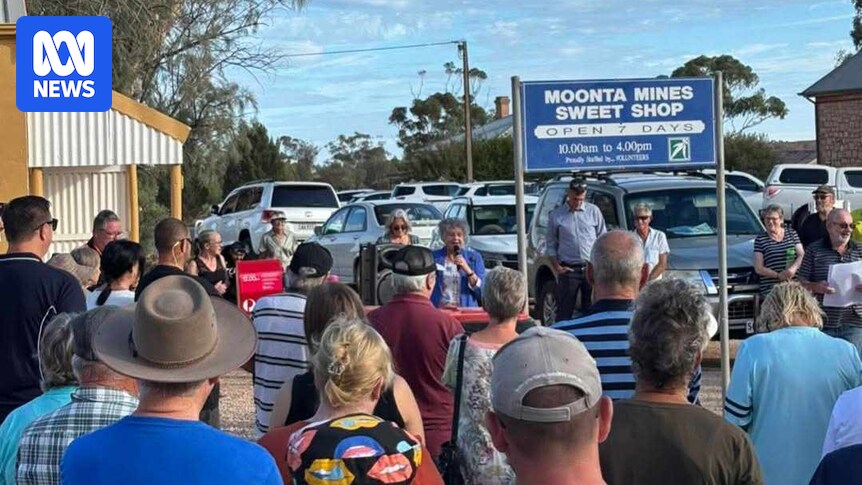
A protest at the Moonta Cornish Mines in February after the local governing committee was suspended. (Supplied: Moonta National Trust branch)
Meanwhile, most attractions at the historic Moonta Mines remain shut after volunteers walked away in solidarity, costing tourism dollars for the Yorke Peninsula’s economy.
‘Challenges over an extended period’
Ms Centofanti told parliament the inquiry was about “ensuring the National Trust … remains a strong, sustainable and respected custodian of our state’s heritage”.
“The National Trust [of SA] has faced a range of challenges over an extended period of time, however, recent events have brought these issues into perhaps sharper focus,”
she said.
“This inquiry is about reviewing the legislation to ensure it is still fit for purpose. It is about understanding the challenges facing the organisation … hearing directly from those affected and identifying opportunities to strengthen the National Trust”.
Nicola Centofanti says she met with volunteers about recent events within the National Trust. (ABC News)
Through volunteers, NTSA manages dozens of historic properties, including landmarks like Ayers House and the Cornish Mines at Moonta and Burra.
However, tensions have bubbled between volunteers and the charity’s head office, over matters ranging from property disputes to the trust’s financial sustainability.
Labor’s Hilton Gumbys told the Upper House the government requested NTSA “make a public register of their assets and details of property transactions”.
This comes after the trust signalled it would sell about five “non-core” properties to plug a $300,000 deficit, and confirmed it had done so in the past.
One of those is the 150-plus-year-old National Australia Bank in Burra, purchased by the local council earlier this year to be used as a visitor centre.
The heritage-listed former NAB bank building at Burra, with staff from the Goyder Visitor Information Centre standing in front. (Supplied: Goyder Regional Council)
Mr Gumbys claimed volunteers “had raised concerns about being asked to fund their own operations … through their own fundraising efforts while having very little oversight or accountability from the central organisation”.
“When people give their time and their fundraising energy in good faith and find themselves without a voice in decisions that affect them, that erodes the goodwill that keeps these organisations functioning.”
Inquiry not the right approach
NTSA chief executive Nicolette Di Lernia previously acknowledged the organisation faced challenges, but argued a parliamentary inquiry would be a “wasteful” use of taxpayer dollars.
She also said any properties sold by the trust would be “below-market value” and preference given to community-minded groups.
Speaking to 891 ABC Adelaide Mornings on Wednesday, Ms Di Lernia said NTSA was trying to mediate with the ousted Moonta leadership.
“We are absolutely committed as an organisation to working with our volunteers, and to do that, we need the volunteers to work with us,” she said.
“In Queensland a few years ago, [the National Trust] decided they couldn’t have any branches moving forward. It had become so poorly suited to our current … environment, that they had to remove all their branches.
“We’re hoping that’s not where we need to come to, but we need to make sure that this organisation, which has an enormous part to play in communities across our state, has a viable future.”