







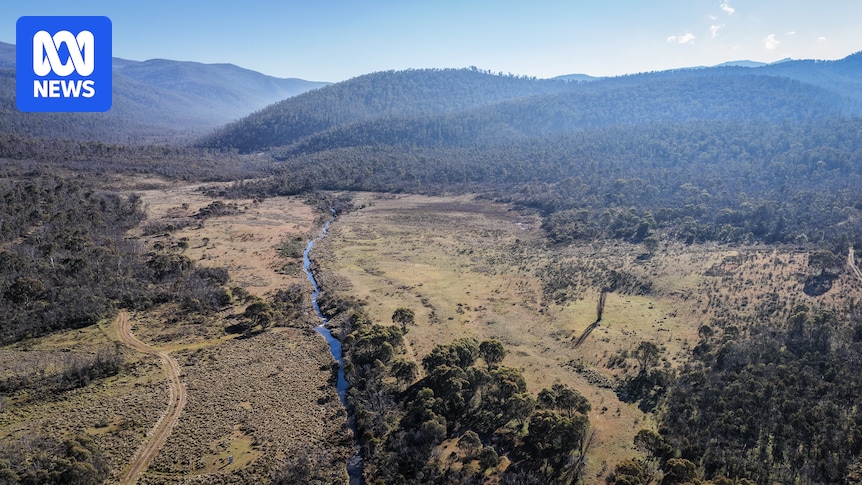
When rain falls on the ACT’s high country, each drop enters a rich and biodiverse ecosystem, with the water stored, filtered and carried by streams and rivers to Canberra.
The territory’s teardrop shape follows the outline of the water catchment now known as Namadgi National Park.
But like melting glaciers in Antarctica or bleached coral on the Great Barrier Reef, Namadgi is now showing signs of damage linked to global warming.
ACT Parks and Conservation’s Simon Stratford says wetlands are fragile in the face of climate change. (ABC News: Matt Roberts)
Simon Stratford, who works with ACT Parks and Conservation to manage the health of the water catchment, said his team sees these signs “day in, day out”.
“These things aren’t happening elsewhere, they’re not far off, they’re happening in our own backyard,” Mr Stratford said.
“While people may not see the impacts in Namadgi National Park, they are directly linked to what happens when they turn on the tap at home.“
Warnings over ‘current trajectory’
The alpine high country along the ACT border still bears the scars of the 2020 Orroral Valley bushfire, which burnt 80 per cent of Namadgi.
“The dirt burnt in 2020. We could see it, stand there and watch it,” Mr Stratford said.
“When it rained, all that sediment flowed into the system, affecting drinking water quality,” he said.
The bogs are rich in biodiversity and can store water for long periods. (ABC News: Matt Roberts)
A system of bogs and fens interconnects across the highest points of the catchment.
“It’s like a big sponge that soaks up the snow and rain, then slowly releases that water back into Canberra’s catchment,”
Mr Stratford said.
As fires become more frequent and intense, and temperatures rise, these fragile wetlands have less time to recover.
“We can expect those systems to go extinct over time if climate change continues on its current trajectory,” Mr Stratford said.
Vegetation in the fens is recovering but the grey skeletons of gum trees will take decades to return. (ABC News: Matt Roberts)
Ecosystem first aid
Rangers in Namadgi are working to help the ecosystem recover and adapt as it enters uncharted territory.
Healthy bogs and fens have a dense, peaty substrate beneath grasses and sphagnum moss.
During the 2020 fire some of the mosses were burned and lost forever.
Namadgi National Park rangers are working to conserve the mosses. (ABC News: James Vyver)
Ranger Nathan Kay said ACT Parks and Conservation has been using a “light touch” to help surviving mosses regrow.
“Anywhere there were signs of living sphagnum among the burnt sphagnum, we installed shade cloth,” he said.
“The idea is to mimic the natural shade and conditions sphagnum needs, giving it a foothold to recover.“
Shade cloths have been strategically placed to give damaged mosses the right conditions for recovery. (ABC News: Matt Roberts)
Rangers have also installed “leaky weirs” made from coconut fibres to slow water flowing through the wetlands.
This keeps the mosses and other vegetation wetter for longer, improving the health of the system.
“The bigger picture is to build resilience in these ecosystems so they can better withstand another fire,” Mr Kay said.
ACT Parks and Conservation ranger Nathan Kay says interventions to protect native vegetation are working. (ABC News: Matt Roberts)
Data collected from these sites shows the interventions are working: mosses are recovering faster and the bogs are staying wetter for longer.
“Our mantra is to leave the place in better condition than when we started,”
Mr Kay said.
“That can be difficult in the face of climate change, but knowing you’re doing something positive for the environment — and for Canberra’s water catchment — gives you a bit of a kick,” he said.
‘Green kidneys’
Namadgi National Park covers 86,000 hectares and is one of three water catchments serving the capital.
Despite its size, small environmental changes can affect Canberra’s water supply.
Icon Water manages the system from the Cotter Dam to household taps across Canberra.
“We want to keep every piece of soil in the landscape thriving,” said Icon Water’s manager of environment and sustainability Ben Wright.
“These natural ecosystem services give Canberra beautiful quality water, and we want to preserve that for generations.“
This gum tree burned in the 2020 fires and fell across a popular alpine walking trail. (ABC News: Matt Roberts)
Icon monitors the water entering the reservoir at the dam, measuring the pH levels and turbidity — the solid material carried in the water.
“After a bushfire, ash, dirt and nutrients can wash through with the first rainfall because the protective vegetation has been burnt off,”
Mr Wright said.
“That’s usually what protects the landscape and acts like green kidneys.”
Like the mosses in the high country, the ACT’s growing population must also adapt to climate change in the decades ahead.
“Protecting this catchment is essential, it exists for both biodiversity protection and for protection of water supply,” Mr Wright said.
While Mr Stratford said people must help address the problems created by climate change.
“If we take a long-term view, the changes and improvements we help manage — and the direct action we take where we can — do make a difference,”
he said.