





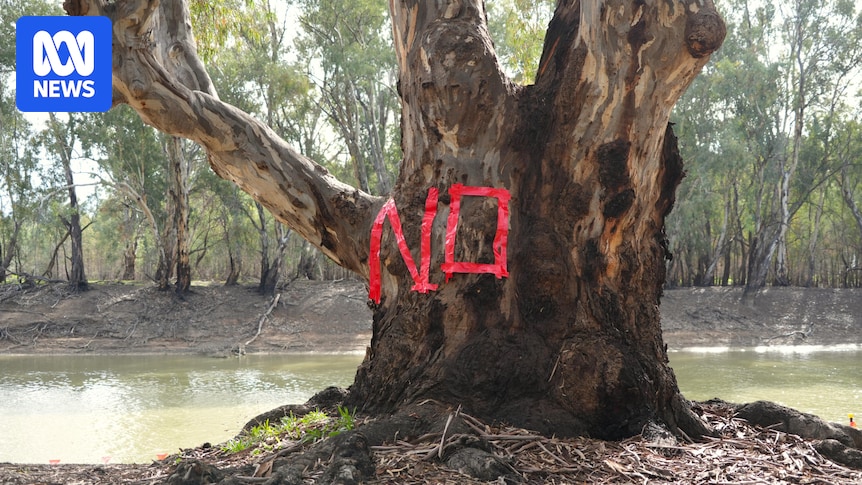
It is a chill morning on the banks of the Murray River as the Friends of Nyah-Vinifera Park (FONVP) protest camp wakes to greet the day.
Protesters have spent the past 40 days blocking river access at the Nyah-Vinifera flood plain, 20 kilometres north-west of Swan Hill in northern Victoria, and say they do not plan to stop any time soon.
The group is lobbying for a pause on the Victorian Murray Flood Plains Restoration Project, which aims to return water to nine high-value flood plains along the Murray River.
FONVP chair Nicole McKay said it was important work because the restoration project would disturb the region’s precious ecosystem.
“How can this be an environmental project if it’s going to have a likelihood of stagnant water that kills plants and animals?” she said.
Protesters are camping at Nyah-Vinifera Park to oppose the restoration project. (ABC News: Sarah Buchecker)
As part of the project, five regulators that act as gates will be installed to help control water movement on and off the flood plain.
Lower Murray Water managing director Paul Northey said it was the “only viable option” to protect the land.
But the FONVP group wants those in charge to pause the Nyah-Vinifera portion of the project, and instead wants constraints on the Murray River to be relaxed to allow for more natural flows.
“We want the river to be allowed to flow at about 20 to 25,000 megalitres for six weeks in spring,” Ms McKay said.
“It’s called relaxing constraints, but it should be called just letting the river flow like it used to.”
The group also has concerns about how many trees will need to be cut down as a result of the work.
Nicole McKay is among those protesting the restoration project at Nyah-Vinifera. (ABC News: Sarah Buchecker)
‘Only viable option’
Mr Northey said extensive environmental approvals and cultural heritage work had been completed as part of the works on the Murray River.
“And we have very strict cultural heritage and management plans to follow to make sure that we absolutely minimise the impact of the works,” he said.
“Overall, the benefit is going to far outweigh any minor impacts as we do the works.“
The Murray River at Nyah-Vinifera Park. (ABC News: Sarah Buchecker)
Experts divided
University of Melbourne hydrology and water resources professor Rory Nathan has backed the restoration project.
Without it, Professor Nathan said there would be a “slow death and slow decline” of the wetland systems.
“Under current climate conditions and what we can expect to see over the next few decades, we’re going to have to rely on [the project],” he said.
Protesters have been camped at Nyah-Vinifera Park for more than a month. (ABC News: Sarah Buchecker)
However, Australian National University ecologist Matt Colloff said the idea the project was the only option was “arrant nonsense”.
“There is this temptation amongst hydrologists and engineers to think that building infrastructure on flood plains is the way to solve everything, and it’s not,” Dr Colloff said.
“The idea that you can put in set infrastructure now and think everything’s going to be OK down the track is not really adaptable because you’re making predictions about what may or may not happen 20, 30, 50 years down the track.
“And if your predictions are wrong, then you’re in serious trouble and you have no way out.“
Protesters are trying to stop components of the Victorian Murray Floodplain Restoration Project. (ABC News: Sarah Buchecker)
Legal action launched
Last month, Wadi Wadi traditional owner Vince Kirby launched legal action against the Victorian government’s approval of the restoration project.
The Federal Court dismissed previous legal action by FONVP in May.
Represented by Environmental Justice Australia, Mr Kirby was arguing the approval process failed to assess and protect Aboriginal cultural heritage and did not adequately consult with traditional owners.
“We’ve looked after these rivers and wetlands forever,” he said.
“My grandmother grew up here, and now I take my great-grandchildren there.”
The land around Nyah and Vinifera does not have a registered Aboriginal party in place under the Aboriginal Heritage Act 2006. Therefore, the secretary of the Department of the Premier and Cabinet has decision-making power in assessing cultural heritage management plans at the park.
“I don’t want to take my grandkids to my beautiful rivers and the places we used to camp and have to explain why there is a giant concrete regulator in their river,” Mr Kirby said.
Support for the protest appears significant, with 400 signatures on a recent petition. (ABC News: Sarah Buchecker)
The Victorian government declined to comment on the issue as the matter is “before the courts”.
Support for protest grows
A petition signed by more than 400 community members was sent to Swan Hill Rural City Council last week.
The council said it would refer the petition to the Department of Energy, Environment and Climate Action (DEECA).
“Council has not adopted a position either in support of or in opposition to the works at Nyah and Vinifera,” a spokesperson said.
“Council’s position is limited to the resolution adopted at the June ordinary council meeting, with no position taken beyond what is outlined in those minutes.”
FONVP member Peta Thornton, who is also a Swan Hill councillor, had written letters to both the federal and state water ministers.
She said she was disappointed “repeated requests” for an open community meeting from the Mallee Catchment Management Authority and Lower Murray Water had not been granted.
Nicole McKay and Jacquie Kelly say they will camp out for as long as it takes. (ABC News: Sarah Buchecker)
Ms Thornton said most locals did not understand the project and those that did, did not want it.
“The community is deeply concerned about construction impacts, lack of clearly defined flow targets for the region and that the potentially catastrophic cumulative risks for Murray cod and silver perch cannot be mitigated,” she wrote in her letters to the MPs.
But Lower Murray Water’s Mr Northey said there had been a “huge” amount of community consultation already.
“We’ve got a process to complete the works by the end of this year, and that’s certainly the plan that we’re sticking to at the moment,”
he said.