







Australia’s Minister for Innovation Tim Ayres has acknowledged tech companies based overseas are already using Australia content to train AI models, conceding the practice is ‘unethical’.
“Copyright is only meaningful when there’s a payment involved,” Mr Ayres told triple j hack.
The comments come after Prime Minister Anthony Albanese announced plans for a new Office of AI on Wednesday.
The office will work to develop a new set of standards for artificial intelligence development in Australia.
As part of the plan the Prime Minister re-affirmed a commitment to protecting Australia’s copyright law.
“No company should use Australian books, music, art or news to build or train AI without the artist’s control,” he said.
“That includes the artist’s control of the price and value of their work.
“Anything less, is theft.”
Loading…
Minister for Innovation and Industry Tim Ayres told triple j hack tech companies using Australian content without permission were behaving unethically.
“We’ve got a responsibility here in Australia to build an Australian answer,” he said.
Aussie artists already impacted
Last month American news outlet The Atlantic created a searchable database from four datasets being passed around the AI development community.
The datasets contain a significant amount of Australian music — including music from local Perth band Smol Fish.
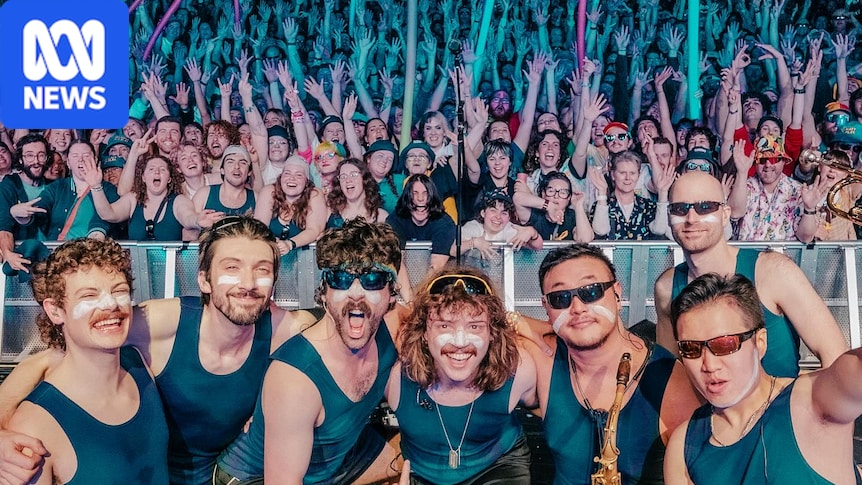
Smol Fish weren’t aware their music had been used to train AI until contacted by triple j hack. (Supplied)
“I’m kind of confused as to how this is happening,” band member Olive Coakley told triple j hack.
“It’s, illegal, right? Is it illegal?
“It should be illegal.”
The band had no idea their music had been used until they were contacted by triple j hack.
“We’re just like a little tiny local band and so you think maybe that you’ll be a bit safer or that it would take longer for anyone to try and steal your intellectual property,”
Olive said.
Playlunch, a Melbourne-based band who’s song Keith finished fourth in the Hottest 100 this year, also had music in these AI training datasets.
Lead-singer Liam Bell told triple j hack the band somewhat expected their music was being taken, but it was still “bizarre”.
“They haven’t taken our music so that they can use our music … They’re making something so that we can be obsolete,” he said.
Playlunch singer Liam Bell says the band wasn’t surprised to find out their music had been used to train AI models. (triple j)
He said the band was pretty “pragmatic” about the risks of AI and would focus on creating music that connected with people on a human level.
“Our job is to focus on making stuff for the people who want to listen to us and who want to engage with us artistically,” Bell told triple j hack.
“I think if you have a melody stuck in your head, like an earworm that was made by an AI, it’s like having microplastics in your brain,” Bell told triple j hack.
Ethical AI needed to protect ‘cultural property’
Perth-based rapper Josh Eggington, or Flewnt, is glad people are starting to take notice now, but wishes more was done to protect First Nations stories years ago.
“AI can almost spit out and recite its own version of a really old creation, [an] Aboriginal creation story because it’s taught itself on all that material that them old fellas used to tell,” he told triple j hack in an interview before the government’s announcement.
“My focus would be there first. And how do we start to protect that?”
Perth-based rapper Flewnt says tech companies have been using First Nations cultural property to train AI models for a long time. (ABC Radio Perth: Alicia Bridges)
Flewnt wants to see a shift towards ethical AI where communities have a say about how cultural material is used.
“I don’t know exactly what that looks like, but definitely permission is one of those things,” he said.
“Just permission in general on what is entered and not entered into the models is definitely a part of ethical AI.”
‘Devil in the detail’
Opposition Leader Angus Taylor has slammed the government’s AI plan, saying it lacks substance.
“It’s motherhood statements at this point,” Mr Taylor told the Today Show.
“All [the Prime Minister’s] done at this point is create an office within an office … to deal with these things.
“There are so many questions that haven’t been answered.”
Music rights organisations have welcomed the commitment to copyright protection, with Attorney-General Michele Rowland this week confirming artists will have a seat at the table to ensure they can “thrive” in the AI economy.
Melbourne University AI lecturer Dr Andrew Cullen told triple j hack Wednesday’s announcement was a step in the right direction but there are still questions to answer.
“The devil really is in the details,” he said.
“It’s great to have these kind of aspirational statements … but there’s no real mechanisms that we have at the moment to force AI companies to disclose what data they’ve used and to pay fairly.”
Loading Instagram content
Innovation and Industry Minister Tim Ayres told hack work is ongoing to ensure artists are protected but that Australia is taking a world-leading approach.
“We want to see artificial intelligence training happening here on our terms, which means consistent with our copyright protections,” he said.
“That is a much better position for the Australia arts community than the current position which is they are reliant upon the copyright laws and frameworks in other countries.”
Tech companies say they will work within new regulations
Two of the world’s leading AI companies have pledged to work with the government as it develops new rules for the sector.
Anthropic General Counsel Jeff Bleich said the company takes its responsibility to meet the government’s new terms seriously.
“AI will reshape democracies, economies and national security, bringing significant benefits and unprecedented challenges alike,” he said.
“Anthropic has been clear for some time that societal-level solutions are needed for AI. We respect the process articulated by the Prime Minister.”
While OpenAI told Forbes it is committed to working constructively on a practical and sustainable solution.