






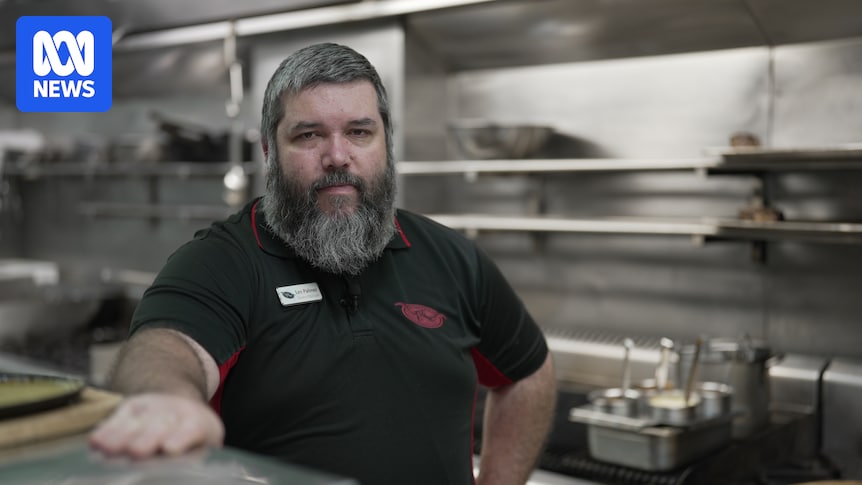
In the expanse of his restaurant’s kitchen, Les Palmer fixes a trained eye on the grill.
It’s midday, and he’s overseeing the lunchtime service, as he’s done so many times over more than two decades as a chef and business owner in the hospitality game.
“Collectively, in hospitality, I’ve been there for 26 years now,” says Palmer, who owns and runs a steakhouse in Albany on Western Australia’s south coast.
“My wife’s been there for over 30.
“And it’s just been our lives. It’s been our career paths.”
This time, Palmer is cooking a couple of prized steaks and some chicken over flames, but it can be much more than that at other mealtimes.
During busy periods, each of the 16 burners can be roaring as the kitchen tries to feed hungry diners packing into the restaurant.
Firing all of this activity, Palmer notes, is gas.
“It is lots of gas,” he says.
“There’s lots of stove tops, the char grill, the hot water system, the deep fryers.
“Without those, we don’t have a business.”
It’s a business, and a business model, which Palmer says is now under threat.
‘Shocked and flabbergasted’
About 40,000 people live in Albany on Western Australia’s south coast. (ABC News)
Earlier this year, the company that owns Albany’s gas pipelines abruptly announced it was shutting the asset and leaving town.
Customers would have, at most, three years to make alternative plans for switching to bottled gas or electrifying their properties.
Either way, though, Canadian infrastructure firm ATCO would not be hanging around.
The decision has rocked a town of almost 40,000 people, left the state government scrambling and raised questions about who should pay for the transition away from gas.
Last month, think tank the Grattan Institute highlighted this tension in a report that said Australians generally were using less gas and governments needed to plan for the decline.
“Without action, gas use will continue to decline, but the process will be costly, chaotic, and inequitable,” the institute argued in its report titled Out of Gas.
Greg Stocks is Albany’s mayor and he, for one, says the precedent set by ATCO and its treatment of the town is a sobering one for consumers and taxpayers.
“I think people on gas networks need to be really cognisant of what’s happening and watch very closely what’s happening in Albany,” Stocks says.
“That’s the corporate playbook, that you get out of this as well as you can, as cheaply as you can.“
WA’s energy minister says gas companies like ATCO have to mind their social licence. (ABC News: Dan Mercer)
While ATCO has subsequently said it would delay the decommissioning for a few months until the beginning of next year, and shut down the city centre last, the decision was still shocking to Palmer.
The first he heard about it, he says, was from a journalist following up on a media release from the company.
“There was nothing in the public,” he recalls.
“And I was just flabbergasted. A little shocked and a bit worried to be honest.”
Palmer’s business is one of about 8,000 customers connected to the gas network in Albany, where the service has been provided for 50 years.
Essential to whom?
According to ATCO, the network is getting too old to safely maintain and upgrading it to a satisfactory level would cost $80 million.
The company, which is privately owned and controlled by the wealthy Southern family, said such a move would add $10,000 in costs for each customer.
“Even if that cost was simply spread over 25 years, that’s an additional $400 per customer per year,” an ATCO spokesman said.
The spokesman added the required upgrades would have made network gas more expensive than bottled supplies.
But Stocks notes Albany customers have been paying a portion of their bill in maintenance fees for the entire time ATCO has owned the network, about 15 years.
He questions what the company has done with that money, suggesting too little of it must have been reinvested in Albany’s gas supply.
Greg Stocks says locals should not be left out of pocket. (ABC Great Southern: Andrew Chounding)
And he is now pressing for ATCO to stump up compensation to ensure it cannot simply wash its hands of financial responsibility.
“There has to be some financial compensation coming from somewhere,” he says.
“This is not the people of Albany’s fault that they are on a system which has now been taken away.
“And an essential service, in my view.”
There is a view that the sun is setting on Australia’s gas demand. (ABC News: Dan Mercer)
By coincidence, the cost of getting off gas has become much clearer thanks to the experience of another West Australian town.
Several years ago, the town of Esperance, about 700km south-east of Perth, served as a portent when the company that owned the reticulated gas network pulled the pin.
In that case, the decision was caused by a bitter dispute with the state government, but the effect was the loss of a utility for many.
While some customers chose to switch to bottled gas, those who electrified spent about $15,000 on average.
Albany residents who want to keep gas appliances will need to transition to gas bottles. (ABC Great Southern: Andrew Chounding)
The bill, however, was largely paid by taxpayers because of the state government’s part in the affair.
WA Energy Minister Amber-Jade Sanderson says the situation in Albany is different. The state was not involved in the decision to decommission the network in any way.
The minister says the government is “incredibly disappointed” with ATCO’s move, which she says was presented as a fait accompli.
She says “there’s a strong case” for ATCO to help pay for the transition costs, arguing trust in the company is on the line.
“It purchased the network with eyes wide open, understanding the age of it,” Sanderson says.
“It made a decision not to invest in it but to walk away.
“So I think there is a social licence requirement here of ATCO.”
A salutary lesson: minister
What customers choose to do will be up to the individual, Sanderson says, but she says the state would ideally prefer people to electrify their homes and businesses where possible.
Doing so, she says, will ultimately be cheaper.
Despite this, Sanderson acknowledges that the size of Albany’s gas network makes the transition away from it an unprecedented challenge that will come with a big cost.
Amber-Jade Sanderson takes a dim view of ATCO’s decision. (ABC News: Keane Bourke)
And she warns that the challenge is made all the harder by previous decisions to privatise the asset and remove public control.
“It’s a function of privatisation, I think,” she says.
“And what we’ve seen here from ATCO is exactly that.
“When private companies are no longer making an investment, they leave.“
ATCO owns assets around Australia, but it no longer wants Albany’s gas network. (ABC News: Daniel Mercer)
ATCO said it was also disappointed to be decommissioning the Albany network, but stressed: “There is not an economically viable solution.”
The spokesman said the company had bought the asset at a time when the WA government was pushing to connect it to the broader gas network, but these plans had foundered.
Though ATCO had “no legal obligation”, the spokesman said it was looking at ways to “contribute” to customers switching to gas bottles.
“ATCO is committed to an orderly decommissioning process. We have given the government and community significant notice,” the spokesman said.
“ATCO has always intended to make a contribution to the transition on top of fully funding the decommissioning of the network.”
Inadvertently, Albany may now become a test case for the shift away from gas at the micro level.
Grattan, in its report, said governments needed to take control of the transition and “both accelerate and manage” the process.
Among the measures it called for were policies to reduce demand by, for example, phasing out the use of gas in households.
The think tank noted domestic gas demand had tumbled 11 per cent since 2020 as users turned to renewable energy and manufacturers struggled with high prices.
It said the trend would increase pressure on the electricity grid while cutting demand on gas networks.
Yet Grattan suggested Australia still seemed to be “over-investing” in gas pipelines while “under-investing” in power poles and wires.
“As Australian households and businesses search for cheaper, cleaner, and more efficient fuels they are using less gas,” Grattan wrote.
“Governments have largely ignored this decline and have failed to plan for it.
“As a result, new problems are emerging: electricity networks are under strain, backup generation for the power system is not being built fast enough, gas bills are rising, and manufacturers are closing.”
Choice ‘in name only’
In Albany, Stocks isn’t so sure about the supposed redundancy of the gas system.
Stocks says many of the town’s businesses still rely on it and, in any case, the up-front cost of electrifying every customer would outweigh the cost of replacing the pipes.
Billions of dollars have been invested in Australia’s gas networks. (ABC News: Daniel Mercer)
If the gas network cannot be salvaged, he argues local consumers should not have to pay for costs many cannot bear.
“If you want to electrify by choice, fine,” Stocks says.
“But you shouldn’t be forced to do it.”
Palmer is equally forthright.
He says it may be possible for him to switch to bottled gas, albeit at significant cost and inconvenience, given that he would lose valuable parking space for customers.
But Palmer says electrifying his business is not realistically an option available to him.
Practically, he says the style of cooking he does — and the product his customers expect — would not be possible with electric appliances.
More pointedly, he says he could not afford the costs.
“If people want us to go electric, that is fine,” Palmer says.
“But there needs to be a broader discussion of how that happens and how that transitions instead of it being thrust upon us.“