







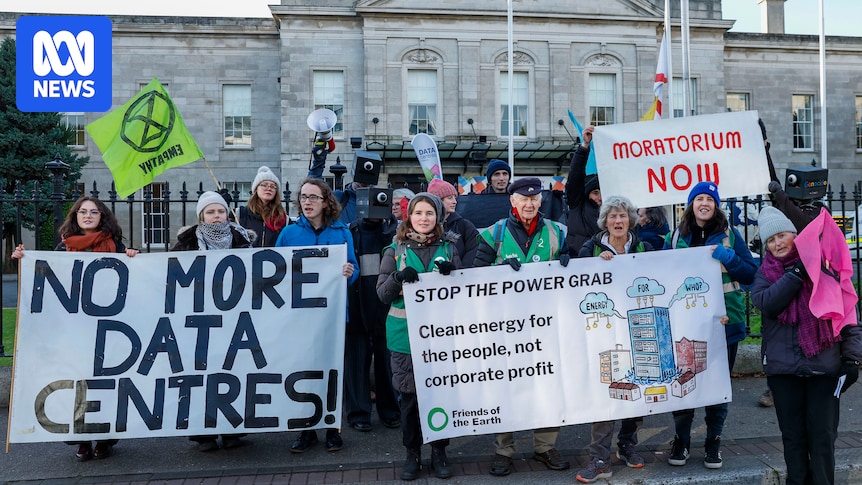
Humming on the outskirts of Dublin, dozens of massive data centres are chewing through more electricity than all the urban homes in Ireland.
Jess Spear lives down the road from Grange Castle in South Dublin, one of the country’s largest data centre precincts.
She walks past one of the “hyper-scale” facilities on her way to work everyday.
“It looks like a giant prison,” Ms Spear told the ABC.
“It’s incredibly intimidating with big high gates behind it, barely any windows … it pollutes the landscape to be honest.”
The Microsoft data centre at Grange Castle business park was the first to open in 2009. (Supplied: Jess Spear)
Ms Spear, who sits on the local council for the People Before Profit political party, said some residents could hear the constant buzz of the facilities at night.
But the presence of the data centres was far more than a “NIMBY”(not in my backyard) issue.
“The main thing that upsets the public is that we are subsidising these behemoths,” she said.
Jess Spear says data centre growth in the region is having stark environmental impacts. (Supplied: Jess Spear)
Ireland’s runaway data centre growth
While many may not associate its cobblestone streets and 12th century roots as a backdrop for big tech, Dublin is known as the “Silicon Valley of Europe”.
It has long been home to the continental headquarters of industry giants such as Google, Meta, Apple and Microsoft.
It now also has one of the largest data centre clusters in the world, with more than 120 dotted around Dublin and the surrounding countryside.
The government pursued the development of the facilities to help fuel big tech’s artificial intelligence (AI) operations, calling it another “strategic opportunity for the economy”.
Jess Spear, holding the black banner, says Ireland’s runaway AI data centre growth needs to stop. (Supplied: Jess Spear)
Data centres now account for 21 per cent of Ireland’s total metered electricity and are projected to grow to 30 per cent by 2030, according to a report by the United Nations University Institute for Water, Environment and Health.
The report cited Ireland as a “cautionary tale” for the rest of the world, highlighting the environmental impact and knock-on effects of runaway AI growth.
Households pay the price
Tallaght, a bustling county town in South Dublin, sits in the foothills of the Dublin Mountains and is traversed by the River Dodder.
Ms Spear said it was a place where residents had a strong connection to the land around them.
So the “explosion” of data centres had been jarring.
Tallaght locals value the abundance of nature surrounding the town and the wider region. (Supplied: Jess Spear)
Microsoft opened Grange Castle’s first data centre in 2009.
Soon after, enormous complexes built by Amazon, Google, Microsoft and other companies expanded around the ruined castle that anchors the business park.
The facilities now span more than 200 hectares.
The Grange Castle business park now covers more than 200 hectares. (Supplied: Ben Ryan Photography)
Albert Perris, a local historian and author from Tallaght, said the expansion had “tipped into a new space”.
“A lot of development was welcome, and it was very progressive, but at some point there needed to be some constraints,” he told the ABC.
“There’s an increasing concern that nobody’s shouting stop.“
Albert Perris leads a walking tour of Tallaght and discusses the centre’s impact on the town. (Supplied: Albert Perris)
Mr Perris said the increasing water usage and environmental impacts were a big concern and locals were paying the price.
“Electricity prices have absolutely soared for domestic users in Ireland over the last five or six years,” he said.
“So there is a growing resentment and a growing realisation that the arrival and the development of the centres is not without a very real personal cost.”
Albert Perris says many Tallaght locals initially welcomed the data centres, but the expansion was changing the town’s identity. (Supplied: Albert Perris)
Last month, Friends of The Earth released a report with Beyond Fossil Fuels that found the average Irish household might have paid an estimated €360 ($589) in additional electricity costs between 2015 and 2023 due to the “intensity of data centre presence” on Ireland’s Single Electricity Market grid.
Cumulatively for all Irish households, the data centre price effect was as high as €715 million ($1.2 million), the research suggested.
AI hits global energy supplies
Last year, global data centres used 448 trillion watt-hours of electricity, according to the UN report.
If it were a country, it would have ranked 11th in the world for electricity consumption in 2025, roughly on par with France.
“If you look at these numbers, we’re seeing scales comparable to nations,” said study co-author Kaveh Madani, a water scientist and director of the UN Institute for Water, Environment and Health in Canada.
By the end of the decade, the report predicted data centres could produce as many emissions as the United Kingdom and consume enough water to meet every person’s drinking needs for more than a year.
Data centres need massive amounts of energy and water to power and cool rows and rows of servers. (Supplied: Microsoft)
AI was largely responsible for the energy surge, accounting for 20 per cent of total data centre electricity use in 2025.
It was expected to rise to 40 per cent by 2030.
According to the International Energy Agency, a single ChatGPT request requires 10 times more electricity than a Google search.
Currently GPT is processing about 2.5 billion prompts per day.
Data centres need a constant supply of water to keep their operations from overheating. (Four Corners: Mark Hiney)
Renewables ‘outstripped’
Ireland’s Minister for Energy and the Environment Darragh O’Brien responded to the UN report, telling local media data centre energy consumption was being “managed and planned appropriately”.
A government plan, he noted, required data centres to use additional renewable electricity to meet at least 80 per cent of their annual demand, within six years of commencing operations.
Those requirements are being challenged by activists in Ireland’s high court.
Rosi Leonard, data centres campaign lead at Friends of the Earth Ireland, which is part of the legal bid, said it would fuel Ireland’s dependence on fossil gas while “undermining access to clean energy for everyone else”.
“The data centre’s energy demand has risen so quickly it’s outstripped the amount of renewables available on the grid,” Ms Leonard told the ABC.
“This means people are locked into fossil fuel use more than they would be if the data centre’s energy use was not so intense.”
The UN report calls for urgent action to ensure AI data centres are developed within environmental limits. (AP: Bram Janssen)
Lessons for Australia
Australia has emerged as one of the world’s premier destinations for data centre development and investment.
There are already about 162 data centres across the country and there are plans for at least another 90.
Currently the facilities use about 2 per cent of energy supplied to the national grid.
That amount is expected to triple in under a decade.
Johanna Lim, research associate at the United States Studies Centre strategic technologies program, said the energy consumption in Australia was “definitely significant” but not on the same trajectory as Ireland.
“But Ireland does provide a useful warning about what can happen when electricity demand from data centres grows faster than the generation, storage and network infrastructure,” she told the ABC.
“Australia is very poised with a lot of advantages for renewable energy, but it’s about making sure we’re building renewable energy generation out at a fast enough pace.”
She said a data centre could be built within 18 to 24 months, whereas some energy infrastructure projects and network upgrades could take five to 10 years to deliver.
Australia is emerging as a potential global data centre hub. (ABC News: Daniel Mercer)
Earlier this year, the Department of Industry, Science and Resources published a set of expectations for data centre developers.
These said the government would prioritise development applications that met certain expectations, including by bringing enough renewable energy generation and storage to offset their demand.
Ms Lim said the expectations helped signal to industry that data centres should contribute to the energy grid, but they were not obligatory.
For Australia to avoid falling into traps seen overseas, she said those requirements needed to be part of federal government policy.
“I know a lot of the operators are already making the argument that they are contributing to the grid and some are,” she said.
“But standardising that across government, across operators and utility providers, makes it a clear requirement.”
Equinix data centre in Melbourne is one of more than 40 facilities already operating in Victoria. (ABC News: Rhiannon Stevens)
In a submission to a Senate inquiry into AI and data centres, the Climate Council of Australia also called for “nationally consistent sustainability criteria” for data centres to be embedded into policy.
Federal Minister for Industry and Innovation Tim Ayres said Australia had “learned lessons” from what happened overseas “where data centre development has gone on without an expectation and without a framework”.
“That will not be the Australian approach,” he told ABC Radio National Breakfast.
But he would not provide an answer when asked when the government’s expectations would be made into requirements.
He said data centre operators were “already meeting the expectations”.