






Four years on from the collapse of the REDcycle recycling scheme, soft plastics recyclers have finally processed all the legacy waste left behind.
REDcycle had plastic waste collection bins at most major supermarkets but shut down in 2022 saying it was unable to find recyclers to take the material.
Stockpiles of plastics were later found in warehouses in multiple states and the company was placed into liquidation, owing creditors about $5 million including storage fees.
A new national recycling scheme has resumed soft plastic collections, but the sector says it is facing new hurdles.
Soft Plastics Stewardship Australia (SPSA) has been tasked with overseeing the rollout of the scheme, which is now at nearly three times the operating capacity reached during REDcycle’s peak.
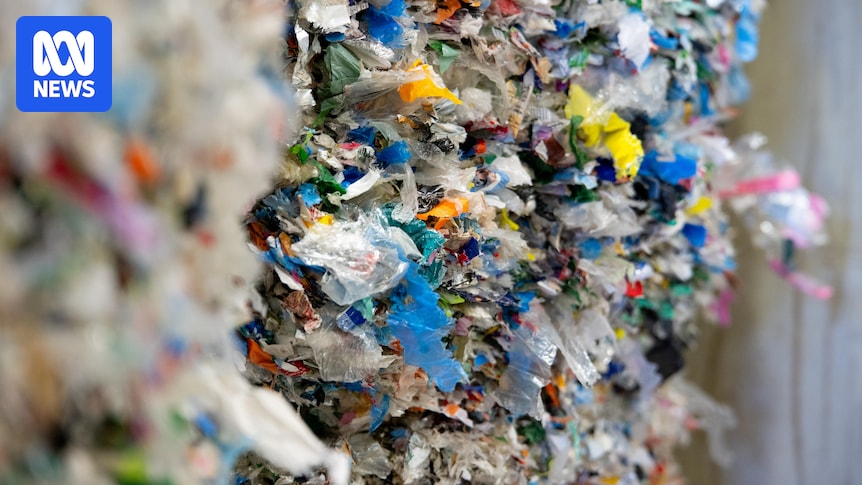
REDcycle’s collapse left behind huge stockpiles of plastic around the country. (ABC Ballarat: Lexie Jeuniewic )
Co-CEO Barry Cosier said the industry now needed to get more customers back on board.
“Our biggest constraint at the moment is collecting enough material for all these facilities,” Mr Cosier said.
“So, we now have the opposite issue of REDcycle.”
There are now more than 700 soft plastics collection points set up in supermarkets across NSW, Victoria, South Australia, the ACT and Queensland.
According to SPSA, that provides recycling access to almost 70 per cent of Australians.
SPSA is also working with 10 councils to trial soft plastics collections in kerbside bins, servicing about 150,000 homes, with plans to eventually expand the model.
Barry Cosier says the scheme needs more consumer buy-in to work. (ABC Mid North Coast: Emma Siossian)
Despite this, recyclers say there is still a lot of work to do to regain the trust of consumers and convince them that this model won’t suffer the same fate as REDcycle.
Mr Cosier said they had worked hard to ensure the systems were sustainable, by “diversifying the market with a lot greater technology”.
During REDcycle’s era, processors mostly used compression moulding to turn the materials into items such as boards or bollards.
Now, improved technology can turn household soft plastics into pellets and flakes, which can then be used to create a wider variety of new plastic products.
Containers for soft plastics recycling have returned to hundreds of stores around Australia. (ABC News: Keira Proust)
Recycling capacity nearly triples
At its peak, REDcycle processed up to 8,000 tonnes of soft plastic waste a year.
SPSA currently works with four recycling partners across Australia, who now have the ability to process more than 20,000 tonnes annually.
The scheme’s largest recycling facility, based on the NSW mid north coast, is recycling 14,000 tonnes alone.
“They’re currently doing some upgrades that will get them to 24,000 tonnes,” Mr Cosier said.
The iQRenew recycling facility, near Taree, will soon be able to process up to 24,000 tonnes of soft plastic annually. (ABC News: Wiriya Sati)
On Melbourne’s outskirts, a plastic chemical recycling plant is being commissioned that will be able to process up to an extra 5,000 tonnes a year.
While the nation’s recycling capacity grows, our consumption of plastic is also increasing.
In the government’s latest reporting period of 2023–2024, Australians consumed 4 million tonnes of plastic and packaging. That was an additional 100,000 tonnes on the year prior.
The national plastics recovery rate remained at 14 per cent.
While recycling is one part of the solution to reducing Australia’s waste footprint, RMIT sustainable development expert Usha Iyer-Raninga said it was time to think about systemic changes that would help reduce the waste itself.
“You can’t just rely on recycling,” Professor Iyer-Raninga said.
“You want to be a society where eventually you don’t want to create waste.“
The RMIT professor, who also co-leads the Circular Built Environment for the Global Alliance, said you couldn’t tackle the issue of plastic waste alone.
“[We need to] think about doing something similar with our food waste or clothing and textile waste,” she said.
The federal government is aiming to double its circular economy’s capacity by 2035. (ABC News: Keira Proust)
This would all feed into the nation’s circular economy, which the federal government has committed to doubling the capacity of by 2035.
Building consumer awareness
Another barrier to collecting enough materials for the processing facilities is the lack of awareness in the general community about the return of soft plastics recycling.
SPSA said it had plans to launch a clearer brand and more visible signage for soft plastic collection points, but that consumer awareness had always been low.
“REDcycle itself, after 10 years and with a national footprint, was only collecting about two per cent of what was put on market,” Mr Cosier said.
More than 80 per cent of people surveyed by SPSA said they wanted to recycle their soft plastics. (ABC News: Kathryn Diss)
A recent SPSA survey showed 81 per cent of the community wanted to recycle their soft plastics, with kerbside collections the preference.
Dr Iyer-Raninga said many people also weren’t aware of the health risks of improper plastic waste disposal, and believed advertisements about the harms of microplastics would have a strong impact.
“I remember those [smoking and drink driving] ads from years ago … they were all pretty powerful in terms of getting a very clear message across,” she said.
“Imagine if we had ads that say if you don’t dispose of your household rubbish appropriately, you could actually end up having microplastics in your system.”
Public awareness about soft plastics recycling is still very low. (ABC News: Keira Proust)
Bill introduced to federal senate
While the industry waits for more consumers to get on board with soft plastics recycling, there is movement in Canberra’s Parliament House to introduce a long called for a mandatory Extended Producer Responsibility scheme for packaging.
The scheme would make packaging producers responsible for the entire lifecycle of their products, including the clean-up of the plastic pollution at the end of life.
Countries around the world have already implemented variations of this scheme, including Canada, Japan, South Korea, along with the EU.
Greens Senator Peter Whish-Wilson introduced a bill to tackle the issue in May, and said it was time for the government to act.
“It’s been extremely frustrating because we’ve been talking about packaging reform now in Australia for decades,” he said.
“Every year that we wait and delay more damage is done to the environment and to human health, so there’s no time to waste, if you pardon the pun.”
Peter Whish-Wilson has introduced a bill to legislate a mandatory packaging scheme for producers. (ABC News: Ashleigh Barraclough)
The Greens put forward amendments to the Coalition government’s Waste and Recycling bill in 2020 in an attempt to address this issue, but they were defeated.
Senator Whish-Wilson is hopeful all political parties would get on board this time around.
“I’m optimistic it’s going to happen because in all the time I’ve been campaigning on this for over 20 years I’ve never seen all the stars align like they are now,” he said.
Federal environment minister Murray Watt did not respond to questions about whether the government would support the Greens’ bill, but said they were committed to building a stronger domestic market for recovered materials, including soft plastics.
“We’re also committed to bolstering Australia’s sovereign packaging manufacturing and domestic recycling capability by creating new, stable markets for domestically recycled products, and making industry responsible for the packaging it puts on our shelves and in our warehouses,” the minister said in a statement.
Mr Watt said the government was investing more than $200 million in new and upgraded infrastructure and contributing towards $1 billion of investment with states, territories and industry.
“More than half of these projects support solutions for plastics, including plastics that are hard to recycle.”