





It’s five long days between now and the proposed time for signing a deal between the United States and Iran which, from what we know at the moment, falls somewhere between a ceasefire and a peace deal.
That’s a long time in the universe of this conflict — and in the sleep cycle of US President Donald Trump. It illustrates just how much can go wrong in the meantime.
The fact that there has been an acknowledgement that there is a deal (of some sorts), and a specific time and occasion for it to be signed, are about the only firm changes to the state of play here.
Within minutes of the initial announcements from Pakistan, the US and Iran, almost every aspect of what has been agreed to as a starting point was being hotly contested.
This means that one element of the war that has certainly already escalated, though, is the spin wars: the battle to frame the story about who has won and lost the most.
The spin wars begin
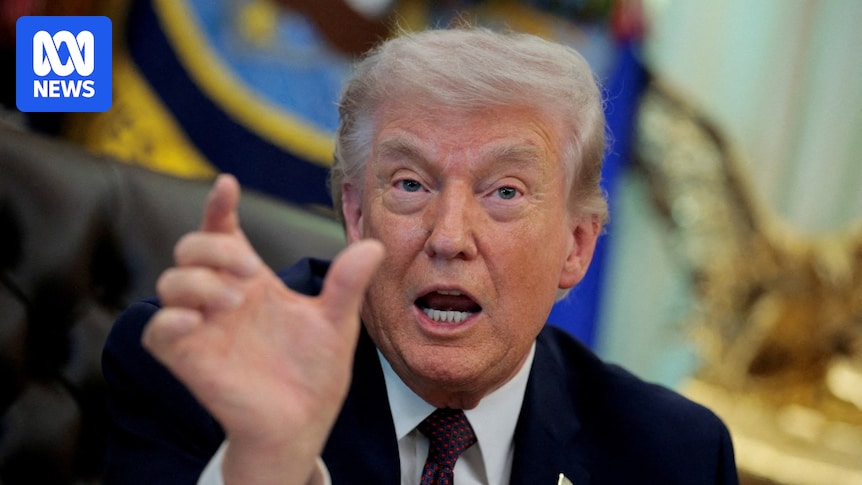
Donald Trump’s fantastical assertion that he was now “authorising” the opening of the Strait of Hormuz — when of course the whole problem for the US and the global economy is that the war has confirmed Iran’s control of the Strait — set the standard for all the claims and counter-claims being made about just what has been agreed to.
For now, it has only been the Iranian side that has outlined what the agreement may contain. And has so often been the case, some of this is hotly contested by “unnamed” US officials.
But it is notable that the terms now being spoken of broadly do reflect those outlined late last week.
A ceasefire has been reached between the US and Iran, with both sides confirming plans to end fighting and reopen the Strait of Hormuz. (REUTERS)
Those terms included an immediate halt to fighting on all fronts, including in Lebanon; the reopening of the Strait of Hormuz; the lifting of sanctions on Iran; the unfreezing of Iranian funds; and a massive compensation scheme being set up for Iran.
Then there is the issue of Iran’s nuclear capacity — another feature of the deal outlined late last week.
If we consider chronologically what could bring the deal undone, where it falls short, and what it has revealed about the changing dynamics of Gulf diplomacy, all roads lead first to Lebanon.
Israel is not a party to this deal
Lebanon remains the most immediate threat to the deal going ahead, for the simple reason that Israel is not a party to this deal.
Prime Minister Benjamin Netanyahu has a personal 30-year commitment to the downfall of the Iranian regime.
When he came under US pressure to cease hostilities against Iran as part of the April ceasefire, he simply shifted his targets to Lebanon and the Iranian-backed Hezbollah that operates there.
The time differences around the world meant that the announcement of a deal on Monday morning (Australian time) came in the middle of the night, (Jerusalem time), so the impact and response of Israel was not immediate.
But early reporting suggested absolute outrage from Netanyahu’s right wing coalition partners, who described the deal as a “strategic defeat” for the Israeli prime minister.
Elections are due in Israel in September and October and Israeli public opinion is firmly behind continued assaults on Lebanon.
There is a sense in Israel that Netanyahu has escalated his attacks on Lebanon — which has included razing whole swathes of villages in the country’s south in a manner very similar to what has happened Gaza — while he felt he had a window to do so before any US-Iran deal was struck.
Credible reports suggested that one of the ways Trump kept this deal progressing — after an escalation of Israeli strikes on the Lebanese capital of Beirut on Sunday — was to guarantee to the Iranians that Lebanon’s borders would be recognised, and that Israeli troops would withdraw to that border.
There is a sense in Israel that Benjamin Netanyahu has escalated his attacks on Lebanon while he felt he had a window to do so before any US-Iran deal was struck. (Reuters: Mohamed Azakir)
‘Israel must withdraw from Lebanon’
The head of the Iranian Revolutionary Guard, Majid Moosavi, posted on social media after the deal was announced that “Iran will never leave Lebanon alone”.
“We will never abandon Hezbollah, and ending the war will include Lebanon and all the fronts,” he wrote.
“Israel must withdraw from Lebanon; ending the war through understanding means Israel’s withdrawal from the occupied areas in southern Lebanon as well, and we have made that clear to the other side with complete clarity.”
This has got to be the first big stumbling block to the deal proceeding.
The fact that there is such a large question mark over whether this can happen shows the US can no longer work on the presumption that it can control the actions of its Israeli ally.
Just as Trump doesn’t control Israel, he will also not be controlling what happens in the Strait of Hormuz under what we know of this deal.
The suggestion is that it could be open from Friday, though the Iranians seem to suggest this relies on the US removing its blockade and committing to other parts of the deal.
Trump says that won’t involve tolls but it also seems clear that the Strait will open under terms set by Iran.
Loading
The financial considerations
While the whole world is relying on the Strait re-opening — and some normality to return to the global market in oil, gas and fertiliser — the Gulf states are particularly reliant on being able to get their exports to market.
The role of those wealthy states in these talks remains opaque, beyond the fact that states like Qatar have been facilitating negotiations.
But it seems likely they may be crucial in dealing with Iran’s demands for massive compensation — $US300 billion on some reports — and for the unfreezing of its frozen assets, many of which are held in Gulf state banks.
The question remains whether those states have decided to literally pay a price, and change their relationship with Iran over time, in the interests of economic survival.
Iran says that at least half of the $US24 billion in frozen funds must be released up front. There have been wildly conflicting reports over the weekend about whether this already happened or will happen.
US officials are denying it. But, once again, if the US doesn’t actually control those funds, it is not really in a position to say whether it happens or not, and would probably enjoy the “deniability” of it happening via the Gulf states so that the US can say that it has not paid anything to Iran.
The nuclear question
These issues are all so fraught that the longer-term question of whether there will be any meaningful change in Iran’s nuclear program becomes a very long term proposition.
Trump was trumpeting Iran’s commitment to not build a nuclear weapon. But that has long been its position.
To date, there has also not been any clear indications of what cap might be put on uranium enrichment.
The Iranian people likely face even further repression of their rights. (Reuters: Jaimi Joy)
The US president told the New York Times that negotiations were still underway over whether Iran would suspend its enrichment for 20 years, hinting he might settle for a 15-year suspension.
He also insisted that Iran would be forever limited to enriching at low levels that “could never be used by the military”.
“They can never go beyond a certain amount,” he said. But when asked whether that limit was the same as in the Obama-era agreement — which limited enrichment to 3.67 per cent, a level that is usable in power reactors but not weaponry — he said only that the new accord would assure that “they can only enrich for non-military purposes. Forever.”
It is also notable that there is absolute silence about the future of Iran’s ballistic missile program, which had been the subject of an earlier Trump demand.
At a global level, the deal, as outlined by Trump, only offers to restore a less certain version of the pre-February 28 world of an open Strait of Hormuz. But at a regional level, it has only re-escalated and concentrated the ongoing struggle between Iran and Israel in southern Lebanon.
Iran has not only won de facto recognition of its control over the Strait and the prospect of having crippling sanctions lifted.
So the Iranian regime has been further empowered by its neighbours and the rest of the world. That greater power must also get reflected at home. That means that the Iranian people — to whom Trump had promised “help was on its way” — likely face a future of even further repression of their rights.
Laura Tingle is the ABC’s Global Affairs Editor.