






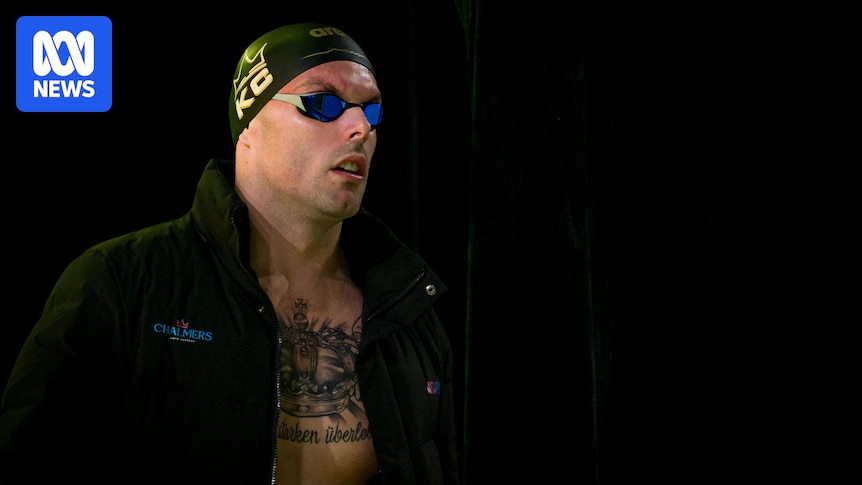
A teenage Kyle Chalmers qualified for his first Australian team as a relay swimmer at the 2015 world championships.
Eleven years later, the 28-year-old is fighting for the next generation of his family and his sport.
After winning the 100m freestyle at the Australian Swimming Trials to book his ticket to Glasgow, where he will try to add to his nine Commonwealth Games medals, Chalmers sounded off about the state of swimming as a potential career.
“It’s such a hard sport … you make a lot of very hard decisions and sacrifices for what I feel is very little reward. I really hope our governing bodies can actually start to create change,” he told reporters.
“It’s very easy for a lot of us swimmers to voice our concerns but nothing seems to change and there’s millions of dollars left in bank accounts [of] people using our image and our performances that we don’t reap rewards of, which is unfortunate.”
A nine-time Olympic medallist and nine-time world champion, Chalmers made no suggestion of retirement, saying he would keep racing until he felt he was no longer capable of getting faster.
But with the next generation of sprinters constantly snapping at his heels, he knows he is closer to the end than the beginning of his time as a competitive swimmer.
Chalmers said when he did decide to leave the sport, he would start at “square one”, years behind his contemporaries in terms of education and experience in the workforce.
The trials marked the first major meet for Chalmers with daughter Astrid in toe, while wife and fellow Olympian Ingeborg Løyning is in Australia on a student visa and cannot be employed in the country.
Chalmers says it is his duty to speak up as a veteran of the sport. (Getty Images: Matt King)
“As a 28-year-old with a young family, and a mortgage, it’s very hard to continue [as a swimmer],” he said.
“We fund these things ourselves; for me to come to trials cost me $5,000, for me to race tonight cost me $36.
“It’s a sport that takes a lot from you and I really hope that from the top right down there’s gonna be some change, whether it’s in my career, but if not hopefully I can at least speak up to make it a little bit better for the next generation coming through.
“Because I don’t see why you would choose this avenue, honestly, as sad as it is.“
The recently completed Enhanced Games, while questionable in their claims of utterly shaking up the balance of power in the global sporting landscape, did raise questions about the financial incentives for Olympic athletes.
There is no direct payment for winning medals at the Games, meaning many sporting superstars are not as well off as some may assume, which is why Chalmers would never criticise someone for chasing the money to set up their future.
“I’ve won 48 international medals and I would’ve got less prize money for those medals than Hunter Armstrong, who raced clean at the Enhanced Games and got $375,000 for two races,” Chalmers said.
“So it’s really sad to see how uneven it is, especially when the IOC president comes out and makes pretty harsh comments through that period of time.”
Kirsty Coventry said Olympians should not receive prize money. (Getty Images: Andreas Rentz)
“I don’t believe in paying athletes,” the IOC boss told New Zealand based-outlet Sport Nation, later clarifying she was referring to prize money for success at the Games.
As well as not receiving prize money, Olympians cannot use footage or images of their performances for self-promotion because of strict broadcast rights restrictions.
Coventry was asked about this specifically and said while athletes surrendered their name, image and likeness at the Games they should be grateful to receive “beautiful venues, beautiful villages [and] beautiful experiences”.
Chalmers said a tipping point was coming if competing at the Olympics became any more financially unrealistic for people.
“I truly believe more and more athletes will be inclined to … walk away from the sport in a slightly better financial situation than they would’ve if they chose the right path and repped their country and went to four or five Olympics,” he said.
“It’s not on Australian taxpayers to cover that, I’m not expecting that, I’m expecting the organisations that are generating so much money out of our races [to foot the bill].
“We’re in a really tough spot in our sport and I feel like it’s on me to speak up so people actually understand because I think there’s a very big false narrative out there that if you’re an Olympic athlete winning gold medals that you’ve kind of set yourself up in life, which is very far from the truth.”