




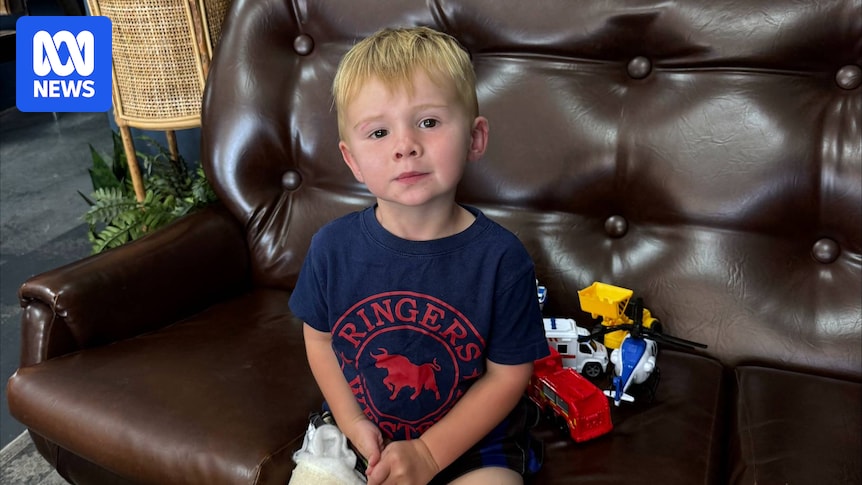
It was late evening and the Pluckrose family was on Marrapina Station in far west New South Wales, 160 kilometres from their nearest hospital, when two-year-old Teddy suffered a suspected broken leg.
Teddy (with older sister Gemma) was eventually too uncomfortable to sit in his car seat after several hours. (Supplied: Jess Pluckrose)
A multi-day, record-breaking rain event meant the roads were wet and the Royal Flying Doctor Service (RFDS) was unable to land nearby.
Teddy’s mother, Jess Pluckrose, made the difficult decision to postpone the drive to Broken Hill hospital until next morning when it would be light and the roads had some time to dry.
Local weather apps indicated the worst of the rain had passed.
“We left quite early in the morning and we hadn’t been on the road very long and the rain really set in,” Ms Pluckrose said.
“We kept pushing towards Broken Hill in the hope that we could make it and the further we got down the road, the heavier the rain got.
“There was just no indication of what we were driving through at that point by reading weather maps.”
The Pluckrose family decided to turn around after making limited progress along the mostly flooded roads. (Supplied: Jess Pluckrose)
Several hours down the road, the family was forced to turn back and wait until next day for Teddy to be flown to hospital, where his broken leg was confirmed and treated.
Months on, the memory of the ordeal remains and Ms Pluckrose is certain she would have done things differently if rain forecasts had been more accurate.
Jess Pluckrose said she would have got Teddy (left) to hospital sooner if the rain forecast was more accurate. (Supplied: Jess Pluckrose)
“Looking back on it now, we would have been better off going to town in the dark, but without that knowledge we couldn’t make that decision,” she said.
‘In the dark’ about rainfall events
Fellow pastoralist Lachlan Gall, from Langawirra Station, said short-term radar coverage was a frustration in the region.
“Pastoralists and all stakeholders in this area are literally in the dark in terms of knowing what’s coming towards them in a rainfall event,”
Mr Gall said.
Most of Australia’s weather data, including forecasting, is sourced from the Bureau of Meteorology (BOM), which is informed by a range of tools, including satellites and weather stations.
The current radar network, which includes Doppler radars, does not cover much of far western NSW. (Supplied: Bureau of Meteorology)
Among its arsenal are a network of 69 Doppler weather radars across the country, which record rain events up to 300km away, updating every few minutes.
Mr Gall has spent almost a decade advocating for a far west-based Doppler weather radar as a councillor with the Pastoralists Association of West Darling (PAWD).
He said the technology would be an important tool for anyone working on the land where rain could change the course of daily operations.
Mr Gall has been advocating for a Doppler radar based in the far west for close to 10 years. (Supplied: Lachlan Gall)
“We’re left to guess as to whether we can get [a] job done before the rain arrives, whether that be mustering or shearing or trucking livestock or using the roads,” he said.
Falling on deaf ears
Sam Beven, of Sturts Meadows Station, is also intimately familiar with the importance of reliable forecasting in the day-to-day running of a pastoral station.
During the same rain event that left the Pluckrose family stranded, his property recorded more than double its annual rainfall average in just a few days.
Sam Beven said pastoralists’ ongoing call for better weather radar technology seemed to be falling on deaf ears. (Supplied: Erin Beven)
“The app on my phone said there was a 70 per cent chance of less than six [millimetres] and then my wife’s phone on a separate app said there was a 100 per cent chance of more than 100mm,” Mr Beven said.
“On that day, we actually got none.
“And then the following day, when both of our phones said we were going to get none, we got 115mm.”
Pastoralists say they felt unprepared for a major rain event earlier in the year due to the Doppler radar black spot. (Supplied: Lachlan Gall)
As the PAWD president, Mr Beven has also been involved with the ongoing calls to the BOM, and state and federal parliaments, for a Doppler radar in far west NSW.
“A lot of letters have been sent, a lot of phone calls have been made, [but] it does seem to fall on deaf ears,”
he said.
No ‘pot of money’ for radars
BOM chief executive Stuart Minchin said its current Doppler network covers about 98 per cent of Australia’s population and, while it uses many forecasting tools, it is particularly useful for those monitoring localised rainfall.
He said the BOM is aware of the ongoing calls for a radar in far west NSW and other isolated parts of the country.
“The bureau has no pot of money available to expand our radar network, so it really does need dedicated funding by someone [external], whether it’s federal, state or local governments,” Dr Minchin said.
Dr Stuart Minchin says the agency lacks the resources to expand its Doppler radar network alone. (Supplied: BOM)
“It’s quite reasonable for communities that are not currently covered by radar to wish to be.
“But ultimately, it becomes a challenge to afford to cover 100 per cent [of] Australia when radars are an expensive piece of kit.”
Dr Minchin estimated it costs around $30 million to run a Doppler weather radar over a 20-year period, including about $12 million alone for the initial build.
Both Mr Gall and Mr Beven said this explanation was a difficult pill to swallow, considering more than $96 million was spent on the BOM’s controversial website upgrade last year.
But Dr Minchin said this figure went far beyond the website’s redesign and included strengthening its database, tools, infrastructure, and security.
Dr Minchin said Doppler weather radars cost tens of millions of dollars to build and maintain. (ABC Wimmera: Sean Wales)
“We were hacked in 2015 [and] there was a real risk with lack of security around [the] old website infrastructure, a lack of access to people who have vision impairment and other things,” Dr Minchin said.
“Much of the community could have been left without weather information, full stop, if that work was not done.”
Dr Minchin added that, despite the black spot in Doppler radar coverage, it did not hinder its overall forecasting capability.
Game changer in other regions
Western NSW landholders were successful in getting the state government to fund three additional Doppler radar installations in Brewarrina, Hillston and Yeoval between 2019 and 2022.
Brewarrina farmer Gerard Glover, who also chairs the Western Division Council with New South Wales Farmers, said the radars had drastically improved forecast accuracy for his area.
“It’s actually a game changer when it’s raining. You can actually see how much is coming [nearly] by the hour,”
Mr Glover said.
Brewarrina farmer Gerard Glover said the Doppler radar installed in his area a few years ago has been a “game changer”. (Supplied: Gerard Glover)
He said that, when Brewarrina’s new radar was installed, NSW Farmers outlined to the government that far west NSW was the last remaining black spot in the state.
“[The far west] is the first warning [location] out there if [a major rain event] was to eventuate,” he said.
“It’s certainly worth spending the money on and covering that last black hole in NSW.”
The campaign continues
State and federal members Roy Butler and Jamie Chaffey have raised the issue in parliament and called for funding in their respective budget requests.
Mr Gall is not giving up the fight for a far west-based Doppler radar. (Supplied: Lachlan Gall)
A spokesperson from the NSW Department of Primary Industries and Regional Development said in a statement that while the state had funded the three radars in western NSW, it would not be doing the same in the far west.
“The NSW government has no plans to further invest in the Doppler radar network as this is primarily a Commonwealth responsibility,” the spokesperson said.
The ABC repeatedly contacted the office of Federal Environment Minister Murray Watt about future funding allocations for Doppler radars, but did not receive a response.
It has been a long road to recovery but Teddy is now back on his feet. (Supplied: Jess Pluckrose)
Asked about the big price tag to install and maintain a Doppler radar, Ms Pluckrose’s message to governments was simple.
“I know events like this don’t happen all the time … [but] we need to be prepared and to be prepared we need to be supported,” she said.