





Hello and welcome to a new version of OFFSIDE, a weekly newsletter looking at everything happening in the Beautiful Game.One pivotal moment in Christopher Nolan’s The Odyssey shows just how far the film departs from Homer’s epic. In the original, Odysseus tells the Cyclops Polyphemus that his name is “Outis”, meaning “Nobody” or “No One”, before he and his men blind him. When the other Cyclopes come to check on Polyphemus, they are told that “Nobody” is attacking him, leaving them with little reason to intervene.Odysseus escapes the cave, yet cannot resist taunting Polyphemus and revealing his true identity. That gives the Cyclops everything he needs to escalate the complaint to his father, Poseidon, god of the sea, who turns the journey home for Odysseus and Co into the ancient Ryanair experience. That version doesn’t exist in Nolan’s movie, which transforms Odysseus from Homer’s polytropos, the “man of many turns” whose cunning is matched by the hubris that angers the gods, into a traumatised veteran who simply wants to return home to his wife.Speaking of hubris that angers the gods, Gianni Infantino, a man who has changed football in every feasible way to improve FIFA’s relationship with Mammon, was at it again after his plan to “sell the World Cup” was leaked. Once caught out, he channelled his inner Odysseus and insisted that “nobody” was selling football.The comparison ends there.
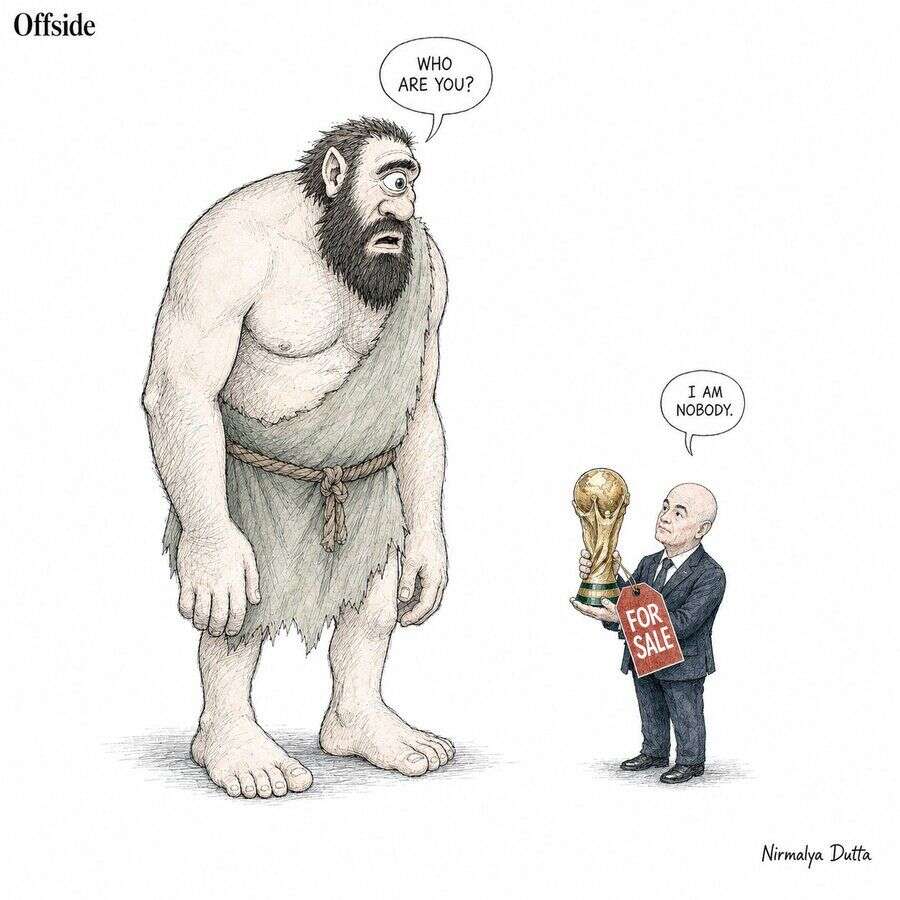
Infantino says ‘nobody’ is trying to sell the World Cup. (AI Cartoon by Nirmalya Dutta.)
Odysseus’ Trojan Horse made it through the gates of Troy. Infantino’s never got past the turnstile, perhaps because this was hardly his first rodeo and, for once, the footballing world decided, to borrown a line from Sir Alex Fergusion, to check under the pasta to see what was under the sauce.So here’s the Homeric story of the modern-day Odysseus, who thought he could get away with it all till the footballing world finally caught on.The Trojan HorseMuch as it describes Homer’s protagonist, the word polytropos – a man of many turns – could very well be used to describe the Swiss man from a nondescript village who had become the most powerful man in football’s history, one whom Donald Trump referred to as the “King of Soccer”. Perhaps he felt even the Fates were intervening on his behalf when the winds blew Donald Trump back into the White House to ensure that the FIFA World Cup in America would be everything his heart desired.One particular anecdote illustrates how Infantino came to view himself amid the pantheon of global soccer stars and movers and shakers in international politics.In India, there’s a term called bandobast that translates to “arrangement”, “management” or “organisation”. It refers to the deployment of police, security protocols and logistical arrangements when a VIP is in town and is seen by many as a social marker of power. According to a report by Martyn Ziegler in The Sunday Times, FIFA requested a similar bandobast for him in Canada, seeking the same transport privileges reserved for the US president. The request was declined by Canadian police.The bandobast request was just the tip of the iceberg. Infantino even has a personal photographer as his “Instagram husband”, someone whose job is to click every moment of his life. He engraved his name twice on the Club World Cup trophy and cast himself as a global peacemaker who brought two “warring nations” to the World Cup.All that is evident in the handprint he has left on the global game.During his tenure, Infantino has managed to expand the World Cup from 32 teams to 48 teams, revamped the Club World Cup into a mini-World Cup with 32 teams, broken football’s long-standing traditions to force through hydration breaks and a half-time show, introduced dynamic pricing for FIFA matches and got players’ bans rescinded, including Ronaldo’s and Folarin Balogun’s. He gave Trump a FIFA Peace Prize when the Nobel Committee wouldn’t give him one and engineered the 2030 tournament by ensuring that it would be played across Europe, Africa and South America to ensure that Saudi Arabia got it in 2034.Earlier, he also tried to push through a secretive $25-billion, 12-year proposal involving SoftBank that envisaged an expanded Club World Cup and a global Nations League culminating in a “Final 8” tournament. That fell through, and he even tried to hold the World Cup every two years instead of four.While neither went forward, both moves emboldened Infantino to think that perhaps his FFE Trojan Horse would go through unchecked.The FFE plan, which sounds rather innocuous, like corporate CSR efforts, was very simple: create a different entity called FIFA Forward Enterprise (FFE), a subsidiary dealing with FIFA’s main mission: improving its relationship with the only god that matters, Mammon.
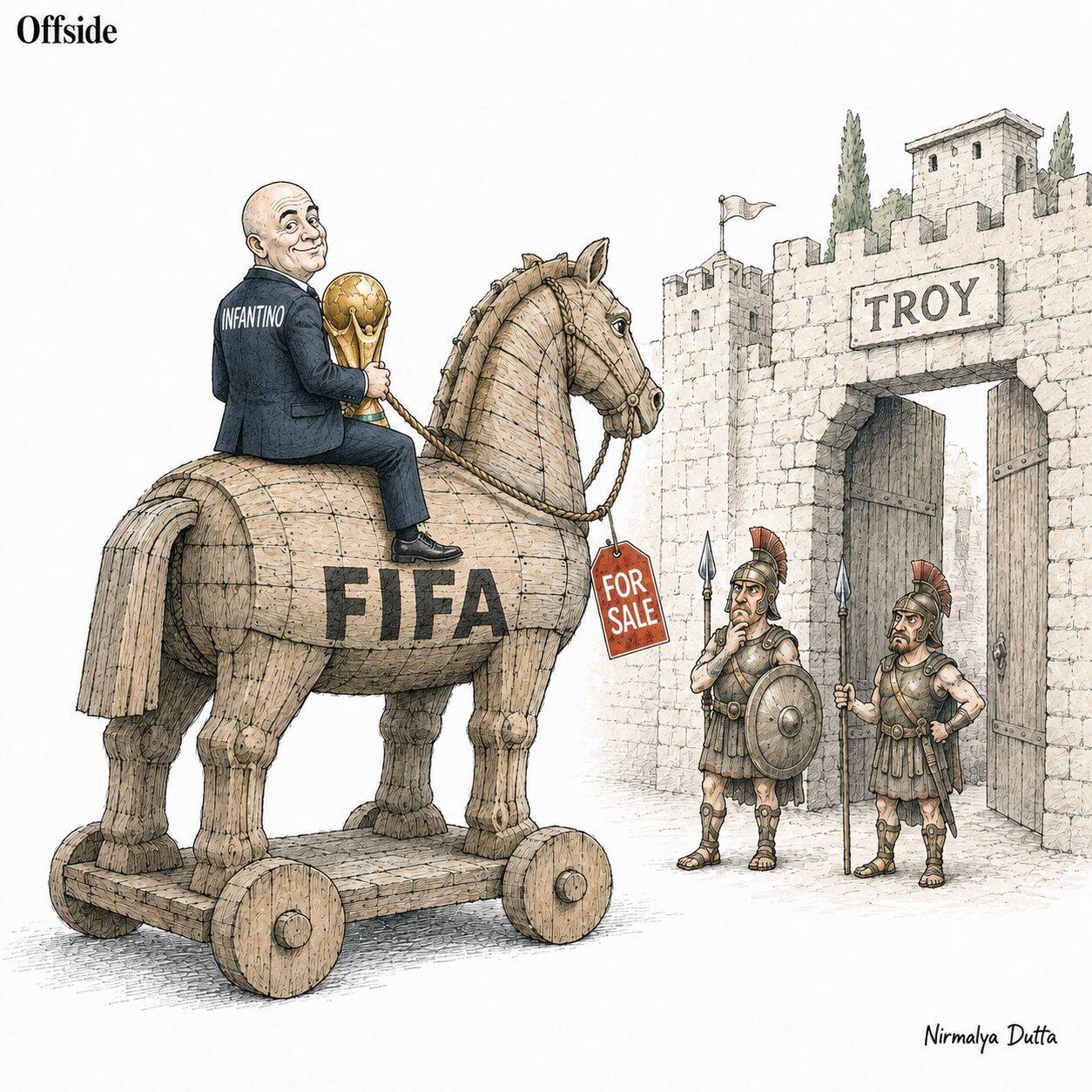
Infantino’s Trojan horse of privatisation fell flat. (AI cartoon by Nirmalya Dutta)
The new company would take care of everything financial: broadcasting rights, sponsorship, ticketing and operational delivery. JPMorgan valued this company at $20 billion, and FIFA would sell a $4.2-billion stake to outside investors while retaining 80%. The pitch was that FIFA was “undermonetised”, with annual revenue of $3.6 billion compared with the NFL’s $21.2 billion, MLB’s $13.1 billion and the NBA’s $12.5 billion.The idea was to grow FIFA’s event portfolio, a hard ask given that the NFL and others are annual franchise leagues, while FIFA is a governing body whose main income is concentrated around periodic tournaments. Infantino hoped to pull this off by promising FIFA’s 211 members $20 million during the next four-year cycle, double the $10 million they were due to receive, with one caveat: they had to come on board as soon as possible.Infantino envisaged himself as the chair of this company once he retired from FIFA in 2030, with a basic annual salary of $30 million, even joking that by 2031 “we can make serious money”. When asked whether his current $6 million annual salary wasn’t enough, he replied: “No, I’m talking a serious amount.”The falloutFor Odysseus, the fallout started when he announced his name to the Cyclops Polyphemus, earning Poseidon’s wrath. For Infantino, the fallout began on July 28, when The Times (UK) and the Financial Times, in a moment reminiscent of Leibniz and Newton’s independent development of calculus, laid bare Infantino’s plan to sell stakes to a private company. The proposed investor group would be led by Josh Kushner, brother of Jared Kushner, Donald Trump’s son-in-law. FIFA was at pains to point out that Josh, unlike his brother, was a registered Democrat who had donated to Obama’s campaign and attended Taylor Swift’s wedding. According to Forbes, he has a net worth of $5.2 billion. In the finance world in particular, Josh is the one who matters and is known for his financial acumen, including a major investment in Instagram that doubled in value in a few days.The angriest remonstrations – enough to make Gertrude wonder whether UEFA “doth protest too much” – came from Europe, which said the “soul and governance of football are not assets to be sold”, a worldview seldom expressed when teams of sportswashing nations break UEFA’s financial fair play regulations.Things came to a head when all 55 UEFA nations agreed to boycott the men’s and women’s World Cups. CONCACAF opposed FFE over the lack of due process, while the AFC called the plan “totally unacceptable”.Senior adviser Carlos Cordeiro resigned, calling it a “bad deal for football”, while FIFA’s chief operating officer (COO), Kevin Lamour, claimed that they had been “deceived” and that it was the “project of one person”.Soon, the screws started turning for Infantino, with UEFA saying FIFA’s leadership had lost “UEFA’s confidence”. CONCACAF said the plan was a “symptom of leadership that has stopped putting football first”. The English FA said it would send a letter to Infantino withdrawing its support for his re-election. Other European nations are expected to follow suit. In fact, UEFA has the power to trigger an Extraordinary FIFA Congress without help from any other confederation. The rules require 20% of FIFA’s 211 members, or 43 associations, and UEFA has 55. Calls for his resignation are also gaining traction. UK PM Andy Burnham, freshly burnished in the role after Starmer’s resignation, has called for him to step down. LaLiga president Javier Tebas has followed suit.Of course, Infantino retains strong support from CAF, CONMEBOL and smaller Asian, Caribbean and Pacific federations that rely heavily on FIFA’s development funding.The end of the road?Perhaps Infantino’s time is up and his fate seems sealed, like that of a tragic hero from the Russian rather than the Greek tradition. The alacrity with which folks who benefited from Infantino turning football into a capitalist behemoth have suddenly discovered hitherto unseen principles is very reminiscent of an old Russian short story by Anton Chekhov titled The Confession. Its protagonist is a cashier who suddenly becomes the cat that got the cream when he gets a minor promotion and finds himself courted, respected and invited by everyone. Then, as he gets mired in scandal, he is quickly dropped. The patrons disappear, and his family turns scornful. The court is only loyal as long as the gifts keep coming; as soon as the gifts become liabilities, that loyalty develops a conscience.Infantino hasn’t been banished from Zurich yet, but he is getting the treatment that would have befallen Odysseus if the Trojan Horse had been burned instead of taken inside the walled city. For the last decade, Infantino has been treated as soccer’s God, but over the past few extraordinary days, he has come to be treated as the man who tarnished world football, even as everyone enjoys the fruits of his spoils. One wouldn’t be surprised if Infantino suddenly felt like quoting Chekhov’s cashier: “My dear ladies and gentlemen, I got caught, or to state it more fully: yesterday I was respected and honoured on all sides; today I am a scoundrel and a thief... Cry out, now, banish me, write editorials, and throw stones, please—not everyone.”