






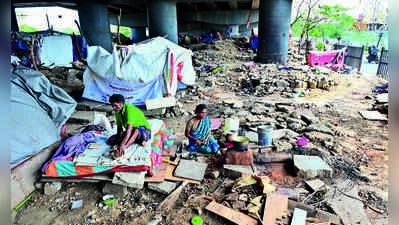
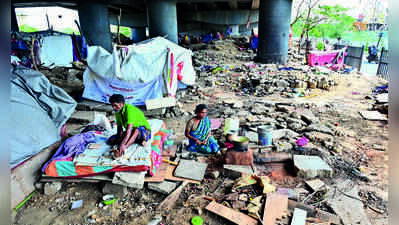
Muskaan.Ahmed@timesofindia.comEvery few minutes, a train rattles past Velachery railway station as passing vehicles kick up clouds of dust into S Valli’s “home”. The 40-year-old lives under the flyover opposite the station, where the smell of urine hangs in the air. But Valli is unfazed.“I’m used to it. I have been living here for years,” she says, sitting on a pile of debris and cooking a meal on a mud stove for her husband. She stops to shoo away the rat that scampers across her husband’s foot.Valli, who came to Chennai from Panruti, earns `600 a day as a construction worker, more than she did in her village. “The money goes towards food and my husband’s medicines,” she says.Across Chennai, thousands live in similar conditions. Information and Resource Centre for the Deprived Urban Communities (IRCDUC) 2024 data says 11% of the homeless population sleeps under bridges and flyovers; 39% sleep on platforms without any cover, exposing them to rain, heat and cold; 48% survive using makeshift tarpaulin or cardboard structures. Most belong to tribal communities or are guest workers. A growing number are elderly people who have been abandoned. “Many are construction workers, waste pickers or street performers,” says Vanessa Peter, founder of IRCDUC.Central funding for the Shelter for Urban Homeless (SUH) component under the DAY-NULM scheme (to reduce poverty and vulnerability of urban poor households) stopped in 2022, says Greater Chennai Corporation (GCC) commissioner G S Sameeran. “We’ve been utilising GCC’s capital fund for the upkeep and functioning of shelters.”Except for GCC, most urban local bodies have not allocated financial resources to sustain shelters, says Vanessa. “Several function without formal assured financial support, affecting the continuity, quality, and sustainability of services for persons experiencing homelessness. Tamil Nadu has no dedicated state-funded programme to sustain these shelters, which are, in any case, only a temporary solution to homelessness.”Homelessness, says Vanessa, should not be viewed solely as a housing issue but as a multidimensional social challenge. “They need housing but also skill development so they can get jobs. But a lack of coordination between govt departments also leaves many unable to access Aadhaar, ration cards, welfare schemes and state health insurance despite existing guidelines.”Nandhini S, from the nomadic tribal saattaikaran community, who lives under a flyover in Koyembedu, says she has no proof that she exists. “All of us here were born behind a curtain drawn across two pillars under the flyover. We don’t have birth certificates or Aadhaar or ration cards. We have never been to a hospital,” says the 20-year-old.Nandhini and the 15 families here make a living begging. “We can’t get jobs as we don’t have documents. I cannot even put my child in school.”Those evicted from pavements and streets are more likely to get a house than those living under flyovers, Shreya P Singh, managing director of Tamil Nadu Urban Habitat Development Board. “We try to accommodate those living on streets in homes that will take care of them on a temporary basis. If they have a family, then they may be considered for housing. It is difficult to do with those living under flyovers because they are constantly on the move and don’t have any govt ID,” she says.D S Sivasamy, former additional director, municipal administration and water supply department, believes “Tamil Nadu should move beyond shelters to affordable rentals, transitional housing, rehabilitation and long-term housing solutions. “Right to life is a fundamental right, and it also means the right to live with dignity. Simply evicting people is not the solution. They should be shifted to proper places and provided suitable accommodation,” says Sivasamy.“Shelters are designed as emergency accommodation. Families need long-term housing solutions that offer security, access to education and essential services, enabling them to rebuild their lives with dignity.”GCC’s standard operating procedure for homeless persons recognises that different groups have different needs and calls for shelter services to be tailored to provide protection, care, rehabilitation and reintegration support. There are 56 shelters in Chennai. But only one for families.WHAT THE NUMBERS SAY11% of homeless population sleeps under bridges and flyovers39% sleep on platforms without any cover, exposing them to rain, heat and cold48% survive using makeshift tarpaulin or cardboard structuresTotal number of shelters in Chennai: 56; this includes 1 family shelter and 1 shelter for transgendered people1,231 people live shelters in the citySOURCE: Greater Chennai Corporation, 2026