



Hundreds of activists and academics have travelled to Central Australia to voice their concerns over the expansion of the nation’s most secretive defence facility and the nature of its operations in warfare.
It has been almost 60 years since Pine Gap was built in the heart of the nation, 18 kilometres south-west of Alice Springs.
It was originally sold to the public as a space base, but the joint Australian-US facility has since expanded to become a major intelligence and surveillance base, its large golf-ball-like domes growing in number and capacity.
Its mission and secrecy have made it the target of countless protests.
Hundreds of activists and academics from around Australia travelled to Central Australia to join tomorrow’s protest against Pine Gap. (ABC News: Will Green)
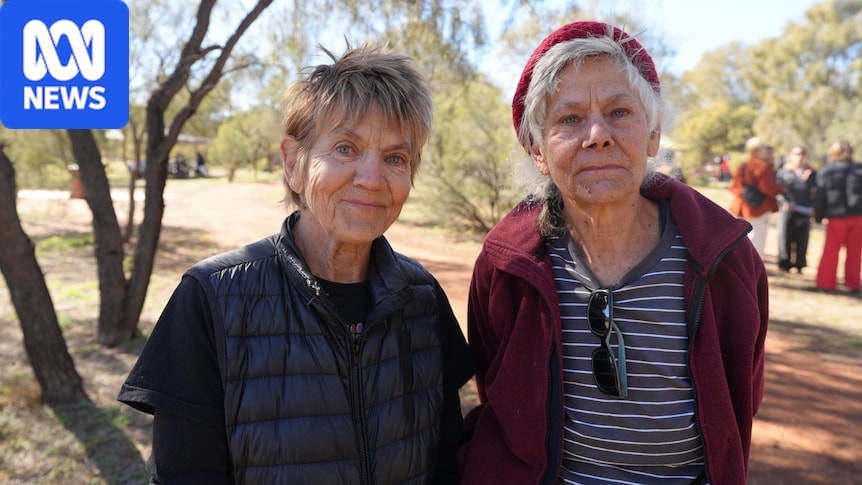
Lies and Els Paijmans were among those to make the trip to Alice Springs for tomorrow’s protest action, travelling from regional New South Wales.
They know the outback town well, having visited for decades and attended a major women’s protest at Pine Gap in 1983.
Els Paijmans said the pair were motivated by “the ongoing American involvement in Pine Gap and what that means on a global level for the military machine”.
“I think the surveillance is used for negative purposes, far beyond any positive purposes that the government or a politician could describe,” she said.
Lies Paijmans said the two women had been protesting the facility for more than 30 years.
“Certainly since the ’70s when Whitlam was in,” she said.
The smoking ceremony went for almost an hour to accommodate the large number of people who travelled to join the protest. (ABC News: Will Green)
“We both went to the Women for Survival camp, and still things are bad, if not worse, definitely worse.”
Back then, the group of around 800 women camped along the road to Pine Gap, but protesters are no longer allowed to get so close.
“It was really quite big, and it went for several weeks; it was huge,” Lies Paijmans explained.
“We were there to protest, and we were right at the gates, which we can’t do now, but we were right at the gates.
“We weren’t planning to break in, but we started to push it, and then everyone started pushing, and then the whole thing came down.
“So we were all wearing our frocks and had teacups and things, so we were on the Pine Gap land having a tea party.
“But then the federal police in their helicopters started coming down really low and stirring up all the dust and the dirt and being quite terrifying.”
Nathalie Farah says Australia should not be “dragged into” US wars. (ABC News: Will Green)
About 100 women were arrested that day, a world away from this week’s “Close Pine Gap” convergence held on the red dirt among native trees and shrubs at a desert research institute, where more than 500 people have gathered to meet and share ideas.
But the passion is just as fervent.
Loading…
Organiser Nathalie Farah said most participants were driven by “frustration”, “confusion” and “grief”.
“There is real concern about escalations that are happening, that the US is waging war in the Middle East and in Iran, and with the US being in a state of unpredictability,” she said.
“Why should we be dragged into their wars?
“The other point about this is also that Pine Gap makes Australia a target.
“It actually isn’t safe for Australians living here, for people living in Alice Springs.“
The group was welcomed by Arrernte traditional owners yesterday with a smoking ceremony that went for the better part of an hour, to allow all attendees to participate.
Pine Gap sits on Arrernte elder Felicity Hayes’ ancestral lands — but she cannot visit the sacred grounds and rock art sites that sit within the facility’s boundaries.
Felicity Hayes says her family wants to visit rock art near the Pine Gap facility. (ABC News: Will Green)
“We just want to ask to go there and, you know, look after country,” she said.
“You can go into the women’s area, but you can’t go into the men’s site, and it’s like, you know, really sad.
“One of my family wants to go out there and check on the rock art and stuff like that.
“Every time you go there, there’s the federal police, you know, I’m just thinking there might be cameras, hidden cameras there that see people going towards, going into Pine Gap.”
Ms Hayes said her grandfather, who was involved in negotiations about the use of the land, did not understand English properly and she believed he did not know what was being proposed when authorities came knocking.
The Defence Department has declined to comment on the protesters’ concerns. (ABC News: Will Green)
“I would like to see my land back and compensate us for what they been doing,” Ms Hayes said.
“Must have did a lot of damage to our sacred sites there.
“I just want to get compensated, and to have houses at my place too.“
She said most of her family lived in makeshift cabin homes and tents at the Whitegate town camp in Alice Springs where water has to be trucked in.
In a statement, a Defence Department spokesperson said in accordance with longstanding practice by successive governments, the Australian government does not comment on intelligence matters or the operation of its joint or collaborative facilities, including Pine Gap.