










For Levi, 15, and his mates, “looking good” is always front of mind.
“When I go out, you know, I want to have like a good reputation,” he says.
“Yeah, same. I want to make sure I’m always looking good and sharp, as much as I can,” Nate, 15, says.
Caring about our physical appearance isn’t anything new, but there is a new movement that’s taking it to the extreme.
This movement is called “looksmaxxing”, and it is targeted at young men. It’s all about making yourself as attractive as possible, by using whatever means possible, whether it’s extreme diets, surgery or drugs.
“People cheek bite: they grip their cheeks really hard inside their mouth to enhance their jawline,” Corbin, 16, says.

Cooper, Nate, Harry (back) and Levi, Josh and Corbin (front). (BTN High: Michelle Wakim)
“I see some people taking peptides and steroids to try and enhance their body,” Nate says.
“[People] hitting [their] jaw with a hammer to make [their] jawline pop more,” says Levi, describing something known as “bone smashing”.
“It creates like a lot of other problems.”
Young men ‘targeted’
Looksmaxxing began in the dark corners of internet forums, where young men would blame their perceived failures on their looks.
Now, experts such as Simon Copland, a sociology researcher at the Australian National University, worry extreme looksmaxxing is making its way into the mainstream.

Simon Copland says the self-help industry is targeting young men. (ABC News: Tahlia Roy)
“One of the things we’ve seen over the past, really, couple of decades is a growing focus on individual success and part of that is individual looks for both young men and young women,” Dr Copland says.
He says young women have always been the focus when it comes to appearance and body image, but now the so-called “self-help” industry has started targeting young men as well.
“The rise of social media and the rise of social media influencers have played a significant role in that,” he says.
Alex and Raven, who are both 17, say as young women, they’ve also come across looksmaxxing content on social media, and see it as another “toxic beauty standard”.

Raven and Alex, pictured with Isabella (left), have come across looksmaxxing online. (BTN High: Michelle Wakim)
“It’s just like how it was for kids in the early 2000s with like what weight you should be, how your face should look,” Alex says.
“I think looksmaxxing is a very hyper-masculine term,” Raven says.
“Looksmaxxing just reinforces very terrible stereotypes about what men should be and what they shouldn’t be, so I think it’s just not good for anyone.”
Insecurities taken advantage of
Zac Seidler, a psychologist and researcher specialising in men’s mental health, says while there are biases in our society that favour appearance, such as the “halo effect” or “pretty privilege”, a lot of what looksmaxxers say is pseudoscience, and takes advantage of young men’s fears and insecurities.
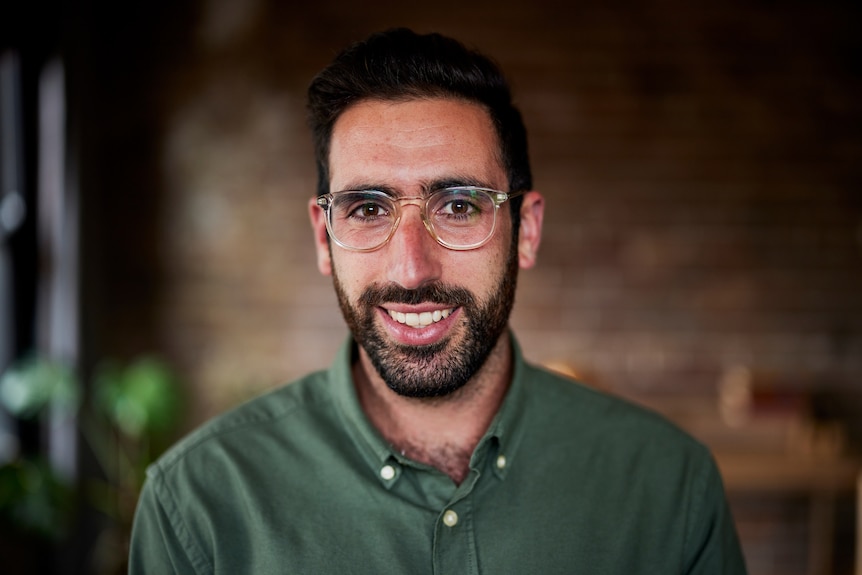
Zac Seidler says there is no validity to how looksmaxxing defines a good-looking man. (Supplied)
“I think that the scientific lens is really important here, because young men are socialised into that like data-driven, logical rationalisation perspective,” Dr Seidler says.
“There is very little emotionality in much of this [looksmaxxing] content.
“It is, ‘This is black and white. This is how it is,’ and so that takes hold. That is a strong grip that is very hard to challenge.”
Dr Copland agrees, saying that looksmaxxing influencers use “dodgy science” to identify what is a “good-looking” man.
“There is no validity to any of this. It’s all pseudoscientific,” he says.
“They have a whole bunch of measures, things like facial symmetry, jawline definition, and something called ‘canthal tilt’, which is the angle of the outer corners of your eyes.
“They try to measure these in a quantitative way, and then that defines whether you’re good-looking enough, or good-looking at all.
“So, naturally, when you use such quantitative measures, it becomes a hierarchy thing.”
When hierarchy comes into it, this is where some people, such as Raven, see the movement becoming problematic.
“I think it [looksmaxxing] might have started as a way for people to become the best version of themselves that they can, but it very much has just become, more so, about ‘out-mogging’ … just being better than other people, and I think that’s very toxic because we already have enough beauty standards that are unachievable.”
What is mogging?
The term “mogging” comes from AMOG, which stands for Alpha Male of the Group. Historically, this phrase has been used in internet communities that encourage ideas about hierarchy and men dominating other men.
Linking in with all of this is a website called Omoggle, which takes the pseudoscience associated with looksmaxxing, and turns it into a game. Omoggle users are matched with a random person, their face is scanned, scored and ranked, with the winner “mogging” and the loser getting “mogged”.
Loading…
The website only launched in May and schools have already tried to block the site.
There are concerns, not only because it allows young people to talk to strangers online, or because it involves sharing their biometric data, but because of the impact it’s having on young people’s mental health.
“There is a really, problematic outcome here whereby these young guys start to believe, in many ways, that there is potentially a solution to that [the way they look], but there is no endpoint, and the goalposts keep moving,” Dr Seidler says.
Pablo Rogers, the man behind Omoggle, says that the ratings are just “a game mechanic”, not an objective judgement, and it’s supposed to be a fun social game, only for those over 18 years of age.
Experts say that this might not be obvious, particularly to young people, and even if those behind the website see it as a game, there is a group of people taking the movement far more seriously.
Ethan, 18, says he sees websites like Omoggle having a big impact on young people’s mental health.
“I think the like hyper focus on looks and stuff is really damaging to just self-esteem and they can get really self-conscious,” he says.
Subjective beauty standards
Dr Copland says that while it is normal to care about the way we look, we need to be conscious of how beauty standards have changed over time, and how they will continue to evolve.
“One of the things we should look back on is that what it means to be a good-looking person has changed throughout history,” he says.
“It’s entirely subjective, and we all have good looks in different kinds of ways, and so the better thing is to be able to focus on what works for you, rather than believing in some particular perfect ideal.”
Ruby and Lola, who are both 17, say this is what they try to keep in mind when they think about the way they look.

Ruby and Lola (third and second from right) say self-acceptance is key. (BTN High: Michelle Wakim)
“Everyone’s unique and beauty’s unique,” Ruby says.
“Beauty cycles through all different stuff, too. So, it’s never going to be the same, either,” Lola says.
“I think you need to take yourself for who you are and just love yourself either way.”