

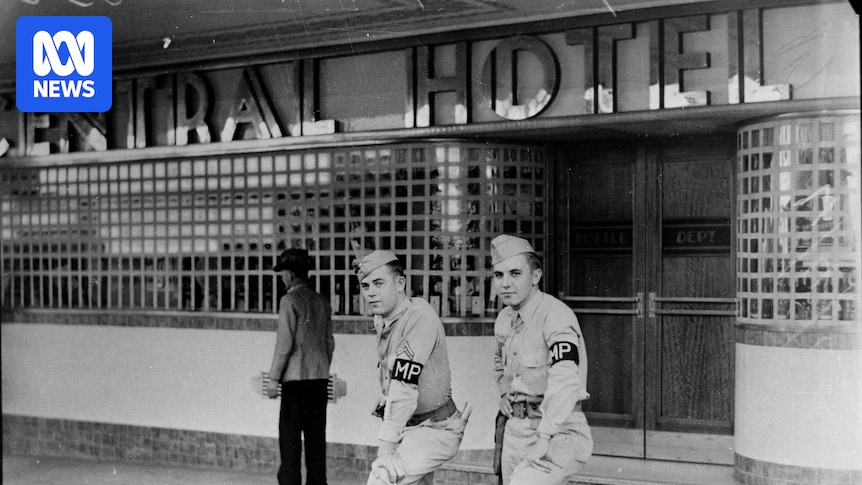
November, 1942. The eve of Thanksgiving in the United States. It’s a balmy night in the Brisbane CBD, and four mates are chatting on Adelaide Street.
The only indication of the maelstrom engulfing the globe is the set of uniforms they are wearing. Three Australian soldiers and one United States Army private.
The exact details of what came next are clouded by myth.
It is generally accepted that an American military policeman (MP) began to give the US soldier a hard time about his leave pass. That did not sit well with his new Australian friends, who proceeded to beat up the MP.
Tensions had been building up like dry kindling since US warships arrived in Brisbane in December 1941 after the Japanese attack on Pearl Harbour.
Those tensions would spark this isolated stoush into a series of wild brawls that would consume Brisbane for the next two days and leave one Australian soldier dead.
‘Overpaid, oversexed, and over here’
By the time of the Battle of Brisbane, the city had become the centre of the Allies’ struggle against Japan in the Pacific theatre.
General Douglas MacArthur had made the city his stronghold after fleeing the Philippines, and thousands of American soldiers were situated in Brisbane.
Historian Judith Powell said the city was “incredibly important in all the battles that were fought in the Pacific”.
Brisbane became central to the Allied war effort in the Pacific theatre, with industry ballooning and air raid shelters built in the CBD. (Supplied: State Library of Queensland)
“Brisbane was filled with air shelters … the schools were closed for quite a period of time. There were searchlights on Mount Coot-tha,” she said.
“For a time, if you think about it, Brisbane really was the front line.”
Relationships became strained where Australian culture clashed with American exceptionalism — the Yanks were better provisioned, better outfitted, and more attractive to Australian women.
Tensions rose between servicemen as it became clear to the Australians the Americans were better paid and better outfitted. (Supplied: State Library of Queensland)
“The general population were just enamoured [by] Americans. Their uniforms were slick, the Australians were all in these awful heavy woollen uniforms,” Ms Powell said.
“The Americans had fancy uniforms, had nylons for women, they had chewing gum.
“[They were] overpaid, oversexed, and over here.“
American soldiers were paid roughly double what Australian troops were, and had better provisions. (Supplied: State Library of Queensland)
In a report filed in December, 1942 to the Office of Strategic Services — which would one day become the Central Intelligence Agency (CIA) — war correspondent J Edward Angly provided the US command with a similar description.
“Australian troops resent the fact that the Americans are better dressed, more affluent, and by reason of their manners, appearance … seem to have taken over a fair share of the Australian womanhood.”
US Major Bill Bentson, a staff sergeant at the time, was interviewed by historian Kay Saunders in 1990 for the Queensland Homefront Oral History Project.*
He recalled one Australian joke which sent a theatre into hysterics during a screening of Bambi, when the baby deer asked “where’s my mother?”
“She’s out with a bloody Yank!“
‘Yanks flying up in the air’
After several MPs joined the fracas against the Australian troops, Ms Powell said, it “all became a bit shambolic once the riot took off.”
More Americans began to pour out of the US postal exchange (PX) and Australian soldiers, militia members, and civilians got involved.
“Things just got out of control. Everyone was drunk, undoubtedly,” Ms Powell said.
MacArthur’s move from Melbourne to Brisbane saw thousands of American troops flood the city, leading to a cultural clash. (Supplied: State Library of Queensland)
Major Bentson recounted watching the riot unfold from a distance, thinking he “better not get mixed up in this”.
“You’d see Yanks flying up in the air, and I said ‘well, that’s not for me,'” he said.
He said he dashed into the MP building and posted up on the sixth floor.
“I looked down and the whole perimeter of that area, up both sides of Queen Street and up both sides of Edward Street were all these Australians,” he recalled.
“It would be a circle, you could see the pavement, and they’d pour Yanks in there and they’re just kicking the hell out of them.“
The situation continued to escalate until the American MPs were armed with shotguns to defend the PX from the Australians, who were breaking the windows and pelting the building with rocks and bottles.
The demonstration of force by the Americans angered the Australians, who attempted to relieve one MP of his shotgun. In the resulting scuffle, the gun went off three times.
Private Edward Sidney Webster was struck in the chest and later pronounced dead in hospital. Eight others were injured in the shooting.
His military papers described his manner of death: “Killed by gun shot wound (inflicted by an American sawn-off shotgun).”
The ground floor of the US PX was completely destroyed in the chaos, but things cooled by 10pm.
Military policemen were forced to defend American occupied buildings from the furious Australian rabble. (Supplied: State Library of Queensland)
Word of the death of an Australian soldier got around, and the next night thousands of Australians and Americans were brawling in the streets.
A crowd of hundreds gathered at the intersection of Creek and Adelaide Streets, where the (now heavily guarded) PX and American Red Cross Club were located.
The crowd moved to MacArthur’s headquarters on the corner of Queen and Edward Streets and began hurling abuse, apparently unaware MacArthur himself was in New Guinea at the time.
Brawls continued, with multiple injuries and hundreds of black eyes, split lips, and broken bones on both sides.
The provost marshall oversaw MP operations in Brisbane during WWII. (Supplied: State Library of Queensland)
The violence only began to subside when the Australian command was able to convince Australian military police to step in and patrol more proactively.
The city was calm by midnight.
‘Like a pressure valve’
Ms Powell said the riot had its own benefits for the relationship between the Aussies and Yanks.
“It was a couple of days, but it was like a pressure valve,” she said.
A considerably downplayed account of the events was published in the Courier Mail on November 27. (Supplied)
“Once it was relieved, everything kind of settled down.”
Major Bentson held a similar view. After the pressure was released, he said, “everybody got along alright”.
“In other words, they came back and you’d be in the pub having a beer and all that would come up: ‘we had a great time the other night!’
“And if I remember right, the next day there was just a little short article in the paper about what went on.”
The MP with the shotgun was eventually court-martialled for the death of Gunner Webster, but was found not guilty by way of self defence.
Workers repaired the American canteen after the incident, but it was later moved to keep tensions down. (Supplied: State Library of Queensland)
Ms Powell said the way crimes were dealt with by the military caused “a fair degree of cynicism” among the Australians.
“The Queensland police would investigate crimes that were committed, but if those crimes were committed by an American, they were simply handed over to the American military authorities,” she said.
She noted that even though a man was killed, the apparent perpetrator had already been shipped to Syria by the time a military court heard the case.
Australian war correspondent and 50-year ABC veteran John Hinde later wrote the chaotic scenes that gripped the Brisbane CBD over those two nights looked “like a civil war”.
“The most furious battle I ever saw during the war was that night in Brisbane.“
*Major Bentson’s full interview can be found in the UQ Fryer Library Queensland Homefront Collection, UQFL330, Box 1, cassette 7, side 1.