





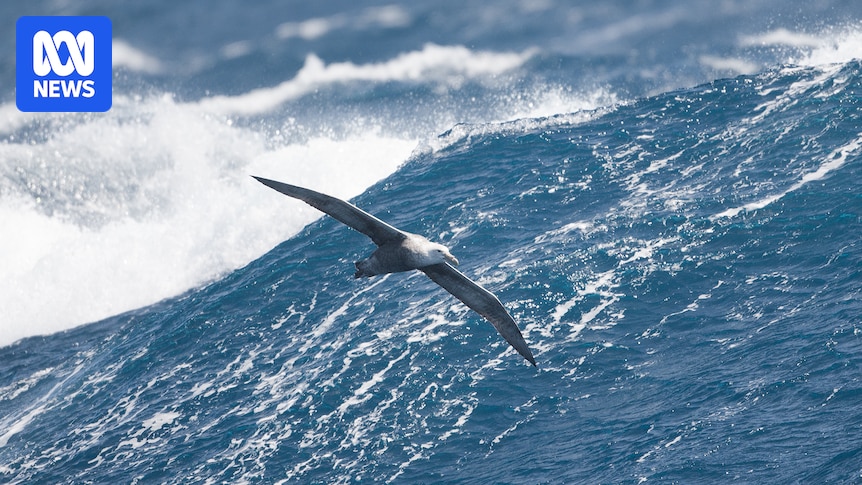
A second case of bird flu has been detected in New South Wales, with a seabird testing positive for the deadly disease on the Mid North Coast.
The federal Department of Agriculture, Fisheries and Forestry (DAFF) confirmed that a second petrel found at Hawks Nest tested positive for the H5 strain of bird flu.
The giant petrel was found dead at Bennetts Beach by a member of the public, who reported it to authorities.
It comes a fortnight after another giant petrel infected with the disease was found at the same beach.
There have now been 15 confirmed or presumed positive detections of H5 bird flu in Australia.
A second petrel found at Hawks Nest has tested positive for the H5 strain of bird flu. (Four Corners: Brendan Esposito)
In a statement, Australian chief veterinary officer Beth Cookson said the risk to human health remained low.
DAFF said in a statement that the cases were all individual wild seabirds found in coastal locations, and all but one had been wild migratory seabirds.
The NSW chief veterinary officer Joanne Coombe said the discovery of the case at Hawks Nest did not signal an escalation of the situation in NSW.
“I think what it does signal is that the enhanced surveillance that we’ve been doing is working, and, of course, our enhanced messaging to the public that they need to report these birds, because this was found and detected on the beach,” Dr Coombe said.
“Of course we are not resting on our laurels, and we are very conscious we need to pick up any spread that may occur to the resident bird population in Australia.
“Up to this point there’s only been one detection in an Australian native bird, that was in a tern in South Australia, but there’s been no evidence of mass mortality of Australian wild birds, or any onward transmission from certainly either of our two cases at this point.“
Dr Coombe said strong surveillance efforts would continue for at least a month.
“Our surveillance operations with Local Land Services and National Parks and Wildlife Service field officers are underway and use innovative spatial mapping tools, decision-support systems and response databases to enable rapid and targeted action,” she said.
“I’d be looking at another four weeks of concerted surveillance, because looking at this from a scientific perspective we are looking at incubation periods for the virus.
“So we like to go past a few incubation periods, so we are confident it hasn’t spread onwards in any capacity.”
NSW’s Acting Minister for Agriculture Yasmin Catley said the detection of the bird “demonstrates the government’s increased and targeted surveillance and monitoring program is working as intended”.
“It is important to note that to date, H5 has not been detected in native birds or commercial poultry flocks in NSW,” she said.
“Our state coordination centre has been operating since June and we are continuing to work closely with the Commonwealth government.”