









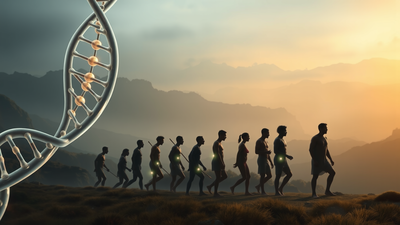
For years, the common belief among scientists was that human evolution had basically slowed to a crawl once we invented medicine, built cities and started farming our own food. If we could grow enough to eat and treat most illnesses, the thinking went, there was no real pressure left pushing our genes to change. A massive new study from researchers at Harvard Medical School has now turned that idea on its head. By analysing nearly 16,000 ancient human genomes stretching back 10,000 years, scientists found that natural selection did not slow down at all, it actually sped up once farming took hold, reshaping hundreds of genes tied to everything from disease risk to basic survival.
What the ancient DNA study actually found
The research, led by geneticist David Reich and his team at Harvard, was published in the journal Nature under the title Ancient DNA reveals pervasive directional selection across West Eurasia. Instead of the handful of clear-cut cases scientists had previously identified, the study uncovered 479 gene variants that show strong evidence of directional selection, meaning specific genetic traits were consistently favoured or pushed out of populations over thousands of years. According to a summary from Harvard’s Department of Human Evolutionary Biology, more than half of these gene variants have known links to disease risk and other traits still relevant to human health today.
How researchers gathered 16000 ancient genomes
Pulling off a study this size took years of groundwork. The Reich Lab spent roughly seven years building a large collection of ancient DNA sequences from people who once lived across West Eurasia, covering what is now Europe and parts of the Middle East. Getting to this scale required essentially industrialising the process of ancient DNA research, using automated systems to extract genetic material from old bone fragments, clean it and prepare it for sequencing on a scale that simply was not possible before.
The computational method that made this possible
Collecting the DNA was only half the challenge. Distinguishing real, meaningful selection from other genetic noise, like migration, population mixing or plain random chance, is notoriously difficult. Ali Akbari, first author of the study and a senior scientist in Reich’s lab, developed a new computational method specifically designed to filter out these confounding factors and zero in on genuine patterns of directional selection across thousands of years of data. Even with these tools, the underlying signal was faint, researchers estimate that directional selection accounts for only around 2 percent of all genetic changes observed, though across an entire genome and ten millennia, even that small share adds up to something significant.
Why farming may have accelerated human evolution
One of the study’s most striking findings is that selection pressure appears to have picked up pace specifically after humans shifted from hunting and gathering to settled farming. Living in permanent, densely packed communities alongside domesticated animals exposed early farming populations to entirely new waves of infectious disease, conditions that simply did not exist during a more mobile, hunter gatherer lifestyle. This shift seems to have forced human immune systems and other biological traits to adapt at a noticeably faster pace than before.
Genes linked to modern disease risk
Many of the gene variants identified in the study carry known connections to conditions people still deal with today, including risk factors for type 2 diabetes and schizophrenia, along with genes tied to immune response and resistance to infections like tuberculosis. Researchers note that while these links are well documented in modern populations, it is not always clear exactly what advantage a particular gene variant may have offered people living thousands of years ago, opening up new questions for future research to explore.
What this means for the future of human genetics
According to Reich, this research essentially allows scientists to assign a specific place and time to the evolutionary forces that have shaped modern humans, something that was largely out of reach before this scale of ancient genomic data became available. As Akbari put it, these new techniques finally make it possible to watch how selection shaped human biology in something closer to real time, rather than relying solely on clues buried in modern genomes. With this dataset alone said to double the size of existing ancient human DNA research, scientists expect it to open the door to a much deeper understanding of how disease, behaviour and basic human biology have evolved over the last 10,000 years.