








Most musicians would be disappointed if their performances were met with silence.
But not Alison Ware.
Every fortnight, the Canberra harp therapist performs for some of her most attentive audience members — rhinos, lemurs, lions and a school of Amazonian fish at the National Zoo and Aquarium.
For the past five years, Ms Ware has been volunteering at the zoo, using music as a form of animal enrichment.
Alison Ware as been volunteering at the National Zoo and Aquarium for five years. (ABC News: Sarah Grieb)
Armed with several different harps of varying sizes, she moves between enclosures, carefully adapting her performance to suit each animal.
“It’s really like humans, some days we feel like music and some days we don’t,” she said.
Alison spends time watching each animal, adjusting the tempo, tone and volume of the music as she gauges their response.
“The primates tend to like the smaller harp with a lighter sound and the rhinos like deeper tones with a larger harp,”
she said.
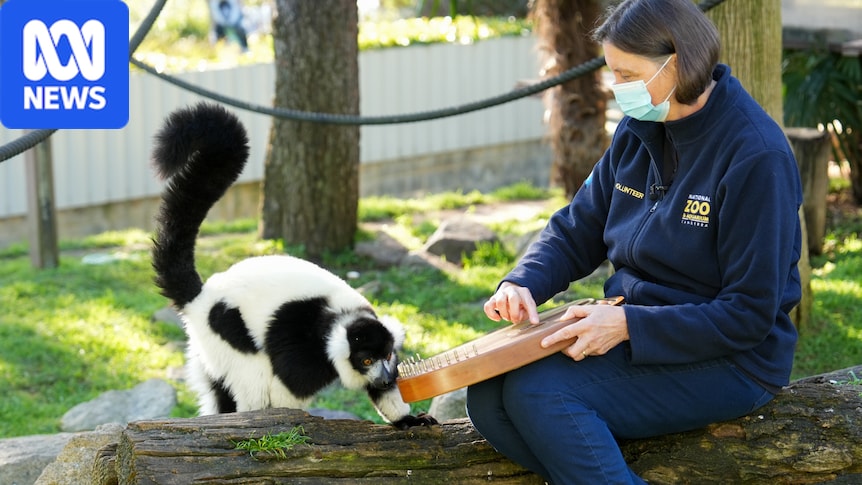
Curious lemurs come up close when Ms Ware plays the harp inside their enclosure. (ABC News: Sarah Grieb)
Some animals wander over to investigate. Others simply settle where they are, seemingly soothed by the gentle melodies.
But Ms Ware’s audience extends beyond furry and feathered animals. Even the aquarium’s South American pacu often swim toward the music as Ms Ware plays.
“Most of the animals fall asleep or they’ll come closer to listen to the music,”
she said.
The South American pacu often swim towards the music as Ms Ware plays. (ABC News: Sarah Grieb)
A calming soundtrack for curious lemurs
Head primate keeper Olivia Ware, who is also Alison’s daughter, said her mother’s visits had become a welcome addition to the lemurs’ enrichment program.
“Of course, being in the zoo, the lemurs already hear a lot of different sounds,” she said.
“But it’s nice to bring the harp in as it’s such a unique auditory enrichment. It’s also very calming for them as well.“
Head primate keeper Olivia Ware says the lemurs have shown a preference for the smaller of the two harps. (ABC News: Sarah Grieb)
Olivia Ware said the lemurs’ response was often immediate.
“Normally they just sit in the sun, curl up in a ball and listen to the harp,”
she said.
Over time, the keepers have discovered the lemurs have their own musical preferences.
“They tend to like the smaller of the two harps. Sometimes the larger harp can be a little bit scary for them,” Olivia Ware said.
Alison Ware plays a number of different harps of varying sizes. (ABC News: Sarah Grieb)
Sharing music beyond people
Away from the zoo, Alison Ware has spent more than 20 years working as a clinical music therapist, using the harp to support patients and families in palliative care wards, emergency rooms and aged care facilities.
She said bringing her music to animals felt like a natural extension of that work.
“I’ve always enjoyed spending time with animals,” she said.
“I use the harp in health care, and I really felt I wanted to do something a little bit different with my music.“
Ms Ware’s playing attracts the attention of an oryx at the zoo. (ABC News: Sarah Grieb)
Five years in, Ms Ware said she still looked forward to every visit, never quite knowing which animals would be in the mood for a concert.
“I absolutely love it,” she said.
“I think I get as much back as I give to the animals. It’s a real privilege.“