





We’ve come a long way since it was Pauline Hanson who didn’t know the meaning of big words.
When the Preferred Prime Minister (patent pending) bowled up her prescription at the Press Club that Australia should really be a “monoculture”, she triggered a national bout of semantic debate so farcical that it could absolutely work as a Christmas pantomime or interpretive dance. “Please Explain: The Monoculture Remix, feat. Karl Stefanovic!”
What is a monoculture?
Not a single millimetre of Canberra-based navel went ungazed-upon.
Asked for his “yay or nay” on a monoculture, Nationals leader Matt Canavan confessed that he’d “never heard of it before, really, until last week”, but he didn’t like the sound of it.
(And that’s fair enough. “Monoculture” does sound a bit like something infectious quietly multiplying in a Petri dish.)
Ted O’Brien, former deputy Liberal leader and current shadow minister for nobody-can-remember, at least leaned in to the absurdity of the moment.
“Who’s in the mono? I don’t know,” he asked the audience at the National Press Club.
“Who decides who’s in the mono? I mean, I assume it’s … government, right?”
Former prime minister Tony Abbott said: “Australia has a Celtic culture, we have a foundational Judeo-Christian ethos. That should never change.” (AAP/Joel Carrett)
Current deputy leader Jane Hume reminded us that Australia has a long and proud history of successful migration. Also that she has a Greek partner.
Tony Abbott, whose recent ascension to the Liberal Party presidency was accompanied by nervous assurances from Liberal moderates that it was a largely non-speaking role, went on Sky News to a) prove them wrong and b) essentially agree with Hanson.
In the course of a merciless cross-examination conducted by his former chief of staff Peta Credlin, Abbott averred that “Australia has a Celtic culture, we have a foundational Judeo-Christian ethos. That should never change.”
“Migrants choose Australia precisely because they like what they see,” he said. “And if we change ourselves to suit the migrants, we’re actually letting them down as well as ourselves.”
Taylor asks journos to throw him a rope
But it was poor Angus Taylor — current Liberal leader and, I guess, shadow leader of the opposition — who found himself in linguistic quicksand up to his fetlocks.
In a transfixing press conference on Wednesday, Taylor seemed unable not only to define monoculturalism, but also to say what his views on multiculturalism were, in a drawn-out encounter so disorienting that he was eventually obliged to ask journalists to throw him a rope.
In a transfixing press conference on Wednesday, Angus Taylor seemed unable to define monoculturalism. (ABC News: Ian Cutmore)
Pauline Hanson herself, meanwhile, popped back into the chat regularly over the week to offer helpful definitional prompts including that Japan is a monoculture.
Now, this in itself should have been a clue that it was well past time for everybody to go home for a lie down.
Because if there’s anything more hallucination-inducing than the woman who 30 years ago had her undies in a bunch about too many Asians suddenly fancying we should be a bit more like Japan, I don’t care to imagine it.
And yet. And yet. Unbelievably, there were still players willing to trudge out and engage, seriously, with the question of whether we should be Japan.
Canavan, for instance, is a hard no on being Japan: “They have very strict enforcement of a single culture in Japan. It’s a great country, I love going there, and good luck to the Japanese, but that’s not who we are.”
Taylor, too, did not think we should be Japan. “I want Australia to look like Australia.”
It didn’t matter, because by Thursday Hanson was saying that what she really meant by “monoculture” was the Socceroos, and how disgusting it was that her original comments had been taken out of context. And off we went on whether the Socceroos are a monoculture, and whether wearing matching uniforms was a monoculture, and so on.
The Hanson playbook
This is the three-step playbook that Hanson has perfected.
Step One: Say something baffling. Step Two: Dignified silence while every Tom, Dick and his dog goes berserk about how ridiculous it is. Step Three: Reappear to complain that the establishment is picking on her.
Each of the three phases yields excellent video content for the One Nation social media operation, pumping out round-the-clock reminders that Hanson is completely different from ordinary politicians, who have obligingly contributed copious supporting material during Step Two.
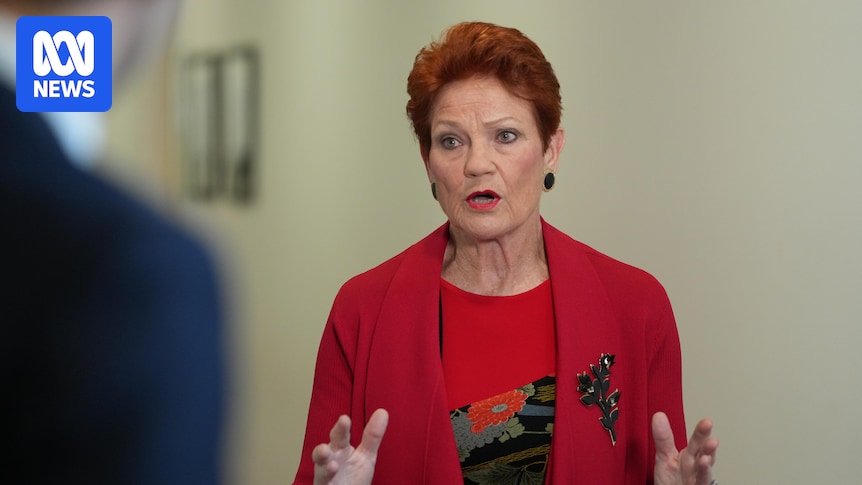
By Thursday Pauline Hanson was saying that what she really meant by “monoculture” was the Socceroos. (ABC News: Darryl Torpy)
What’s surprising isn’t that Hanson would employ these tactics. They’ve proved very effective in various other representative democracies whose constituents are in a comparable state of pissed-off-ness. She’s not stupid. What’s genuinely surprising is that so many of her opponents are happy to serve as indentured workers down the One Nation content mines. How is this not staggeringly obvious to all concerned?
I mean: Guys. If you’re not paying for the product, you are the product, right?
But this week-long embarrassment — probably the silliest round of national semantic beard-stroking since John Howard went to the mattresses 20 years ago on the difference between “sorry” and “apology” — obscures a deeper and more alarming reality.
Which is that we seem somehow to have arrived in a new dimension in which it is thoroughly unremarkable for a group of federal politicians who are almost universally white (and they really are, with all due respect to Hume’s Hellenic beloved) to stand around chewing the fat about which of Australia’s immigrant groups are okay and not okay, and whether they should be allowed to speak another language at home, while the people they’re talking about are literally standing right there.
Not an abstract word game
This is not a fun abstract word game. These are our own people whose merits our leaders are casually discussing. Not since the postal survey, which invited Australians to vote on whether being gay was gross or grouse (Survey says: “Grouse!” Book a wedding venue, fellas!) have we seen such an overt and indeed blithe public deliberation on whether a minority group should be treated like, you know, “normal” people.
And as for the weird détente that was achieved by the end of this week — an awkward acceptance that nobody can quite work out what a monoculture is but we definitely all defer to the ancient Australian consensus that the Socceroos are awesome — dear God. Are we that dense? Are our memories that short? Do we really not remember how this story goes?
I guess this is a month where a horrific alleged attempted beheading committed by a Sudanese refugee set off race riots in Belfast, with citizens going house to house to find and drag out immigrants to defray the possibility of further violence. And if the people of Northern Ireland can convince themselves that chopping bits off people is an imported tradition, then maybe global attention spans are even worse than we thought.
So let’s revisit the story-arc of the Socceroos.
As the timely SBS documentary Wogball spelled out this week over 55 minutes, soccer in this country was for a long time viewed as a menace. A threat to the proper football codes. The preserve of foreigners and homosexuals. Criminals, even. A driver of sectarian and ethnic violence. And it was simultaneously — as Matildas great Moya Dodds vividly recalled — an entirely male preserve.
Loading
What happened? Well, what happened is what usually happens. Ethnic divisions grow smaller in the rear vision mirror as new generations are born and — in the case of Australian soccer — a new national competition emerges based more on geography than on specific diaspora groupings.
The male players, meanwhile, after decades of rank pay inequity, in 2019 stood shoulder to shoulder with the women of the Matildas to demand they be paid more fairly. The revenue-sharing model introduced in the resultant landmark agreement has gone on to benefit male and female players alike as the Matildas’ popularity has boomed. When we ask ourselves what we like about the Matildas and the Socceroos today, is it… maybe … this? Is this the bit we like? People who are different from each other sorting their shit out and building something cool together? Is that, perhaps, what it means to be Australian?
When the ABC conducted its mammoth Australia Talks survey in 2019, more than 50,000 respondents were asked what attributes were the most significant elements of “being Australian”. They were given 10 options.
“Being white” ranked dead last in the survey.
“Being born in Australia” ranked second-last.
What came first?
“Respecting Australia’s laws and institutions”.
Yep: This nation of larrikins and bushrangers, it turns out, loves an orderly queue and respect for rules.
And our migration history shows clearly that we are suspicious of newcomers who we fear have not yet learned the ropes.
When she was running her Ipswich fish and chip shop, Hanson used to go to the fish markets early in the morning to buy stock. She was the first businesswoman — Hanson wrote in her 2007 memoir — to enter the fish market’s overwhelmingly male preserve.
She got along well with the Greek migrant fishermen who stocked the market, sharing ribald jokes and a collegiate sense of fun. But as more Vietnamese-born migrants started to move into the industry, she recalled, they were different. They kept to themselves. Didn’t speak English. It made her feel uncomfortable.
When Hanson delivered her first speech in 1996 after being elected to Parliament, she warned of an Australia “swamped” by Asians, setting up their own cultural enclaves; was it these uncommunicative Vietnamese fishermen she had in mind? These “bad” migrants who didn’t speak English and huddled together, unlike the “good” Greeks who loved a laugh like she did?
In the decades since, Hanson has stopped worrying about Asians. Not because they’ve disappeared; they haven’t gone anywhere. Most likely, it’s because they’ve ceased to be noticeable. Asian faces have started looking like Australian faces. An Aussie accent from an “Asian” face is profoundly unremarkable. These days, it’s Muslims the Senator is worried about.
What’s the difference, for Hanson, between a good migrant and a bad migrant? On the available evidence, the answer seems to be “about 20 years”.