









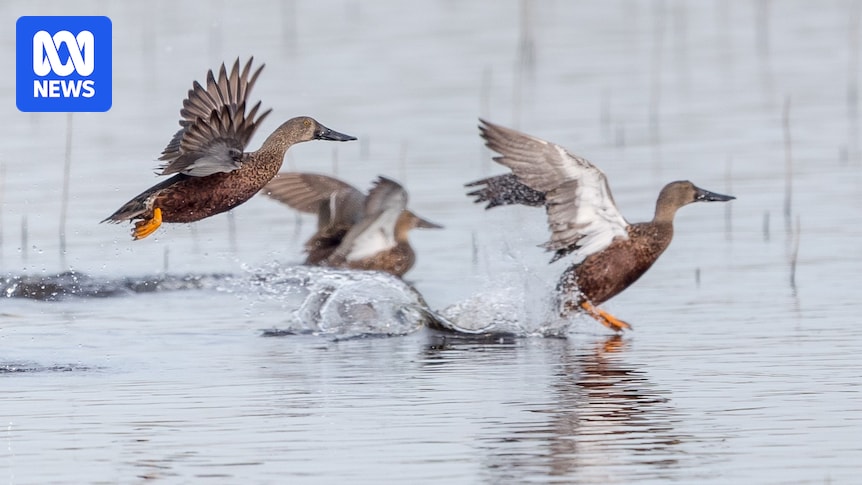
Avian influenza represents an existential threat to Australia’s native duck population, according to Birdlife Australia waterbird scientists.
The H5N1 virus could potentially put further pressure on the 15 indigenous duck species already menaced by habitat degradation, urban sprawl and mistaken identity by hunters.
Two migratory seabirds — a northern giant petrel and a brown skua — found near Esperance, Western Australia tested positive to the virus, effectively announcing H5N1’s arrival on the Australian mainland.
There has been a further confirmed case in South Australia.
An Australian wood duck. Native Australian ducks face many threats. (Supplied: Peter Rowland, PRPW)
Birdlife Australia ecologist Ryan Kilgower said the reduction in refuge wetlands caused by human encroachment put native ducks and other wetland birds at far greater risk if infection takes hold.
“With waterbirds over the past few decades, a lot of the decline is to do with environmental changes due to expansion of agricultural land and urban settlement, whether that’s large cities or regional towns,” Mr Kilgower said.
Ryan Kilgower says birds that do not adapt well to environmental change could be most at risk from bird flu. (Supplied: Birdlife Australia)
“Other factors such as drought, and how much water is taken out of the environment for farming, especially in south-eastern Australia, has seen a further decline in species.
“What happens is some birds adapt well but others don’t adapt at all.”
Mr Kilgower said the birds that did not adapt well could be most at risk.
“These certain species that don’t adapt don’t just decline in population numbers, they also become confined to their remaining refuges,” he said.
“If bird flu gets into those last refuges, then you end up losing those species.“
Diving duck numbers
None of Australia’s 15 duck species are classified as threatened nationally, however, the blue-billed duck and freckled duck are classified as endangered in Victoria, while the musk duck and blue-winged shoveller are categorised as vulnerable.
Birdwatcher and animal rescue volunteer David Mould said the overall trend was heading in a worrying direction.
“If you lump them all together, they are not threatened yet, but they have been in decline over the past 30 years,” Mr Mould said.
“The East Australian Waterbird Survey has found that waterbirds in general are in population decline, and that is data which has been collected for 40 years.“
David Mould says there is a worrying trend happening with native ducks. (Supplied: David Mould)
The survey, which is coordinated by the Centre for Ecosystems Science at the University of NSW and directed by Professor Richard Kingsford, analyses about 2,000 wetlands each year.
The survey is conducted from a light aircraft and measures the abundance of 50 waterbird species, including ducks.
Observations represent a proportion of the entire population, with changes over time reflecting a proportional decline in total numbers.
The number of ducks observed had reduced from close to 900,000 in 1984 to fewer than 100,000 in 2022, although there has been a slight increase since 2023.
A shrinking number of wetlands have become a refuge for Australian native ducks, including the pink-eared duck. (Supplied: Peter Rowland, PRPW)
Hunting impact
Duck hunting is permanently banned in New South Wales, Queensland, Western Australia and in the ACT, but recreational hunting is permitted in Victoria, South Australia, Tasmania and the Northern Territory during limited open seasons.
While Mr Mould agreed the biggest immediate threats to native ducks were habitat loss, climate change and encroaching human civilisation, he argued duck hunting put further pressure on increasingly isolated populations.
“We can confirm, based on government estimates, more than 550,000 ducks killed [each year] from recreational shooting, with a further 20 per cent wounded to die later,” Mr Mould said.
“While it is not the main cause of decline, it adds an extra burden.”
Australian shelducks in flight. (Supplied: Peter Rowland, PRPW)
Even in states where duck hunting is allowed, some native species remain protected, such as the musk duck, freckled duck and blue-winged shoveller in Victoria.
But Mr Mould said many protected ducks were killed each year, often by inexperienced or lazy hunters.
Know your native ducks
Blue-billed duck
Blue-billed duck (Oxyura australis). (Supplied: Geelong Duck Rescue)
One of the smaller ducks. The male has a blue bill that becomes brighter during breeding season and its plumage changes to brown with a glossy black head at the same time of the year. During the non-mating season, they turn dark grey. Females are dark brown all year.
Australasian or blue-winged shoveller
Blue-winged shoveller (Spatula rhyncotis). (Supplied: Geelong Duck Rescue)
Has an odd-shaped bill, shaped like a shovel, which for rummaging through mud for insects. The male’s head and wing leading edge is blue-grey, while the female is mostly mottled brown.
Pink-eared duck
Pink-eared duck (Malacorhynchus membranaceus). (Supplied: Geelong Duck Rescue)
Has a small pink patch behind its ear, hence its name, despite the far more obvious zebra stripes that help with identification. They filter water through fringes in their bill to scoop out the tiny organisms that form their diet. Smallest of all the ducks and population numbers are very low.
Musk duck
Musk duck (Biziura lobata). (Supplied: Geelong Duck Rescue)
The male has a musk-filled pouch below his bill that becomes larger during breeding season. Otherwise, males and females have a similar brown-grey appearance. Early colonists were ordered not to bring one on board a ship for food because of the smell of the musk.
Pacific black duck
Pacific black duck (Anas superciliosa). (Supplied: Geelong Duck Rescue)
Has a black stripe over the eyes, which looks like a mask. Currently interbreeding with an introduced duck species, the mallard, which is creating a lot of hybrids and putting the local species at great risk of extinction. Hybrids can be identified by their orange legs.
Hardhead
Hardhead duck (Aythya australis). (Supplied: Geelong Duck Rescue)
Named for their rounded heads, these small ducks are mostly brown. Also known as the white-eyed duck, or Punkari, which is an Indigenous name for them.
Wood duck
Australian wood duck (Chenonetta jubata). (Supplied: Geelong Duck Rescue)
Also known as the maned goose and found across much of Australia. This species is often seen in parks or lakes. They regularly sleep in trees, surprising some people. Males can be identified by their brown heads. It is not closely related to the wood duck from North America (Aix sponsa).
Freckled duck
Freckled duck (Stictonetta naevosa). (Supplied: Geelong Duck Rescue)
Adults are dark grey with small white flecks. Males often have red at the base of their bill, while the smaller female has a grey bill.
Grey teal
Grey teal (Anas gracilis). (Supplied: Geelong Duck Rescue)
Males and females have a similar mottled brown colouring, with green flashes on their wings. They are migratory and can be found across Australia apart from the depths of the West Australian desert.
Chestnut teal
Chestnut teal (Anas castenea). (Supplied: Geelong Duck Rescue)
Closely related to the grey teal, which the female looks similar to but is larger. The male, however, is a rich chestnut colour with a green head. Chestnut teals are found across southern Australia.
Mountain duck or Australian shelduck
Mountain duck (Tadorna tadornides). (Supplied: Geelong Duck Rescue)
Largest of Australia’s ducks. Ducks are essentially monogamous, but the mountain duck goes to some lengths when mourning the loss of a partner, often circling the body, or where they last saw their partner, with repeated mournful cries. They honk more like a goose than a duck.
Radjah Shelduck
Radjah shelduck (Radjah radjah). (Supplied: Peter Rowland, PRPW)
A distinctive, mostly white-duck with a white head, and brown-to-black back and wings. Its primarily coastal range extends from northern Australia into New Guinea.
Plumed whistling duck
Plumed whistling duck (Dendrocygna eytoni). (Supplied: Peter Rowland, PRPW)
Tall, with a long neck. More often found in northern Australia, although their range extends down the eastern coast into Victoria. Can be identified by its cream-coloured plumes (feathers) along its flanks.
Wandering whistling duck
Wandering whistling duck (Dendrocygna arcuata). (Supplied: Peter Rowland, PRPW)
Another tall, long-necked variety that has a range that includes Pacific island nations such as Indonesia and Papua New Guinea. Its plumage is darker and redder than the plumed whistling duck.
Spotted whistling duck
Spotted whistling ducks (Dendrocygna guttata). (Flickr: Spotted Whistling-duck/Jerry Oldenettel/CC BY-NC-SA 2.0)
Males and females can be distinguished from other whistling ducks by their white spots on their otherwise brown plumage. Their range spreads from Australia into the Pacific up to the Philippines.