







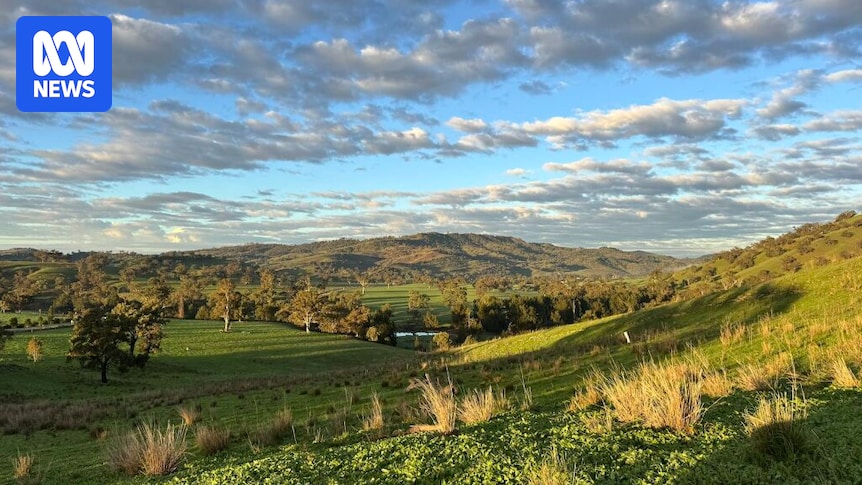
A splash of green has returned to paddocks across New South Wales that were bare and barren just weeks ago, but the drought isn’t over.
The stereotypical scenes of drought: dusty landscapes, dry dams and livestock crowding around hay and grain has been the case across much of the state throughout 2026.
But now, farmers are facing a different challenge. A green drought.
A green tinge is returning to many parts of the state, but farmers say they are not out of the woods yet. (ABC: Ross McLoughlin)
What is a green drought?
A brown drought, masked by deceptive green grass.
You’d be forgiven for thinking the short green shoots, or green pick, coming through mean a drought is over, but it is just the first step in recovering.
After falls of about 100 millimetres in the space of a week last month, grass is there and it is green but it lacks nutritional value, because the soil is still depleted.
And so are farmers’ bank accounts.
Farmers are continuing to handfeed stock, despite green grass peeking through. (ABC Rural: Amelia Bernasconi)
Animal nutritionist Jill Kelly said the deceptive green grass could cause livestock to lose condition quickly.
“That green pick looks great but it’s probably 80 to 90 per cent moisture, so it’s water,” Dr Kelly said.
“It’s like trying to live on watermelon.
“You’ve got to eat a huge volume of it in order to maintain yourself, particularly at this really critical time of year where we’ve got a lot of lambing, calving and lactating animals.”
On top of the energy needed for females to produce milk and raise offspring, Dr Kelly said all animals were at risk of losing weight as they “chased feed”, walking to eat more to try to feel full.
“So they’ll probably go backwards.”
Jill Kelly says she understands the temptation to put livestock back on pastures, but is urging farmers not to act too quickly. (Supplied: Jill Kelly)
Dr Kelly is urging farmers against the temptation of letting animals back on paddocks too quickly.
“I hate the thought of letting them out, letting them chase pick, letting them lose weight, running out of feed in three weeks anyway and then having to feed them again and they’ve dropped a few kilos in the process, but I do get the temptation.
“Usually when you get rain you get to stop feeding, but I’m just not sure that we’re quite there this time because of the time of year.“
She said grazing on short grass stopped the plants’ ability to grow properly.
“Imagine every leaf is like a solar panel and so with limited sunlight, if we’ve got some overcast or some colder winter June days, we really want every leaf on that plant to be doing its absolute maximum to capture sunlight and to get plant growth,” Dr Kelly said.
The landscapes across much of drought-hit NSW has dramatically changed in recent weeks. (ABC Rural: Amelia Bernasconi)
Why is it so tough for farmers?
In the first four months of this year, more than half a million head of cattle were sold through the saleyards, with many areas setting new daily records with the incredible volume of cattle offloaded from farms.
Dr Kelly said the recent rain had come about two months too late and made things even more complex.
“We’re finding it is actually more difficult to make decisions with livestock right now than we were three months ago,” she said.
“I think a blazing drought is easier to manage than this green, in-between, no man’s land that we’ve currently got.“
Many farmers have been selling off cattle due to the intense dry conditions. (ABC Rural: Amelia Bernasconi)
While deceiving green grass lacking nutrients is challenging for livestock producers, it is no walk in the park for grain growers either.
Soil and pasture agronomist Drew Walsh said the naked eye could not spot all the changes that happen to soil during a dry spell.
Organic matter, plant residues and some soil fungi break down, releasing a fatty, waxy compound, which then coats the soil particles.
“It literally repels water,” Mr Walsh said.
The green has been a welcome sight, but farmers know it is still a long road ahead. (ABC Rural: Amelia Bernasconi)
“It takes a bit of time and sustained gentle soaking to break down that waxy barrier but a sudden, heavy downpour on hydrophobic soil just causes massive runoff and erosion and leaves our subsoil dry.”
While many cropping farmers have taken an educated punt on sowing a late winter crop off the back of recent rain, they will need much more through the season for the root systems to grow and support healthy crops.
“After a big rain hits a dry seed, the clock starts ticking,”
he said.
“It’s a race between the seedling trying to punch its way up and the sun drying out the topsoil.”
Drew Walsh says moisture in the top layers of the soil is disappearing quickly, with ongoing warmer-than-average temperatures. (Supplied: Drew Walsh)
The rain activates the seed’s metabolism, initiating germination.
“It shoots down a radical, which is the primary root, and sends up a shoot.
“And without follow-up rain to push moisture deeper to connect that topsoil moisture and the subsoil reserves, that tiny little fragile root system hits a wall of bone-dry, hard subsoil.“
How are farmers managing?
Cattle farmer Susannah Simpson runs Fernlee Station at Ashford, in northern NSW.
While she is enjoying a greener picture out the window, she knows the drought is far from broken.
“I’ve got a beautiful sea of green, but no real grass growth and I don’t expect to see that in winter. We’ll see that in spring,”
she said.
Susannah Simpson is grateful her view has changed from dusty paddocks, but knows she is not out of trouble yet. (ABC Rural: Lara Webster)
She is continuing to sell cattle to take pressure off her property and navigate hefty feed bills, while the cattle market is strong.
“I’m still strategically putting cattle along the road.
“I’m trying to get through with some of my core breeders to come out the other side so that I don’t have to restock.”
Genetics are built up over generations to suit each property’s business and climate, so to lose core breeding cows is a major setback that comes at significant cost.
Susannah Simpson has been droving cattle along the road where there is more feed than in her paddocks. (ABC Rural: Lara Webster)
Drought could worsen through winter
NSW Department of Primary Industries and Regional Development (DPIRD) agricultural climatologist Anthony Clarke said while recent rainfall had been welcome, people needed to be aware of a false recovery.
“We’re seeing good soil moisture reserves start to build again … but that can be temporary,” Dr Clarke said.
“If you go back through history and look at drought recovery, it’s a really risky window at this early stage.
“It can be very short-lived.”
The NSW DPIRD forecast shows drought is likely to worsen by the end of August in north-east NSW. (Supplied: NSW DPIRD)
The Bureau of Meteorology has declared El Niño active, and the NSW DPIRD’s drought forecast shows conditions will likely worsen by the end of August, with some areas of the Hunter and Mid North Coast in “intense drought”.
“This recent rainfall is providing a bit of green pick, but you’ve got to recognise the run of conditions the north of the state had was a very harsh, sharp drought entry into quite a severe pasture deficit,” he said.
“We’ve still got a long way to go to turn that around.“
Additional reporting by Lucy Thackray and Lara Webster.