







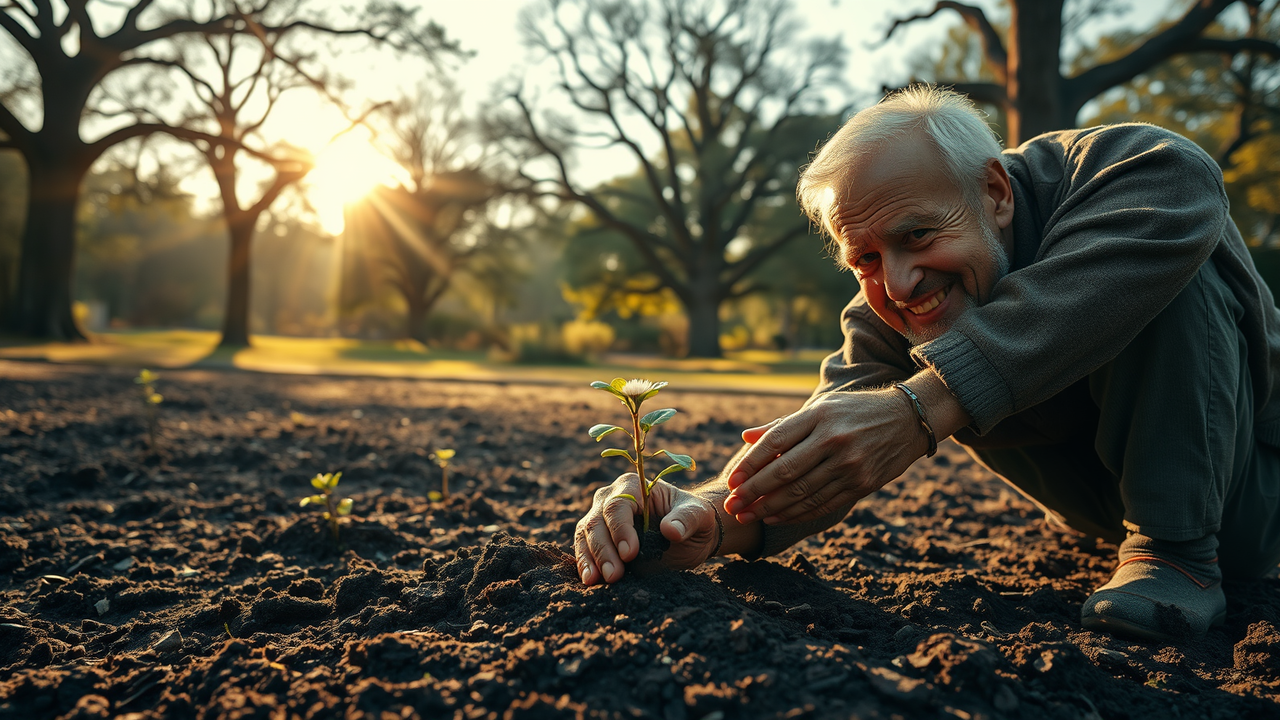
Think about something in your life that you use every day without thinking about who built it. A road. A hospital. A school. A park with trees old enough that no living person remembers them being planted. Somebody made a decision, at some point, to begin something they knew they would never see finished. They put in the effort anyway. They did not do it for the reward of sitting in the shade. They did it because the shade would eventually exist, and that was enough.This proverb is about that decision. And its real origin turns out to be more interesting than the label it usually travels under.
Proverb of the Day
“A society grows great when old men plant trees whose shade they know they shall never sit in.”
The question of where it actually comes from
The saying is almost universally described as an ancient Greek proverb. Politicians quote it as Greek wisdom. It appears on countless platforms under that label, repeated so many times that the attribution has long since stopped being questioned.A search through the written record, however, quickly reveals that results vanish before the mid-1980s. The “old Greek proverb” is hardly heard of before 1993, when it began appearing in the Congressional Record of the US Congress. Ronald Reagan used a version of it in 1983. Before that, a 1989 article attributed a similar line to motivational writer Dennis Waitley. And the earliest traceable version appears in a volume of moral writing by a Quaker author in 1951.As a Greek, one commentator noted, there is no such Greek proverb in the original language. No ancient text has been found containing it.There is, however, a much older version of the same idea worth knowing about. A Rabbinic tale from around the 4th century, recorded in the Talmud, tells of the sage Honi who came upon an elderly man planting a carob tree. Honi asked whether the man expected to live long enough to eat its fruit. The man replied simply: just as my fathers planted for me, I plant for my sons.The label may be recent. The spirit behind the saying is ancient.
What the proverb is really about
The image is precise enough to carry its meaning without assistance, but the layers are worth examining.The old man planting a tree knows two things simultaneously. First, that the tree will one day provide shade. Second, that he will not live to sit in it. He plants it anyway. Not because he is indifferent to his own comfort but because the shade itself is worth creating even when the creator will not benefit.This is not about making money, gaining recognition or achieving fame. It is about creating value for other people’s benefit. Teachers educating students, parents nurturing children, researchers carrying out studies and leaders contributing to society are all planting trees. They might never experience the full benefits of their labour, yet their contributions shape future generations.
Why this is harder than it sounds
Most human motivation runs on some form of return. People work for wages. They are kind in the hope of kindness back. Even generosity often carries a quiet hope of being seen and appreciated for what was given.The tree planter in this proverb has cut all of that away. There is no return. There is no acknowledgement waiting at the end. There is only the shade, belonging to someone else, in a future the planter will not reach.This requires a specific expansion of concern beyond the self, beyond people currently alive, into a future that is entirely abstract. It is easy to say you care about future generations. It is considerably harder to make real sacrifices on their behalf when those sacrifices produce nothing you will personally experience.
What it means for society
The proverb is not simply about individual generosity. It is about what makes a society function across generations.Every institution that exists today was built by people who knew they would not see it complete. Every long-term investment in education, infrastructure, culture and the environment depends on people making decisions whose full benefit will arrive long after they are gone.Great leaders often make decisions based not only on present needs but on future consequences. They understand that lasting progress comes from creating opportunities that will continue benefiting society long after their own time. Each person receives the fruits of someone else’s labour as their heritage. However, each generation also contributes something to the development of future generations.The inverse is also true. A society in which people plant only what they will personally harvest, and build only what they will personally use, begins to shrink. Not immediately. But gradually, the shade disappears, because nobody was willing to plant for someone else’s afternoon.
Why this proverb still holds true
Whatever its precise origin, the saying has earned its place in the conversation because the choice it describes is one every generation faces and most find difficult.It is easier to consume than to build. Easier to sit in shade than to plant trees for people you will never meet.The proverb does not demand this of anyone. It simply names what greatness, in any honest sense, actually requires. The willingness to do something whose full reward belongs entirely to someone else. To plant the tree. To not wait for the shade.