



Even six years out from the Brisbane 2032 Olympic and Paralympic Games, there is a sense of anticipation in the air.
Opportunities for places like Brisbane to prove they are “world cities” do not come around every day, and when they do, it is essential to seize the moment.
But it’s not the first time Queensland’s capital has hosted an event of global significance.
The world came to Brisbane’s doorstep in the late 1980s for a ‘specialised exposition’: a world’s fair coinciding with Australia’s bicentennial celebrations.
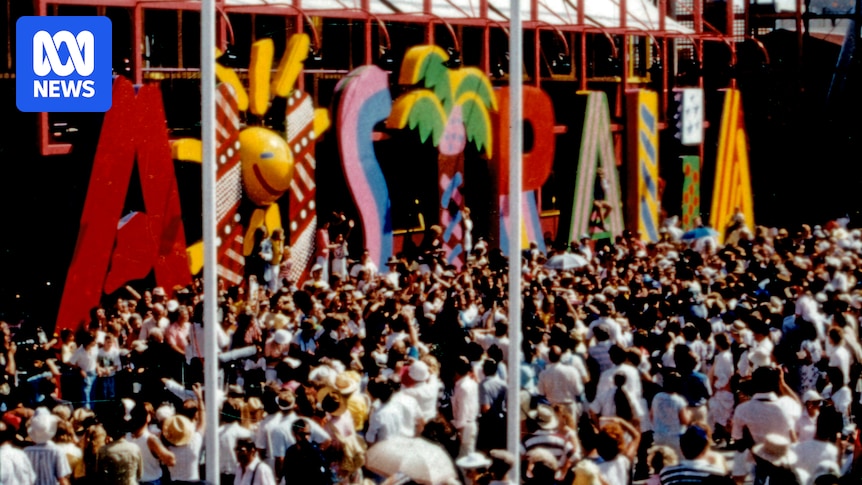
More than 15 million people attended Expo ’88 over its six month run. (Supplied: Queensland State Archives)
The expo’s motto was Leisure in the Age of Technology, an ethos that created a range of infrastructure projects and kooky spectacles all centred on the expo’s home at the redeveloped South Bank.
Opened by Queen Elizabeth II in April, 1988, more than 15 million people would pour through the gates over the coming months.
‘Cultural change’
Expo historian and enthusiast Jason Ford said people at the time did not fully understand “what was going to happen”.
“I don’t think people were fully aware of the size of it, how much international interest it would generate,” he said.
Jason Ford says the expo “broadened people’s horizons” and brought the world’s culture to Brisbane. (Supplied: Queensland State Archives)
Mr Ford said Expo ’88 brought to the city a unique cultural shift and “broadened people’s horizons”.
“It was bringing cultures to Brisbane that maybe people who had never travelled outside Australia weren’t familiar with.
“For young people to know what it was like: it was literally the world’s culture coming to one place in Brisbane.”
Expo ’88 was Australia’s first real “world event”, with more than 15 million people attending over six months. (Supplied: Queensland State Archives)
Changes needed to be made to Brisbane’s food safety codes to enable people to dine al fresco.
“A lot of that had to happen at expo, people sitting outside because we had these big shade sails and everything there,” Mr Ford said.
“So it was a cultural change. There was something born from it.“
Mr Ford said planners for the 2032 Olympic and Paralympic Games would be well-served by taking lessons from the transformation of South Bank after the expo finished.
“Probably the crown jewel of Expo’s legacy is the Parklands, even though that probably wasn’t really the initial intent,” he said.
“The lesson would be that the legacy would need to be something useful in the long term in regards to infrastructure, whether it be roads, train lines, public transport.”
South Bank ‘put people first’
Before the expo transformed the location, South Bank was a very different place.
Associate professor at the University of Queensland’s School of Architecture, Design and Planning, Stephanie Wyeth sat on the board of the South Bank Corporation between 2016 and 2022.
She said the shifting of shipping equipment further down the river during the 1980s had left the industrial district derelict and unused.
The south bank of the Brisbane river was revitalised for the expo, after remaining derelict and unused for years. (Supplied)
“This was seen as a derelict or troublesome part of the city,” Ms Wyeth said.
“It was the time of Joh Bjelke-Petersen and that government was really looking at development opportunities for the city, so you started to see interest in renewal that side of the river and how it could contribute to the city.”
If you need a signpost for how different the world was for Expo ’88, it was the final world exposition to be attended by the Soviet Union before its dissolution. The world was getting larger — and smaller.
“At that time that Expo came around, we were bidding to be part of connecting ourselves to the rest of the world and bringing along with that economic and tourism opportunities,” Ms Wyeth said.
Plans changed over the years after Expo ’88 as South Bank became what it is today. An original plan, focused more around apartment living and commercial interests, never quite got off the ground.
There were fears wholesale development of the site would create a competing CBD, and besides, Queenslanders had their own ideas about how the space should be used.
Ms Wyeth said there were lessons to be learned with the Olympics approaching.
“That whole idea of democratising the space … people want a say on how those spaces operate post-Games,”
she said.
“We have an opportunity to, whilst we’re building some of these major events precincts and the other connected parts of the city … to really put people first and think about what are the types of experiences people are going to have.
South Bank Parklands has become one of Australia’s most beloved precincts. (ABC News: Curtis Rodda)
“Post the games, governments and stakeholders are going to have to be open to the idea that people want a say on what’s next.”
Expo ’88 remnants are still littered around South Bank today, including the Nepalese peace pagoda, and the pond and garden from Japan’s presentation are still situated in the Mount Coot-tha Botanic Gardens.
‘Don’t let stuff go’
Stefan Ackerie pictured with the Sky Needle at Expo 88. (Supplied)
Nestled amongst apartment buildings which now largely obscure it from the skyline, the Skyneedle rises to a height of 88 metres over South Brisbane.
It’s by no means the most famous of the towers built for expositions, with the Eiffel Tower a remnant of Paris’s 1889 event.
But, sitting on the shores of the Brisbane River throughout Expo ’88, it captured the imagination of Queensland hairdressing magnate Stefan Ackerie.
The Skyneedle was slated to be shipped off to Japan Disneyland at the end of Expo ’88, but it was instead saved in a final-hour purchase by the mononymous Stefan.
“[I] couldn’t imagine allowing Brisbane to part with something so monumental and so historic that became such a part of Brisbane,” he said.
“I was in Italy, France … and all you see there is monuments and landmarks. And I think subconsciously … it had some kind of an impact on me.”
Stefan said Brisbane “will become a world city after the Olympics”.
The Skyneedle dominated the south bank of the Brisbane River during Expo ’88. (Supplied)
“After all the hype has calmed down”, he said creations for the 2032 Games should remain in Brisbane.
“Don’t let stuff go. It belongs to the city.
“There’s always people who are passionate about [these] things.”
Another piece of the Expo ’88 legacy was similarly saved by passionate Queenslanders, with the expo’s centrepiece ‘Australia’ signs found and rescued in 2018.
They’re now sitting in the Caboolture Historical Village, north of Brisbane.
The Australia signs remain in place at the Caboolture Historical Village north of Brisbane. (ABC Radio Brisbane: Hailey Renault)
Other famous Expo creations were not so lucky. The monorail was pulled down after the expo, with one of its carriages living on at Sea World, and others shipped to a theme park in Germany.
Stefan regretted the Skyneedle didn’t remain in pride of place by the river, but he was relieved it at least stayed in his favourite place.
“I think when God made Australia, he made Brisbane for himself.”