






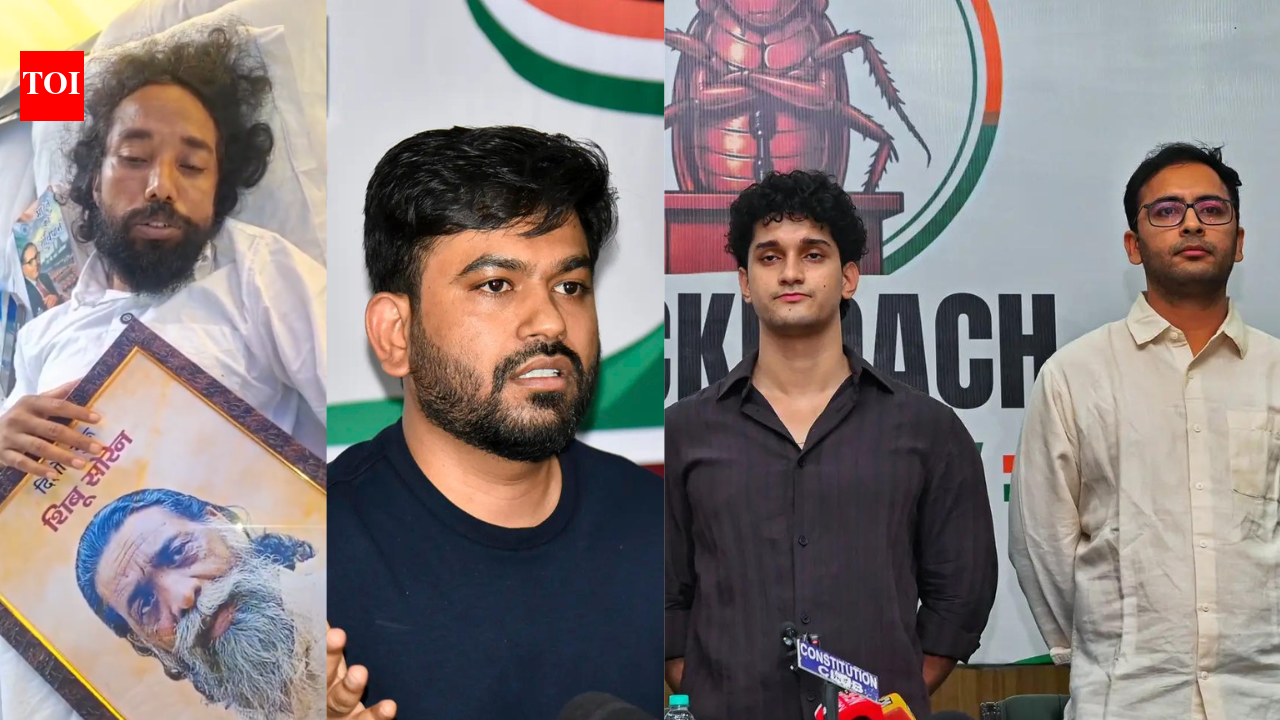
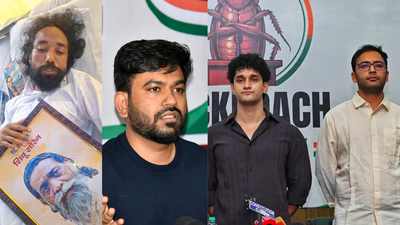
NEW DELHI: India’s recent youth-led protests have brought a new set of organisers and public faces into the spotlight.From a Jharkhand student leader who turned to an indefinite hunger strike to activists and communicators associated with newer forms of political mobilisation, the country has witnessed several new ‘faces’ in the arena.While the faces and causes differ, the movements have increasingly relied on social media, public protests, hunger strikes and direct engagement with political institutions to amplify their demands.Among the prominent names are Devendra Nath Mahto, who is leading a student agitation in Jharkhand over alleged irregularities in recruitment examinations.Meanwhile, the hype continues with the faces associated with the Cockroach Janta Party (CJP), including founder Abhijeet Dipke, chief spokesperson Saurav Das and national spokesperson Ashutosh Ranka.
Devendra Nath Mahto: From student leader to hunger-strike face
The latest example comes from Jharkhand, where student leader Devendra Nath Mahto has emerged as a prominent face of protests over alleged irregularities in recruitment examinations.Mahto began an indefinite hunger strike at Jaipal Singh Munda Stadium in Ranchi, demanding the cancellation of the JPSC examination and a CBI probe into alleged irregularities involving recruitment examinations conducted by the Jharkhand Public Service Commission (JPSC) and Jharkhand Staff Selection Commission (JSSC).His fast drew the attention of climate activist Sonam Wangchuk, whose intervention led Mahto to agree to consume water while continuing his agitation.The episode has placed Mahto at the centre of a student movement that is using a traditional protest tool, the hunger strike, to push recruitment and examination-related grievances into the political spotlight.
Abhijeet Dipke: From Anna Hazare movement to CJP
The CJP movement has a markedly different origin.The organisation founder, Abhijeet Dipke, was a student in Boston and had earlier participated in the Anna Hazare movement.Dipke’s political activism gained fresh momentum after he reacted to a controversial remark involving unemployed youth and the word “cockroach”.His response, asking what would happen if “all cockroaches” came together, became a rallying point and eventually developed into the CJP movement.The CJP subsequently evolved from an online phenomenon into a youth-led political formation, with Dipke becoming its most recognisable face.Dipke has also maintained that the movement does not currently intend to become a conventional political party.He has said CJP will operate as a pressure group, arguing that the focus should be on influencing governance and public policy rather than immediately contesting elections.His journey therefore reflects a different route into activism, from participation in an established anti-corruption movement to building a new, social-media-driven platform around youth concerns.
Saurav Das: Journalism, RTI activism and political communication
Another prominent CJP face is Saurav Das, a New Delhi-based independent investigative journalist who is now the organisation’s chief spokesperson.Das’s background is rooted in journalism, public-information activism and accountability reporting.His transition into the CJP’s public-facing role has placed him at the intersection of journalism, activism and political communication.As the movement’s chief spokesperson, Das has emerged as one of its most vocal defenders, regularly responding to government representatives, political opponents and criticism of the protests.His role has also extended beyond conventional protest messaging, with Das using social media and public statements to articulate the movement’s position on negotiations, FIRs against protesters and its demands from the government.The CJP’s decision to formally appoint spokespersons further underlined its attempt to build a structured leadership around what began as a largely online movement.The organisation named Das, Ranka and Vijeta Dahiya as its official spokespersons, before Dahiya was removed from his position.
Ashutosh Ranka: From AAP to youth mobilisation
Among the CJP’s public faces, Ashutosh Ranka is a former AAP associate, making his transition into the CJP leadership notable in the context of the movement’s claim to operate outside conventional party politics.He has also been among the CJP voices articulating its demands during the protests.Apart from his political involvement, Ranka’s educational background also stands out.He studied at IIT Kanpur and later completed his master’s at the London School of Economics and Political Science (LSE).His presence gives the CJP leadership a link to conventional political communication while also reflecting the movement’s emphasis on younger, educated faces.
A new mix of protest leadership
Taken together, these faces show that India’s emerging youth protests are not being led through a single template.Mahto’s rise has come through student mobilisation and a hunger strike.Dipke’s journey runs through online activism, the Anna Hazare movement and political satire.Das brings journalism and RTI activism into the movement, while Ranka brings experience from electoral politics and political communication.Their routes into activism may be different, but their emergence points to a broader change in how youth movements are building leadership, combining street protests with social media, public communication and increasingly organised pressure on governments.The result is a new generation of protest faces who do not necessarily fit the traditional mould of political leaders, but are increasingly becoming the public representatives of youth-led movements.