








Listen to this article
Estimated 5 minutes
The audio version of this article is generated by AI-based technology. Mispronunciations can occur. We are working with our partners to continually review and improve the results.
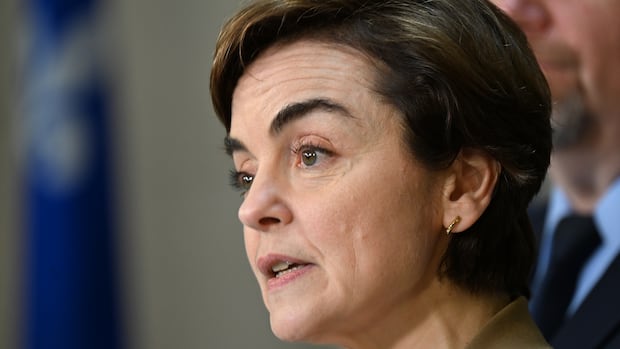
Quebec Premier Christine Fréchette followed in her predecessor’s footsteps on Monday when asked whether systemic racism exists in the province.
Fréchette refused to use the term when addressing the investigation underway at Montréal-Nord’s Station 39, where 16 police officers are being investigated following allegations of racist and discriminatory behaviour against Black and Arab residents in the borough.
The allegations include officers collecting pieces of locs that had been cut from individuals’ hair during police interventions to keep as “trophies,” and issuing tickets to citizens solely on the basis of their ethnic background.
On Monday, Montreal police Chief Fady Dagher told CBC’s Daybreak he’s expecting more allegations to surface.
“That’s pretty much the definition of systemic racism,” Radio-Canada’s Patrice Roy said to Fréchette during an on-air interview on Monday.
“No,” the premier replied.
‘That’s not systemic racism’
“For me,” she continued, “it’s a small group that’s behind these organized, repeated action.
“That’s not systemic racism. If it’s a small group, it’s not necessarily systemic. For me, systemic means on a larger scale.”
The premier wouldn’t directly respond when asked if systemic racism exist in Quebec.
“It’s clear that racist behaviour has been reported … it’s unacceptable,” she said.
In 2019, a report exposed systemic racial bias within the Montreal police service.
Former premier François Legault consistently rejected the concept of systemic racism in the province, saying in 2020: “There’s no systemic discrimination, no system in Quebec of discrimination.”
That same year, Joyce Echaquan died, and the Legault government refused to adopt Joyce’s Principle, the series of recommendations drafted by the Atikamekw woman’s community, because of its mention of systemic racism.
A year after Echaquan’s death, a Quebec coroner found racism and prejudice had contributed to the death of Joyce Echaquan in hospital.
More recently, the Quebec government also turned down federal funds aimed at combating systemic racism in the criminal justice system, saying it doesn’t agree with the program’s approach.
Monday marked Fréchette’s first opportunity to address the issue herself.
When asked why the Coalition Avenir Québec (CAQ) doesn’t want to acknowledge that systemic racism exists, Fréchette replied that the party acknowledges the existence of racism.
“And that’s why we have a minister responsible for combating racism, precisely to equip organizations grappling with these issues with the right tools and ensure that the situation is evolving positively,” she said.
“For me, this doesn’t necessarily involve using the term ‘systemic racism.'”

Sixteen police officers at a Montréal-Nord station are under investigation following allegations of racism and hateful acts toward Black and Arab people during police stops in the borough.
‘An intellectual debate best left to universities’
CBC recently spoke with Christopher Skeete, the CAQ minister responsible for the fight against racism, for another story about racism in the province.
Like Fréchette and Legault, he didn’t want to use the term “systemic racism” either, saying debates around the word “move us away from the ideal that we all share, [which] is to fight racism.”
For Skeete, “systemic racism is an intellectual debate that’s best left to universities.”
The minister stood by those comments on Monday afternoon. He added that he finds the events in Montréal-Nord to be “unacceptable,” and told CBC: “Any situation that contributes to dehumanizing a person or community must collectively challenge us.”
While the CAQ continues to shy away from the term, the mayor of Montreal has a different take.
“Absolutely, there is systemic racism, profiling every day on the streets of Montreal,” said Mayor Soraya Martinez Ferrada.
“To tackle that, we have to tackle social biases. It starts with acknowledging that they exist.”
This month marks 10 years since a petition was launched asking for a public commission into systemic racism in Quebec.

Borough mayor Christine Black wants to hear from anyone who may have encountered any racial profiling or discrimination, after SPVM launched an investigation into 16 police officers accused of committing racist and hateful acts. Hoodstock, a Black-led organization in Montréal-Nord, has been calling out police brutality and systemic inequalities in the area for years.
On Monday, some politicians and advocates called for an independent investigation into the racism allegations at the Montréal-Nord police station. Among those voices were the Ligue des droits et libertés (LDL) along with the Canadian Civil Liberties Association.
“A public inquiry into police racism at the SPVM is necessary to shed full light on this phenomenon that has persisted for decades and to hear the voices of victims of racism and police violence — too often ignored by the political class,” said Lynda Khelil, an LDL spokesperson.
“We must examine the systemic nature of this phenomenon, the police practices that make it possible, and the real actions that political authorities must take.”