




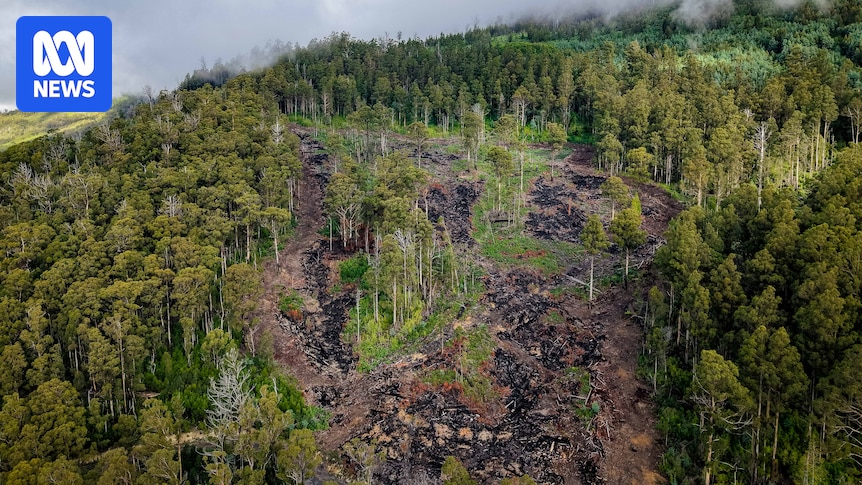
A coalition of conservationists, artists and forest industry figures has called for an end to old-growth logging in Tasmania but major environmental groups have distanced themselves from the “shared vision statement”, saying it does not go far enough.
The Forest Congress began in 2023, when artist Kirsha Kaechele from Hobart’s Museum of Old and New Art (Mona) invited a variety of disparate groups to discuss the future of the state’s forests.
Kirsha Kaechele started the Forest Congress in 2023. (Australian Story: Simon Winter)
Today, the Forest Congress released what it described as a Palawa-led push to end the harvesting of old-growth trees while supporting a “responsible” forestry industry.
“We agree that forests should be managed for all their values — ecological, cultural, social and economic — with the forest health as the foundation,” the statement says.
“We support an end to old-growth logging alongside the ongoing, responsible management of our native forest resources.“
The statement defines old-growth forests “as those whose ecological continuity has never been interrupted by industrial felling”.
Kirsha Kaechele brought together members of the forestry industry, Indigenous community and environmental movement. (Supplied)
Historically, native logging in Tasmania was carried out selectively before it transitioned to industrial clear-felling around the 1970s.
Giant trees and important habitat clumps are generally supposed to be retained in native logging operations, but larger trees are routinely felled after being deemed safety risks by contractors.
Sawmilling company says it won’t accept old-growth logs
The Forest Congress statement has been signed by more almost 30 individuals and groups, including Palawa elders, sawmillers, artists and The Tree Project.
“We acknowledge that a holistic approach must consider the whole ecosystem, including both forest and human,” the statement says.
“In healing our landscape, we must care for our communities.
“Regional communities should remain places where people can raise families, pursue livelihoods and shape their own futures.”
Sawmilling business Neville Smith Group is one of the signatories.
Andrew Walker’s sawmilling business has signed onto the statement. (ABC News: Laura Beavis)
Its CEO, Andrew Walker, today told ABC Hobart it would no longer accept old-growth logs from Tasmania’s state-owned forestry company.
“We’ve actually formally written to STT [Sustainable Timber Tasmania] in the last seven days and ceased receiving any old-growth logs into our group, noting that less than 3 per cent of our supply is old growth.”
Mr Walker said about 80 per cent of its supply was from the private estate, which was mostly plantation hardwood.
“So, we’ve undergone a quite rapid transition over the last four years towards plantation, noting that we do still process some native regrowth.”
Mr Walker said the Forestry Congress vision statement was an important initiative.
“We believe this is a really positive step forward in finding some common ground and moving forward with a new vision for forestry that does enable regrowth, harvesting and processing to continue.”
A Four Corners report last month revealed the Neville Smith Group had exported whole logs from Tasmania’s native forests to Victoria for processing.
Green groups call for wider environmental protections
Four national environmental groups said the Forest Congress’s focus on old-growth forests was inadequate.
The groups, the Australian Conservation Foundation, Wilderness Society, Wilderness Australia and Bob Brown Foundation, say all native forests should be protected.
Bob Brown says the Forest Congress statement does not go far enough to protect native forests. (Supplied)
Bob Brown said limiting action to old-growth forests would cover only a small portion of the state’s native forest.
“What [Kirsha Kaechele] is saying effectively gives to the forest industry 96 per cent of the forests while protecting 3 or 4 per cent,”
Mr Brown said.
“This isn’t performance art.
“This is a serious endeavour, backed by the vast majority of the people of Australia, to end this unnecessary destruction of what’s left of our native forests and their wildlife.”
Last week, the Wilderness Society formally withdrew from the Forest Congress, saying an extractive industry should have no part in the management of the state’s forests.
“What we’ve seen over the past three years is just a constant dragging out of any action by the industry,” Wilderness Society forest campaigner Hugh Nicklason said.
Hugh Nicklason says the Wilderness Society withdrew from the Forest Congress due to the industry’s lack of action. (ABC News: Ebony ten Broeke)
“We’ve seen constant gaming of the system.
“And now, even now with this announcement [by the Forest Congress], there’s no timescale.”
Government to ‘take a closer look’ at vision statement
A forest “peace deal” was signed in 2012, including by the Wilderness Society, which designated native forest areas for logging, and those to be reserved.
Tasmania’s native forest logging system operates under a regional forest agreement, which means it sits separately from federal environmental law.
New national environmental standards will be applied to the system from July next year.
The system is being assessed by the Commonwealth, and would then continue to be regulated by the Tasmanian government.
Tasmanian minister Bridget Archer said trees from old-growth forests made up only a small portion of what was harvested in the state.
She said the government remained a strong supporter of the forestry industry, and welcomed the process behind the Forest Congress initiative.
“It is fantastic to see a whole range of stakeholders coming together and having those conversations and we will take a closer look at the detail and have more to say later,” Ms Archer said.