







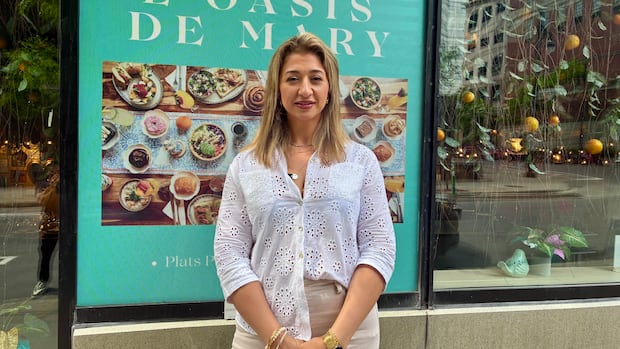
Inside SoLIT Café in downtown Montreal, orange-grove-inspired decor hangs from the ceiling above customers sipping coffee, chatting with friends and working on laptops.
Like many small business owners, Maryam Rahimi does a bit of everything in her shop — takes orders, helps in the kitchen, serves customers and manages staff.
But she says another part of her job has increasingly taken up her time over the past several years: responding to compliance requests and follow-ups from Quebec’s language watchdog.
“To be honest with you, I’m not quite sure what’s happening,” Rahimi said.
She opened SoLIT Café nearly five years ago and worked with lawyers to trademark its name and branding, hoping to eventually expand the business.
She says she expected the challenges that come with running a café. What she did not expect was the amount of time she would spend communicating with the Office québécois de la langue française (OQLF).

The OQLF says its role is to help businesses comply with Quebec’s language laws and to protect the right of Quebecers to live, work, be informed and receive services in French.
Rahimi says her interactions with the office began almost three years ago.
“They basically audited everything that was in writing, including our receipt paper,” she said.

SoLIT café in Montreal has for years received visits and compliance requests from the Office québécois de la langue française over the use of English words in business materials. Owner Maryam Rahimi says the redesigns, printing costs and legal consultations have cost her thousands of dollars.
‘Chicken nachos’ and ‘flat white’
One of the first concerns involved the word “Thank you” printed in small letters at the bottom of customer receipts.
“They sent me a formal letter and then so many emails,” she said. “You have to make sure it says ‘merci.'”
She says other requests followed.
She recalls being asked about terms such as “chicken nachos” and “flat white.”
“They said your chicken nachos is in English,” Rahimi recalled.
“So we changed it to ‘nachos de poulet‘, but they said, ‘no, the word nachos… you should find a French equivalent for that.’ I said, ‘What do you mean?'” she laughed in disbelief.
Thousands of dollars to comply
The issue that frustrated Rahimi the most involved the café’s name.
She says one OQLF inspector questioned whether “SoLIT” could be interpreted as an English phrase if separated into two words: so lit.
“I said, well, any word that you separate could mean anything else,” Rahimi said.
At one point, another inspector said she might have to go to court if she doesn’t comply, which she welcomed.
“I actually want to be heard,” she said. “I want to present my case to a judge and say, ‘How is this fair?'”
Instead, she continued making the requested changes.
Most recently, she installed three new signs in French after receiving a compliance deadline earlier this year.
But she says she feels as though the process is never-ending.
“We’re always under review,” she said. “It really feels like harassment because mentally it’s exhausting.”
Rahimi estimates that redesigning materials, replacing signage and consulting lawyers has cost her thousands of dollars over the years.
For a small business operating on narrow margins, she says the time spent dealing with compliance issues can be just as costly.
“To have to put my energy into something else that doesn’t help me sustain my business or make it profitable,” she said. “It’s frustrating.”
OQLF says it’s received 22 complaints about café
In a statement to CBC News, the OQLF said SoLIT Café is not undergoing a francization process and that its interventions with the business stem from complaints it has received.
The office says it has received 22 complaints concerning the café since March 2022, although it notes some complaints may ultimately be deemed inadmissible or unfounded.
The agency says a company can be subject to multiple complaint files at the same time and that new complaints can result in additional interventions.

The OQLF says the length of a file depends on several factors, including the complexity of the corrections required, the circumstances of the business and its level of collaboration.
The office says its approach is based on helping businesses comply with the Charter of the French Language and that nearly 94 per cent of cases are resolved collaboratively.
‘Quebec is home’
Rahimi says she understands the importance of protecting the French language and recognizes that businesses operating in Quebec must comply with the law.
Her frustration, she says, is with what she views as an ongoing process that leaves little certainty about when the file will finally be closed.
“What I want is support,” she said. “You need to support small local businesses.”
Some people have suggested she move her business elsewhere, she said.
That is not something she is considering.
“Quebec is home,” Rahimi said. “I grew up here. My kids are here.”
For now, she is waiting to hear the outcome of the latest inspection.
“If they come, of course I have moments where I just want to give up,” Rahimi said.
“But for the most part, you just keep fighting.”