


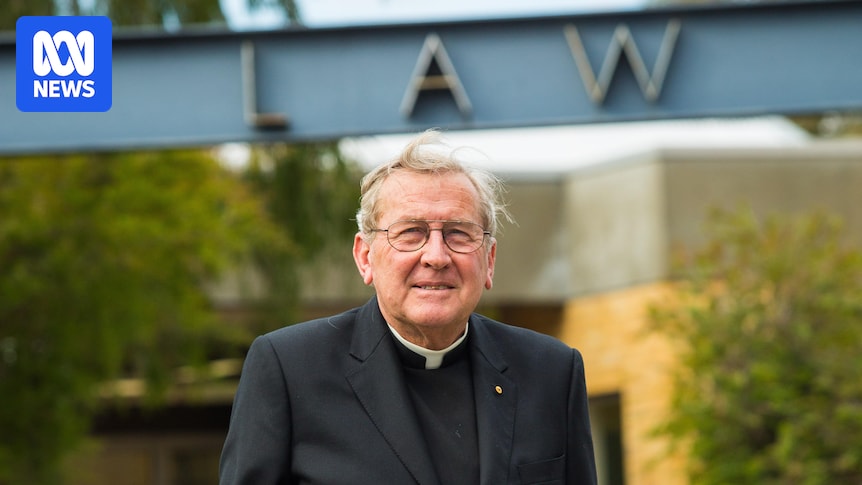
Michael Tate was an academic, a politician, a diplomat and, for the past 26 years, a Catholic priest.
“It would be easy to stand here and simply recite that record … it reads almost like four different lives,” his friend Jeffrey McGee told the hundreds gathered for Father Tate’s funeral in Hobart on Tuesday.
“But anyone who knew Michael knew it was in truth one life with one thread quietly running though it from the very beginning — a life of warmth and service to others.”
Politicians of various stripes, former premiers, fellow legal professionals and Catholic parishioners were among the mourners at St Mary’s Cathedral.
Tasmanian Governor Barbara Baker, Emeritus Professor Don Chalmers and Premier Jeremy Rockliff were among the mourners. (ABC News: Jake Grant)
“Michael was one of the most influential people this state and this university [of Tasmania] has produced,” Mr McGee said.
“He held some of the highest offices in our country and received some of its highest honours.
“And, I suspect, if you asked him in these last years what mattered most, he would have pointed not to the Senate or The Hague or even to the university, as much as he loved it.
“He would have pointed to his parish, to the people of South Hobart, who had become in every sense that matters, his family.”
Loading…
He was also a great lover of music. Musicians from the Tasmanian Symphony Orchestra (TSO) played at his funeral, and singers from the TSO Chorus and All Saints Church joined the St Mary’s Cathedral Choir for the mass.
Fr Tate died in Hobart on June 5, aged 80.
He was born in Sydney in 1945, and grew up in South Hobart. He studied law at the University of Tasmania, and theology at the University of Oxford.
Fr Tate joined the law faculty at the University of Tasmania in 1972, and lectured in constitutional law. He became dean of the faculty in 1977, and kept a connection to the faculty throughout his life.
Hundreds of people were at St Mary’s Cathedral for the funeral. (ABC News: Jake Grant)
In December 1977, he was elected as a Labor senator for Tasmania, and served as justice minister in the Hawke and Keating governments from 1987-1993.
During his time in politics, Fr Tate fought against military conscription, played a key role in setting up the Royal Commission into Aboriginal Deaths in Custody, and was prominent in the drafting of a new oath of allegiance — which removed any reference to the monarch — for those becoming citizens.
Michael Tate was re-elected in 1993 but with then-prime minister Paul Keating looking to refresh the cabinet, he did not continue in the ministry. (ABC News)
After leaving politics, Fr Tate became Australia’s ambassador to the Holy See and The Hague.
In 1996 he was appointed an Officer of the Order of Australia for distinguished service to Australia.
Michael Tate was the South Hobart parish priest at the time of his death. (ABC News: Jake Grant)
He was ordained a priest in 2000, something he had described as an early vocation long deferred.
“He could walk with kings and not lose the common touch,” his friend John Kelly said during the funeral.
“He practised what he preached long before he became a priest.“
Michael Tate at the start of the Way to St James pilgrimage in 2023. (ABC News: Loretta Lohberger)
In 2016, Fr Tate founded the Way to St James, a pilgrimage in the Huon Valley, south of Hobart, inspired by Spain’s Camino de Santiago.
He was the Vicar-General, a senior leadership position in the Archdiocese of Hobart from 2017 until 2020, and was a chaplain at the University of Tasmania from 2005 until 2014.
‘Continuously learning, teaching and sharing knowledge’
Fr Tate’s niece, Monica Biddington, remembered an uncle who was a great mentor.
“As our uncle, Michael took a genuine interest in our paths,” Ms Biddington said.
“Michael has encouraged so many of us that we can do good things with skills and knowledge so long as we retain our own curiosity to explore and challenge ideas.“
Michael Tate died on June 5, aged 80. (ABC News: Jake Grant)
Curiosity was something she said had been a strong theme in his life, both personally and professionally.
“On a daily basis across every career, Michael would be continuously learning, teaching and sharing his knowledge,” she said.
“I will miss the phone calls to talk about the latest political crisis … election night commentary won’t be the same without Michael’s perspective about who actually deserved the responsibility of electorate or state representation.”
Michael Tate with recipients of the Michael Tate Oxford Scholarship in 2017. (Supplied: University of Tasmania)
Archbishop Tony Ireland said Fr Tate was a generous man who challenged people and encouraged them to “think more”.
“He delighted in exploring questions, making connections, opening new horizons and helping others see the world in fresh ways,” Archbishop Ireland said.
Archbishop Tony Ireland presided over the funeral mass for Michael Tate. (ABC News: Jake Grant)
“He loved ideas because he believed ideas mattered.”
Often, Fr Tate discussed ideas with others in cafes and restaurants.
“There are a few notable restaurants and cafes around here that are probably wondering how they will survive now that Michael will no longer occupy their seats,” Archbishop Ireland said.
Fr Tate is survived by his brother Richard, sister-in-law Helen, nieces Adele and Monica, great-nephew James and great-niece Leila.