





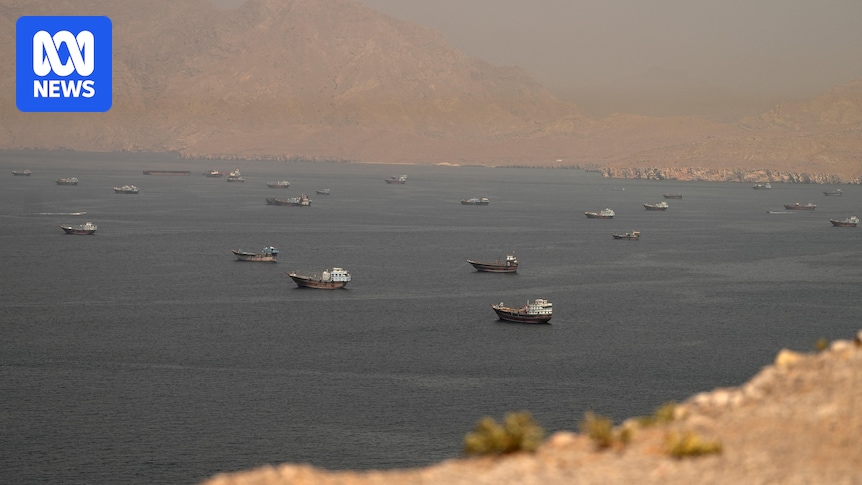
An evacuation plan to enable hundreds of ships to sail through the Strait of Hormuz is being enacted, according to the UN’s International Maritime Organization (IMO).
The plan will affect about 11,000 seafarers on the ships that have been stranded in the Gulf.
“We have now started contacting the ships to start the evacuation,” an IMO spokesperson said.
The operation comes after Iran and the US reached a ceasefire deal last week.
The IMO said it had secured the necessary safety guarantees and verified conditions for safe navigation.
“This large-scale operation will be carried out in close cooperation with Iran, Oman, all other coastal states in the region, the United States and the maritime industry,” IMO Secretary-General Arsenio Dominguez said in a statement.
The evacuation process under the plan, which has been under discussion for months, will be carried out in phases, Oman’s defence ministry said separately in an advisory.
“Given the elevated risk of collision in the current environment, a gradual and controlled evacuation of vessel traffic is required,” it said.
The Omani ministry said the previous Traffic Separation Scheme was “not safe for use at this time” and two temporary routes to the north and south of the scheme could be used for evacuation.
“Vessels will be contacted individually and advised of their allocated transit day by the parties coordinated by IMO,” the ministry advisory said.
The separation scheme, adopted by the IMO in 1968, established routing lanes through Iranian and Omani waters in the strait.
Floating mines are among the major risks with waters around Hormuz.
Rubio warns against tolls
The tentative ceasefire agreement calls for Iran to allow traffic to flow freely in the strait for 60 days, but Iran has said it might impose tolls or other fees on shipping after that point.
Marco Rubio says Washington will not accept Iranian tolls or fees on the Strait of Hormuz. (Reuters: Eric Lee)
In a joint statement on Tuesday, local time, Iran and Oman, which controls the other side of the strait, stressed their “sovereign rights” in the waterway, adding that they would work together to manage traffic, along with associated costs.
But US Secretary of State Marco Rubio, visiting Gulf allies unsettled by the peace deal, said Iran would not be allowed to charge tolls in the strait as part of any final agreement.
“It’s an international waterway. No country is allowed to charge tolls or fees on an international waterway,”
he said.
He added that he believed “all the countries in this region would agree”.
Traffic through the strait on Monday reached the highest level since the war began, according to two maritime tracking platforms, although it remained just over 40 per cent of the normal peacetime level of about 120 vessels a day.
Reuters/AFP