







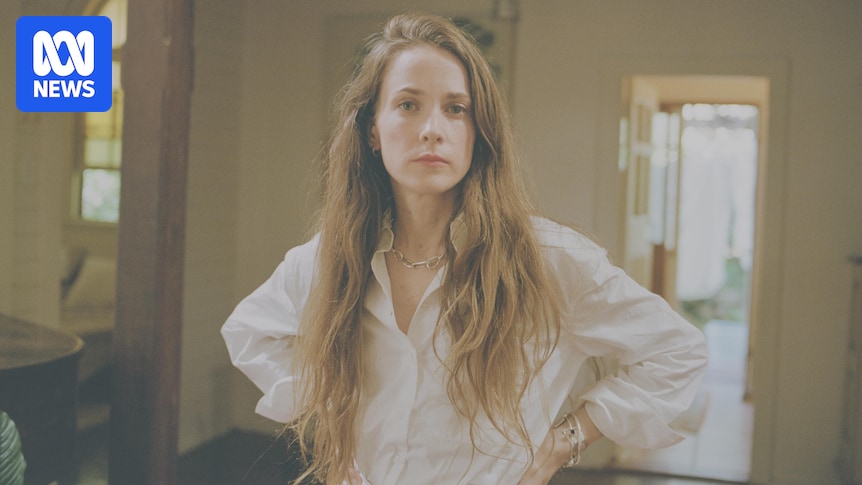
Emma Louise has been writing music since she was 12 but sharing it with the world hasn’t always been easy.
“I’ve always found the releasing of albums really stressful,” she admits to Zan Rowe for Take 5. “But it’s different now because I’m happy with who I am.”
That’s something of an understatement regarding her fifth album, Sunshine For Happiness, a record born from a harrowing period of upheaval but signifying a profound artistic rebirth.
It features the most deeply personal, emotionally revealing songs of Louise’s career, processing a period in which she got married, became a mother, got divorced and underwent an intense mental health recovery.
Songs like Beggar and Medicine examine an unhealthy romantic desperation but delivered in gorgeously intimate vocal performances and understated arrangements — all swooning organ, muted rhythm section and swelling strings.
Dust is a folksy rumination on mortality; The Absence of You laments feeling abandoned by the spirit of creativity amid fragile vibraphone and ghostly harmonies.
Loading SoundCloud content
Taming the beast
Growing up in Far North Queensland, Louise achieved success early on.
She was 19 when she uploaded synthpop single Jungle to triple j Unearthed.
It won the 2011 Song of the Year at the Queensland Music Awards and became a breakout hit at home and abroad, charting across Europe thanks to a remix by Berlin DJ Wankelmut.
“My head is a jungle,” went the song’s hooky chorus. Fifteen years later, it feels like Louise has finally cut a path through the wilderness.
Sunshine For Happiness follows Dumb, last year’s collaborative album with super-producer (and Future Classic labelmate) Flume, on which Louise explored her autism and ADHD diagnoses over warped electronics.
However, Louise’s last solo album was 2018’s Lilac Everything, where she boldly pitched her vocals to a lower, unrecognisable register.
The record was produced in Seattle with Louise’s then-husband, Canadian artist Tobias Jesso Jr.
“I never wanted to be a producer ’til I heard Emma’s demos,” the Grammy Award-winning songwriter to the likes of Olivia Rodrigo, Adele, Dua Lipa and Harry Styles said at the time.
But the stylistic decision to alter her voice masked Louise’s deeper anxieties.
Living in Los Angeles, she became increasingly isolated and burnt out, measuring herself by other’s milestones and developing a harmful dependency on songwriting as the measure of self-worth.
“I feel I had this beast in me, and I don’t know where it came from, that basically whenever I wasn’t writing music or when I didn’t have something to show, I would just start burning up,” she explains.
“I’d lock myself away, for weeks, trying to write. But I was suffering so much.
“It would get to this point where I wanted to not be here anymore … It was like, if I couldn’t do that, then what was the point of being alive?”
After experiencing a “complete mental breakdown”, Louise checked herself into a hospital, undergoing treatment and slowly re-evaluating her art and life.
A musical recovery
In the hospital’s lobby was a grand piano, where Louise sat one day and wrote a “prayer out to the universe”.
The result became All Beautiful Things, a tear-jerking ballad yearning for divinity and redemption.
“I just wanted to live and breathe in all of the beautiful things in life, to conquer my fear so I could have more of the love.
“Wishing for the end of suffering, the kind of suffering that led me to this massive shift I had. And I realised if I could do that, then living would be beautiful.”
More songs soon came, including Medicine, rendering the epiphany that true healing doesn’t come from anyone or anywhere else but within.
Loading SoundCloud content
When Louise eventually checked out, “everything was different … It was the best thing that’s ever happened to me. And then also my creativity just exploded”.
She started painting, sculpture, pottery, and more music came pouring out.
Capitalising on the inspiration, she decamped to Seattle’s idyllic Bear Creek studios in 2019, spending two weeks recording with a small band, with Jesso Jr producing alongside fellow Grammy winner Shawn Everett.
“Making this record in a vortex away from the world, magic happened and it was so good.”
“And I think that magic, it kind of stayed in the music.“
“To alchemise the world, how it hurts and affects me, and bring it into creation — that’s redemption.” (Supplied: Sam Kristofski)
Half of Sunshine For Happiness features music written before or around Louise’s treatment, full of “suffering and pain”, the rest is “the other side”, defined by light, reconnection and recovery.
That context weighs upon the album’s heavier themes.
Trigger of a Gun is a grieving response to a 2018 shooting in an LA nightclub, while God Between Us is a heartbreaking account of a doomed romance, but seeks love amid both destruction and creation.
Buoyed by a rolling, up-tempo groove and warm, clipped guitar-monies, Nothing Could Tear Us Apart is a paean of positivity, celebrating the good that abides even out of her separation from her ex-husband. (Case in point: “our best collab, our son Ellsworth“.)
The sunny Bahía de Banderas provides another much-needed moment of levity, named after the coastal bay in Mexico where it was written and animated by beachy guitar, mariachi horns and lively percussion.
Loading Instagram content
Finding light in the darkness
Releasing a body of work that had been shelved for seven years, and revisiting its dark inspirations, has “unearthed all of this beautiful but also painful stuff”, Louise says.
“There’s so much grief in it,” she confesses. But in promoting the album, re-learning the songs for a run of intimate East Coast shows, and “sinking into it, I feel the joy”.
“This old magic is still in it. I feel I’ve re-attached parts of myself.“
There’s sadness, hardship and vulnerability embedded in Sunshine For Happiness, but rather than sounding tortured or bitter, Louise sounds restored and always ekes out light amid the darkness.
The 34-year-old isn’t religious, but she achieves something akin to spiritual enlightenment on songs that invoke God and a hymnal quality, bringing you into the headspace of someone going through profound suffering and then salvation and clarity.
It’s there in the gentle strings and synth that rise like the dawn amid the slow, stately grandeur of God Between Us, or the stand-out Holy Holy.
An ode to the therapeutic, transformative power of art and music, the track ascends to the heavens on a swirling cloud of chirping synths and modulated vocals.
Loading SoundCloud content
Having exorcised her breakdown and breakthrough, Emma Louise is now in a good place: healthier, grateful, and resolved in sharing the music that carried her through her lowest point.
“Before, I didn’t love myself or had some subconscious shame, so I was afraid of putting myself out there. Whereas now, it’s not stressful because I don’t mind being out there, because I don’t mind me.
“I feel a lot of gratitude because I can do this. It’s not even really a job, which feels nice. It’s amazing.”
Sunshine For Happiness is out now.