





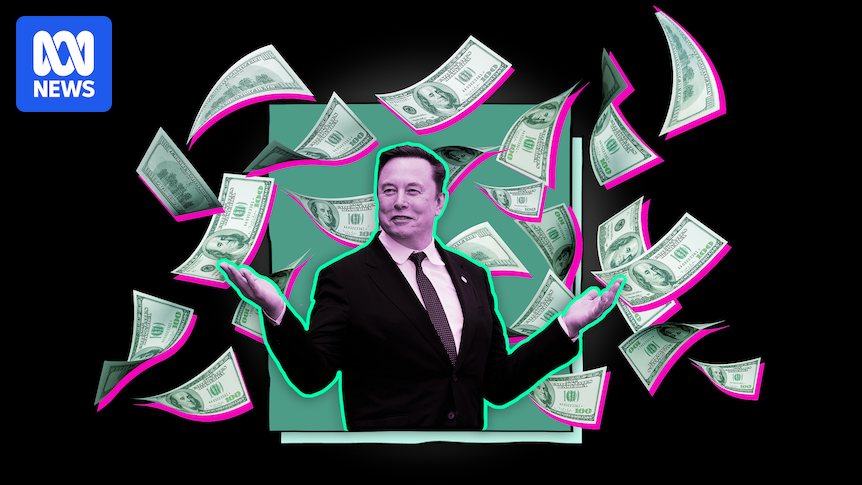
It’s hard to fathom how much $1 trillion is. But let’s give it a shot.
No-one has ever been worth $1 trillion — until now.
Elon Musk has become the world’s first trillionaire after SpaceX debuted on the Nasdaq exchange, making history as the world’s biggest stock market float and propelling the tech titan’s wealth to unfathomable heights.
It’s a staggering amount of money. Just look at all these zeroes: $1,000,000,000,000.
Of course, Musk’s wealth is not a pile of cash sitting in a bank account. It is tied to how investors might continue to value his companies, and there are plenty of questions about exactly how it all stacks up.
But still, it’s a lot of money.
You could think of it as 1,000 billions, or a million millions. Or you could think of it like this…
This shape represents Musk’s $1 trillion.
Keep in mind, we’re talking US dollars throughout this story, so that’s more like $1.4 trillion in Australia.
Figuring out just how much money the super-rich have can be a murky business.
But based on the best estimates available, when we compare Musk’s worth to his billionaire peers the difference is stark.
As a freshly minted trillionaire, Musk now has more money than the net worth of the world’s next three richest men combined.
Behind Musk is Google and Alphabet co-founder Larry Page, who has an estimated net worth of $309 billion.
Then there’s the other Google co-founder, Sergey Brin, who is worth a reported $287 billion.
Next is Amazon’s Jeff Bezos.
When you add those three together, there’s still $138 billion worth of space left in Elon’s trillion-dollar shape.
To try and fill it further, we could throw in the estimated net worth of Australia’s richest citizen, Gina Rinehart.
The iron ore magnate is reportedly worth about $37 billion (once you convert her estimated wealth to US dollars).
But enough about billionaires … for now. Let’s bring this closer to home.
The median net household wealth in Australia is about $531,000.
Just another quick reminder: we’re still talking US dollars here so we can compare apples and apples.
If you’re wondering why you can’t see a block showing this comparison, that’s because it turns out Musk’s apple is a lot bigger than yours.
The typical Aussie household’s net wealth is so small that it won’t even register against this trillion-dollar block.
To make it visible, let’s multiply that by 10,000.
That gives us $5.32 billion — what 10,000 typical households in Australia are worth all together.
It gives us a slightly more visible square, but it’s still a drop in the ocean in comparison.
We might need to think bigger…
Musk famously likes tunnels, so how does his wealth compare to some big infrastructure projects?
The money in his kitty could easily fund Sydney’s new Metro West line, which is estimated to cost between $18 billion and $20 billion.
Not to mention Victoria’s most expensive project, the Suburban Rail Loop.
And there’s still plenty of room left to fund some big-ticket federal budget items.
Like health…
… and defence.
In fact, we could fit the entire Australian budget in and still have some elbow room.
That said, we can’t fit Australia’s entire economy inside this box as that’s $2.1 trillion.
But there are only 20 countries in the world whose economies are worth more annually than Musk’s purse.
That means Musk now has more money than Taiwan’s entire GDP, which sits at $976 billion.
The same is true for Belgium, Ireland, Greece … and the list goes on.
Another way to think about this is what you could do with this much money.
The United Nations estimates it would take $512 billion to lift 700 million people out of hunger and malnutrition over a six-year period.
In other words, you could pretty much solve global hunger.
A trillion dollars would also easily bridge the $286 billion annual funding gap of what’s needed to fund the globe’s energy transition to reduce the impact of climate change.
One of Musk’s dreams is to send people to Mars. In fact, he’s said he wants to go himself.
NASA reckons that would cost bang on half of his trillion-dollar pile.
And let’s not forget that when Musk ran the Department of Government Efficiency (DOGE), he boasted about feeding the US Agency for International Development, or USAID, “into the woodchipper“.
With a trillion dollars, you could fund the Joe Biden-era US State Department and USAID for 15 years.
Musk has big ambitions of his own.
His money has been made sending rockets into space, building electric cars, pioneering digital payments, building brain implants and developing AI.
But it’s SpaceX’s float on the stock exchange that has delivered his biggest win and pushed him over the trillion-dollar line.
It’s the biggest initial public offering in history by an order of magnitude. But it’s also raising plenty of questions about whether the company’s value is inflated.
“It’s out of whack at every level,” Australian shareholder activist Stephen Mayne told ABC TV’s 7.30.
“It loses $5 billion a year. It had negative cash flow of $14 billion in 2025, and it’s got accumulated losses of $41 billion.”
This is not the first time society has witnessed one individual amassing extreme wealth.
History buffs will tell you people like Mansa Musa of the Mali Empire or Augustus Caesar commanded fortunes so vast they could well have been trillionaires, even once you adjust for inflation.
But that’s ancient history, and economic historian Cameron Gordon sees a slightly more modern parallel.
He describes the current moment as a “second Gilded Age”, referencing the late 19th and early 20th centuries when figures accumulated large amounts of wealth through monopoly power.
But Professor Gordon says the real-world output of the current crop of billionaires — and trillionaire — is more abstract than oil tycoon John D Rockefeller or industrialist Henry Frick.
“Elon Musk, how much is he really worth? How much are his various enterprises really worth? A lot of them aren’t really performing too well in real terms,” he says.
“Unlike the first Gilded Age, the connection between money value of fortunes and real value are a lot more tenuous.”
Following in the footsteps of SpaceX, AI companies such as Anthropic and OpenAI are expected to go public at a combined valuation of almost $US4 trillion.
Professor Gordon says the vagueness surrounding these companies’ worth allows room to accumulate even more wealth.
“The cycle is the same. I think this kind of economic system does produce large inequality,” he said.
“[But] it’s a lot less clear how much the link [is] between the accumulation of fortunes and actual real value created. Now it’s like, I don’t know, what’s the limit?”
Regardless of historical comparisons, one thing that’s clear is the net worth of the world’s richest people has continued to rise.
Billionaire wealth is estimated to have increased by 81 per cent since 2020.
Australian National University School of Politics head Nicholas Biddle has recently conducted polling to see what Australians think about extreme wealth, and says more than half think billionaires are creating an unfair society.
He also found 62 per cent of people think billionaires are not doing enough with their fortune to better society.
“The vast majority do not see this concentration of wealth as being good either for society or good for the economy,” Professor Biddle said.
“What this highlights is the kind of inequities of the tax system. People are less concerned about increases in individual wealth if they felt that people were contributing to society.”
As with trillionaires, there was also a time before billionaires.
The last person to break into a new category of wealth was oil tycoon John D Rockfeller, who became the world’s first billionaire in 1916.
A century on, as Musk turns his billions into trillions, it’s anybody’s guess when the next threshold might be reached.
About the data
- The net worth of Larry Page, Sergey Brin, Jeff Bezos and Gina Rinehart were sourced from the Bloomberg Billionaires Index as of June 9, 2026.
- The median Australian household net worth was calculated with help from the Grattan Institute.
- The cost of the Sydney Metro was outlined by the NSW government and was converted to USD.
- The cost of the Victorian Suburban Rail Loop was sourced from state budget papers and converted to USD.
- The cost of the Australian federal budget, including measures such as healthcare and defence, is outlined in the budget papers and was converted to USD.
- Global GDP figures were sourced from the International Monetary Fund.
- The cost of ending world hunger was estimated by the University of Bonn’s Center for Development Research and the United Nations Food and Agriculture Organization.
- The cost of funding the first human mission to Mars was estimated by NASA’s Ames Research Center.
- The cost of the annual funding gap for the energy transition was sourced from the United Nation’s Sustainable Development Goals report from 2023.
Credits
- Reporting and production: Jessica Riga and Ahmed Yussuf
- Design: Georgina Piper
- Development: Joshua Byrd
- Editing: Matt Liddy