







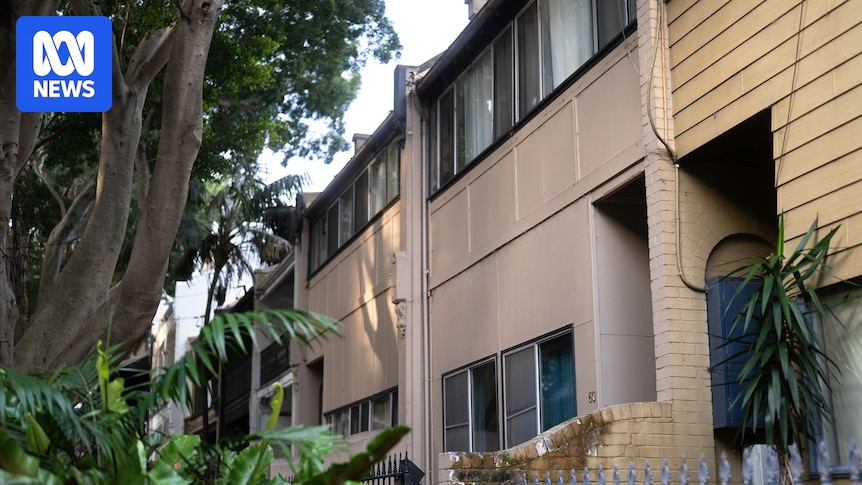
A rundown boarding house which was once a haven for vulnerable people in inner Sydney is set to be converted into luxury apartments after a lengthy legal fight.
Private developer LFD Homes has been granted approval on appeal to transform the 32-bedroom Selwyn Street site in the leafy suburb of Paddington into four luxury homes.
It is the latest update in a long-running legal battle between the developer and the City of Sydney, which in 2023 rejected the proposal due to concerns about the loss of affordable housing stock in the area.
An appeal against the decision was rejected by the NSW Land and Environment Court in what was at the time described as a precedent-setting legal ruling.
But an appeal against that finding has now been successful, with the developer given the green-light to proceed with the proposal.
The developer has been given the green light to proceed with the proposal. (ABC News: Keana Naughton)
The NSW Land and Environment Court on June 17agreed the removal of the boarding house would reduce the amount of affordable housing in the area, and there was “insufficient comparable accommodation to satisfy demand”.
But the boarding house was found to be financially unviable under the Housing State Environmental Planning Policy (SEPP), returning a rental yield of 2.75 per cent.
Because of this, the court found no monetary affordable housing contribution could legally be sought from LFD Homes.
The boarding house in Paddington was home to dozens of vulnerable residents. (ABC News: Warwick Ford)
Commissioner Susan O’Neill said it was “not a solution to retain a boarding house that does not achieve an acceptable housing standard and is financially unviable”.
“There is insufficient comparable accommodation in the area because the low levels of rent demanded for the boarding rooms were responsive to the poor and unhygienic accommodation on offer,” she said in her decision.
“I accept the applicant’s submission that accommodation classified as affordable to very low-income earners and of an acceptable condition could not be provided in Paddington by an investor and be financially viable.
“I accept the applicant’s submission that compelling private landowners to continue using their land as a boarding house when it is not financially viable would undermine the economic incentives designed to encourage private investment in such accommodation.”
LFD Homes did not respond to requests for comment.
Former residents ‘scattered’ across Sydney
The boarding house had provided accommodation for men on a low income since the end of World War II and some residents lived at the property for more than 50 years.
The mostly-elderly men were given eviction notices in October 2024and had since vacated the boarding house, moving into private and social housing accommodation outside the area.
Ms O’Neill said she was satisfied “arrangements had been made to assist the residents who had been displaced to find comparable accommodation”.
Mike Mannix says he is not surprised by the appeal outcome. (ABC News: Keana Naughton)
Community representative Mike Mannix spearheaded the initial campaign to block the development proposal.
He said the appeal outcome was not a surprise.
“This is just the latest in a long line of low-cost and affordable housing that’s been approved for redevelopment into another form of housing,” he said.
“It reinforces an unwelcome precedent when it comes to the retention of affordable housing.“
The community had rallied to keep the men in their homes. (ABC News: Warwick Ford)
Mr Mannix said he remained in contact with many of the men who had been “scattered to all parts of the city”.
“Some have moved into a slightly better housing setting, others are living by themselves in a completely foreign place and they’re really struggling to adjust to that, and that’s the heartbreaking thing about it,” he said.
“This little community of men were split and they don’t stay in touch with each other.
“It takes community groups like us to stand up and try and fight for them, but at the end of the day … we failed them.”
Planning laws ‘woefully out of date’
There are about 3,500 rooms in boarding houses across the City of Sydney’s local area, with Lord Mayor Clover Moore saying that number was shrinking “as there is greater profit in turning these buildings into a small number of luxury residences”.
“Sydney is in an affordable rental housing crisis, with the problem particularly acute in the inner city,” she said.
“Boarding houses make up an important proportion of diverse housing in the city, providing much needed affordable dwellings for some of our most vulnerable residents.”
The Housing SEPP is meant to protect boarding house residents, but Cr Moore said the legislation was ineffective.
“Ultimately our hands are tied by NSW government legislation, which is woefully out of date and needs to change,” she said.
“I have repeatedly called on the Minns government to change the planning laws related to boarding house retention.
Clover Moore says boarding houses across the City of Sydney are shrinking. (ABC News: Alexander Lewis)
“While [NSW Planning and Public Spaces Minister Paul Scully] said in 2024, 2025 and 2026 that the relevant part of the SEPP was under review, nothing has changed.
“I again implore them to complete this review and implement better protections for our most vulnerable residents.”
Mr Scully said the state government continued to support the delivery of more diverse homes across NSW.
“The Minns Labor government is driving the delivery of more affordable homes than ever before through smart initiatives which balance both feasibility and increasing supply,” he said.
“The Infill Affordable Housing Scheme has created a pipeline of close to 40,000 homes, including affordable homes including more than 3500 affordable homes, which are already approved.”