






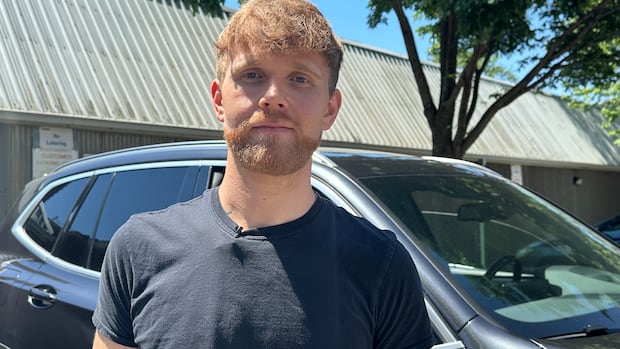
After his 2021 BMW required major repairs, Zack Giacomelli decided last month he wanted to sell it back to BMW Toronto — the same dealership from which he bought the used car in 2023.
At first, the buy-back process seemed easy. After submitting an online inquiry, Giacomelli got a text from Quinn at BMW Toronto, who was eager to help.
Quinn expressed sympathy for Giacomelli’s car troubles and asked questions about the vehicle, which was still being repaired at the dealership. Later in the same text conversation, Quinn made a firm buy-back offer: $27,162.79.
Giacomelli, a 31-year-old funeral director, was satisfied, as the offer was just enough to cover what he still owed on the car.
“I felt this Quinn person was finally hearing me out,” he said. “I was feeling really good.”
The good feeling didn’t last. Moments later, Giacomelli said, a BMW Toronto sales consultant called to revoke the offer, explaining that Quinn wasn’t a real person, but rather an artificial intelligence chatbot that had made the offer in error.
“He said the offer is not valid,” recalled Giacomelli. “I was shocked, I was astounded, like my jaw was on the floor.”

He said his shock turned to anger when the dealership informed him the actual buy-back offer would be, at best, $20,000 — a drop of more than $7,000 from what Quinn had promised.
“I was devastated,” said Giacomelli. “If they’re going to be replacing their employees’ jobs with AI, then they need to be honouring what that AI says.”
Can AI enter into a contract on a company’s behalf?
As Canadian businesses rush to adopt artificial intelligence tools, they face a growing risk of customer backlash — even legal action — if those tools make mistakes.
Canadian law has already established that companies can be held liable if AI chatbots dole out bad information. In a 2024 case, Air Canada was forced to honour a fare rebate after its chatbot provided a passenger with incorrect advice about bereavement fares.
The airline argued before the British Columbia Civil Resolution Tribunal that the chatbot was “a separate legal entity that is responsible for its own actions.” But the tribunal disagreed, stating that Air Canada was ultimately responsible.
“Just like an employee may do something wrong and the company’s held responsible, a bot is just like an employee,” said Tanya Walker, a litigation lawyer with Walker Law in Toronto.
“I don’t think companies really realize the magnitude and the power that a bot can have,” she said. “It can enter into a contract on your behalf.”
Dealership honours AI offer
Part of Giacomelli’s frustration stemmed from the fact that he had no idea he was communicating with AI. Quinn never revealed its true identity, according to text exchanges examined by CBC News.
“I feel embarrassed, and I feel angry that I’ve been negotiating with this bot,” said Giacomelli.

When Quinn initially offered $27,162.79 for the BMW, Giacomelli countered with $28,500, just to see if he could get a better deal. Quinn sounded optimistic, texting that “the team” would consider it, and that “$28,500 sounds reasonable.”
By the time the dealership revoked Quinn’s original offer, Giacomelli had not yet accepted it, as he was waiting to hear back about his counter-offer.
Even so, Walker said, Giacomelli could still argue that he had an agreement because, near the end of the text exchange, Quinn set up a physical meeting at the dealership to seal the deal. “Let’s lock in today at 3:30,” the AI texted.
“It is reasonable for him to believe that there was a binding contract,” said Walker.

After CBC News reached out to BMW Toronto, it reinstated Quinn’s original offer of $27,162.79.
“I feel so relieved,” said Giacomelli, who immediately accepted.
BMW Toronto sales manager Scott Shadbolt told CBC News in a phone interview that the dealership wanted to “do right” by Giacomelli.
Shadbolt said that, due to miscommunication from a human employee, Quinn misinterpreted the amount Giacomelli owed on the car — $27,162.79 — as the amount BMW would pay to buy back the vehicle.
“The AI bot ran with that, misunderstood the message,” he said.

Walker said companies shouldn’t let AI broker deals if they’re not prepared to stand by them.
“I think that’s an unfair business practice.”
Shadbolt said Quinn was never programmed to independently negotiate contracts, only to relay human-generated buy-back offers. Moving forward, he said, only human employees will present customers with such offers.
Shadbolt also said that BMW Toronto is making changes to ensure customers know when they’re interacting with AI.
“It’s a bit of a new territory for us,” he said. “We’re trying to figure out the best way for a good [AI] customer experience.”

As the federal government’s newly announced AI strategy champions more giant data centres, a growing number of Canadians want nothing to do with them, including Manitoba Premier Wab Kinew who just killed a plan to build one near Winnipeg. Backlash is also growing across the U.S.
More trouble ahead?
Walker expects more of these types of disputes will emerge as businesses use AI to enhance their customer service.
According to Statistics Canada data compiled in the second quarter of 2025, 12 per cent of Canadian businesses reported using AI to produce goods or deliver services — up from six per cent in the same period in 2024.
Among those companies, 25 per cent were using chatbots or virtual agents.
Legal obligations aside, companies have a corporate responsibility to make it right for customers if their AI tools fail, said Gus Skorburg, a professor at the University of Guelph.
“A human decided to deploy the chatbot. Presumably, they made that decision because they judged, like, ‘Hey, this is going to save us some costs,'” said Skorburg, co-director of the university’s Centre for Advancing Responsible and Ethical Artificial Intelligence.
“But bots don’t always pay off, and so when they make mistakes, you have to be willing to sort of own up to that.”