







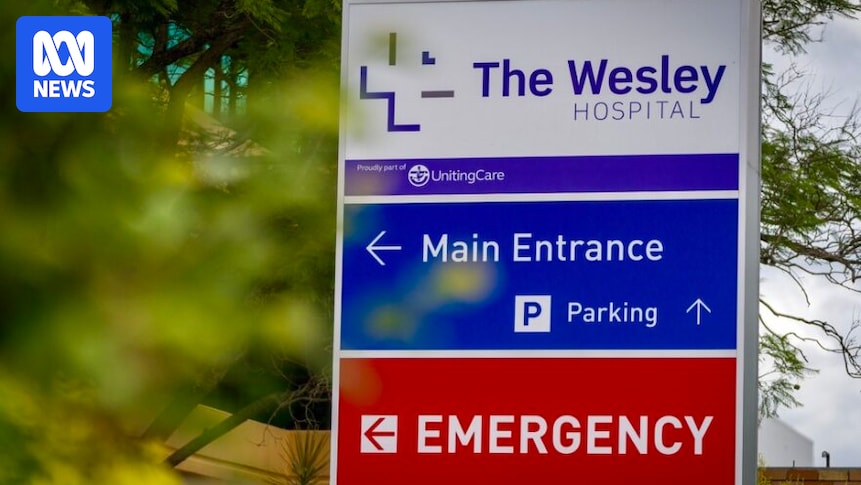
A woman who died three days after gastric bypass surgery likely would have survived if she had not been discharged, an inquest has found.
Gold Coast woman Rosemarie Campbell died in February 2022 at her home of complications after the operation performed by Vahid Reza Adib at The Wesley Hospital in Brisbane.
A coronial inquest into her death, held over three days in August last year, heard from nursing staff at the hospital, medical experts and Dr Adib, who has been in a relationship with former premier Annastacia Palaszczuk.
Rosemarie Campbell’s family attended the inquest last year. (ABC News)
According to evidence submitted to the inquest, Ms Campbell began complaining of nausea the evening after her gastric bypass surgery on February 24, 2022.
She was discharged at midday the following day despite vomiting several times.
In her findings published on Tuesday, Deputy State Coroner Stephanie Gallagher said Ms Campbell should not have been discharged due to her deteriorating condition.
“It ought to have been appreciated that Ms Campbell was sufficiently unwell that she ought not to be discharged from hospital,” the coroner’s report said.
The inquest found Reza Adib was not informed of Ms Campbell’s deteriorating condition. (ABC News: Kenji Sato)
During the inquest, Dr Adib said that vomiting after surgery was common and he did not need to ask more questions.
Ms Gallagher rejected this submission, stating, “Dr Adib should have asked more questions, especially about the volume of vomiting”.
She said the volume of vomiting was not normal or satisfactorily controlled on the normal medication.
However, the coroner found nurses had not informed Dr Adib that Ms Campbell’s condition was worsening.
“Had Dr Adib been alerted to the issues of concern and attended upon Ms Campbell, it would seem that he would not, acting appropriately, have agreed to Ms Campbell’s discharge and indeed, she would have been assessed and investigated for the cause of her complaints,” Ms Gallagher said in her findings.
The coroner found Ms Campbell should not have been discharged from hospital. (Wikimedia: Commander Keane)
She said had that assessment and investigation occurred, it was likely the complications with the surgery, namely the herniation and perforation of Ms Campbell’s bowel — which in hospital are not normally fatal — would have been discovered and corrective surgery would have been undertaken.
“It is likely that these things would have prevented the further deterioration and that Ms Campbell would have survived this surgical complication,” she said.
“Both complications are treatable and while death may still occur, it can be inferred from this evidence that it would more likely than not have been avoided had Ms Campbell not been discharged and instead had been reviewed by Dr Adib.”
Credibility questioned
Ms Gallagher found Dr Adib had used false statements to encourage Ms Campbell’s general practitioner to support her weight loss surgery.
The coroner found Dr Adib’s “credibility was seriously undermined” by a letter he wrote supporting her early access to superannuation to fund the surgery, which was based on a template.
“It is plain that he intended for Ms Campbell’s application to be successful, and it follows that he wrote a letter that contained false statements for that purpose,” she said.
“His explanation for doing that, when surely he must have known that he ought not, was that it was his patient’s choice.”
She rejected this as an excuse and said that having such a template letter “casts doubt on the use of it being patient initiated”.
“In any event, it was an egregious breach of his responsibilities as a medical practitioner to have signed such a letter,”
she said.
“It reflects very poorly on his credit generally and re-enforces the unreliability of his contemporaneous records.”
The coroner questioned Dr Vahid Adib’s credibility. (Supplied: LinkedIn)
Ms Gallagher further found Dr Adib had “engaged in deliberate and substantial exaggeration about the quality and intensity of the pre-operative care Ms Campbell was provided by him,” and the only reason he could have done so was to mislead the investigating coroner.
“It reflects a disturbing tendency to exaggerating matters pertaining to his surgical service, tending to further raise concern about what advice he gave Ms Campbell,” she said.
Ms Gallagher concluded Ms Campbell’s death was the result of acute bacterial peritonitis and pneumonia and recent gastric bypass surgery.
Since the inquest, The Wesley Hospital has implemented improvements to discharge criteria, vital signs procedure and nurse training on recovery from bariatric surgery.
The coroner made no formal recommendations.
The Health Ombudsman suspended Dr Adib from practising medicine on June 2 this year.