







If you want to work out where the next frontier of political and social conflict will come from, it’s often worth listening to what politicians on both the hard left and hard right are saying.
Last week, while everyone was focused on Pauline Hanson calling for a monoculture, railing against mainstream media, and branding Australian workers as lazy, another part of her tightly scripted speech went largely unnoticed.
The nation’s now preferred prime minister also used her press club speech to tap into growing anxiety about AI’s impact on jobs, promising “mechanisms” to protect workers and calling for stronger regulation of artificial intelligence.
Labor’s AI problem
The fact that she mentioned AI during her speech provides a clear insight into just how effective the populist leader is in detecting the anxieties Australians face. She warned that the technology’s many unknowns demand “enforceable safeguards”.
While she may have banged on about workers in her call to overhaul industrial relations, she was strategic in zeroing in on their anxieties about what AI will do to their jobs and the jobs of their children.
And that anxiety isn’t limited to what AI will do. It’s also about the bits and pieces that come with it.
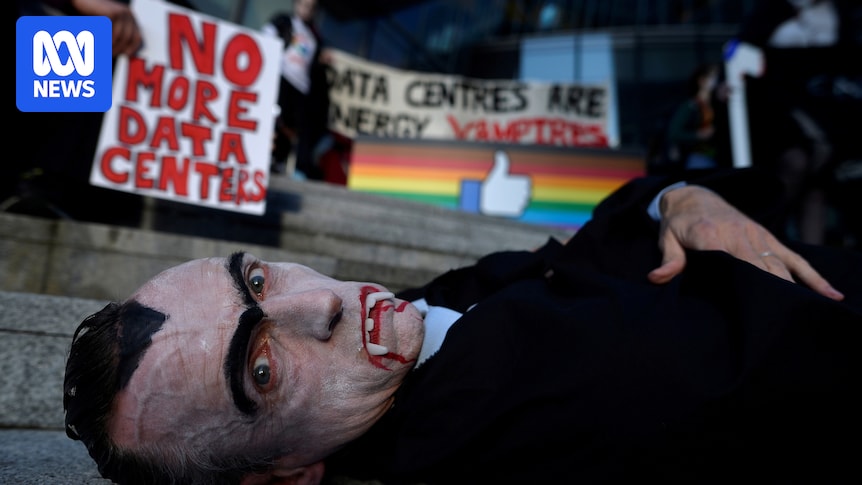
At the same time, the Greens have been campaigning against the rapid growth of data centres, arguing they are putting pressure on power supplies, water resources and local communities.
The Albanese government has been keen to say it is learning the mistakes of other nations and getting ahead of the backlash. (Reuters: Clodagh Kilcoyne)
These may seem like different debates, but they aren’t. One is about what AI does to us, and the other is about the infrastructure it needs.
This is problematic for Labor. The risk here is that anxieties and concerns about AI and the infrastructure behind it are bubbling up in very different parts of politics.
Hanson is talking about jobs. The Greens are talking about power and water. ACT independent senator David Pocock is asking whether communities are getting enough back in return.
In a recent speech, the Coalition’s industry spokesman, Andrew Hastie, compared the global race for AI supremacy to the Cold War nuclear arms race. He stressed that Australia faced a critical choice: either we establish sovereign capability and shape our own technological destiny, or we become heavily dependent on the US, China, and major global technology companies.
All of those above are unusual bedfellows, but all on a unity ticket about the same underlying concern.
That’s a dangerous force for Labor to confront. When progressives and populists lock in on an issue, it can leave the government looking flat-footed.
Sleepwalking into catastrophe
Housing and migration have become potent political issues. The fact that both Hanson and the Greens have AI and data centres on their radar means the issue risks becoming not a policy conundrum but a dangerous political minefield for Albanese.
Former industry minister Ed Husic told this column that Australia is sleepwalking into a catastrophe. He didn’t miss.
“Mainstream Australian politics doesn’t get it, but the edges of the political landscape are picking up these vibes and are ready to pounce,” he said.
Ed Husic told this column that Australia is sleepwalking into an AI catastrophe. (ABC News: Adam Kennedy)
“Increasingly, I’m hearing from people from all walks of life how concerned they are with the pace of AI growth.
“Again, if we think new One Nation voters are attracted to the idea of giving the system a kick, look how we’re managing [the] massive wave of data centre construction.
“Most local communities have absolutely no say about the construction of these centres in their area, leaving average residents fuming.
“When they resist, they’re told these data centres are important for the economy. So if they’re so important, why aren’t they being built in Bellevue Hill instead of Blacktown?”
On the left side of the ledger, Greens senator David Shoebridge has called the emissions rise from new data centres a “catastrophic trend”, claiming that it’s locals who are paying the price with spiking power and water bills.
In a recent speech laying out the Albanese government’s views on how to encourage the growth of AI — and increase investment in the data centres that underpin it — without pushing up energy bills and job losses, the assistant minister responsible, Andrew Charlton, said the sector needed to win public trust to avoid a major backlash.
That’s a reasonable ambition. The problem is that trust in institutions is at an all-time low.
Loading
Data centre debate no longer about technology
The government here has been keen to say it is learning the mistakes of other nations and getting ahead of the backlash. But if you listen to the Greens and One Nation, it’s pretty clear that the message isn’t penetrating.
Both have clocked that people are worried about AI and data centres; they see the eye-watering amounts of money in announcements, handshakes and ribbon-cutting, but they worry about what the new era means for their jobs and communities.
Prime Minister Anthony Albanese has enthusiastically backed data centre investment, including Amazon’s $20 billion expansion across Sydney and Melbourne. The government argues these projects are critical to economic growth, productivity and making the most of AI.
In the United States, there is evidence of a strong backlash that could hurt politically. Consumers are pissed off about higher energy and water prices, blaming the demands of data centres, while fears of massive job losses are growing.
Husic believes governments are making the same mistakes, being tech permissive and crossing their fingers that these companies will do the right thing by us. He says this isn’t just naive — it’s irresponsible.
“Australia has some of the lowest levels of trust in AI, but governments and businesses keep telling Australians to use a technology that they worry will be the end of their jobs or worse still, their kids’ jobs,” he said.
David Pocock is concerned that the government is just seeing the huge dollar signs data centres investment is bringing and not stopping to really think about the benefits for Australian communities.
“If not planned well, these behemoths can put huge pressure on power and water, not to mention job displacement from AI, so we need to be asking, where’s the pay-off?” he said.
“Where are the mechanisms to ensure locals get access to the computing power we will need to compete in an AI world?
“How are we making sure these companies don’t offshore all their profit and pay some tax here?
“Countries like France and the UK have already established digital taxes to capture some of that benefit.”
While the government has been trying to assure people there is nothing to fear from AI, many have already decided the technology is moving so quickly the government can’t keep up.
The risk for the government is how to explain what this technological wave will mean for people. Ribbon cuttings and regulations aren’t going to give comfort to an anxious public.
We don’t yet know who wins and who loses in the AI era.
The Greens, Hanson and Pocock understand the public is worried. The question is whether the government has clocked that this is no longer about technology, but a looming political debate where data centres serve as the perfect physical manifestation of this unpredictable new era.
Patricia Karvelas is host of ABC News Afternoon Briefing at 4pm weekdays on ABC News Channel, co-host of the weekly Party Room podcast with Fran Kelly and host of politics and news podcast Politics Now.