




Citizen scientists in South Australia say they were told to collect a dead bird from a beach when they called the government’s Emergency Animal Disease Hotline — advice they claim contradicts official messaging around handling sick or dead birds, amid the risk of H5N1 bird flu.
Warning: This story contains images of a dead animal some readers may find distressing.
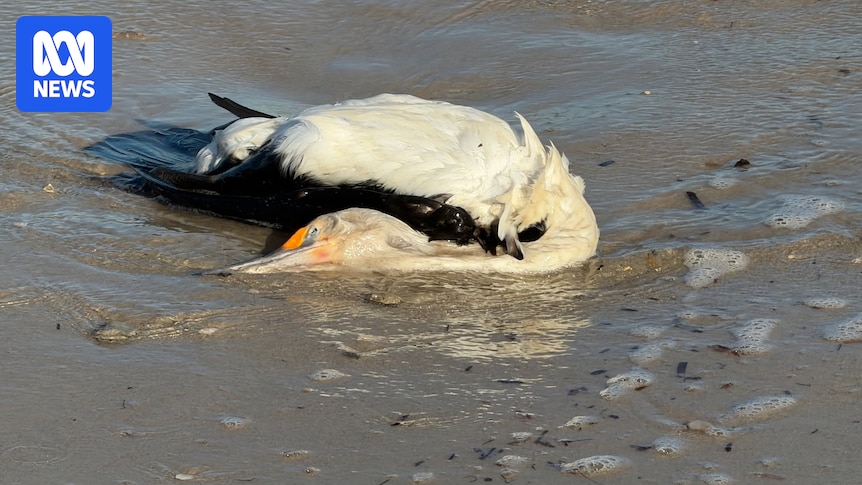
In a post to social media, Susan Belperio said she and fellow citizen scientist Johanna Williams had found a dead pied cormorant at Glenelg on Thursday June 25.
She said when they called the hotline that day, the pair were advised to collect the bird.
“The mantra is AVOID (don’t get close and keep dogs away); RECORD (which is what we did from a safe distance); and REPORT (to EAD Hotline 1800 675 888),” Dr Belperio wrote on social media.
“Unfortunately this state government funded 24 hour hotline FAILED in spectacular fashion this morning.
“No trouble getting through, but I suspect it was an overseas call centre because they advised us to collect the bird!”
Susan Belperio says she has been seeing an increasing number of dead pied cormorants at Glenelg, which she suspects are starving. (Supplied: Susan Belperio)
She said she had to explain to the hotline staff member that the bird flu had already been detected in SA and that the official advice was to avoid contact.
“The government has supposedly spent an enormous sum on preparedness for this event, so where has the money gone?” she wrote.
She said those answering calls to the hotline “must be brought up to speed urgently” and added that some members of the public still did not know what to do if they encountered unwell or dead birds.
“Another member of the public that we encountered had just called the police to report the death, so the advertising hasn’t reached everyone,” she said.
Johanna Williams says she has been documenting dead wildlife through iNaturalist since the beginning of the state’s algal bloom. (Supplied: Susan Belperio)
Fellow citizen scientist Johanna Williams said she wanted to make sure she followed the correct advice.
“We’re facing quite a severe and significant threat and we really can’t afford to be on the back foot with this, we really need to be proactive. We can’t let it, kind of, overwhelm us like the algae bloom did,” she said.
“I really want to be proactive in doing anything that we can to prevent this from spreading, and saving what we have left because it is really precious.“
Government ‘adamant’ advice must be provided correctly
SA’s Primary Industries Minister Clare Scriven said the state had still only recorded one case of bird flu and that reports of incorrect information being provided were being investigated.
“I was advised yesterday through a media report that there had apparently been some wrong information given on the Thursday — I immediately asked PIRSA [Department of Primary Industries and Regions] to investigate that,” she said.
“They haven’t been able to identify a staff member giving incorrect advice, but of course they have reiterated to all staff that the information must be up-to-date.”
Clare Scriven says PIRSA is investigating the women’s accounts of receiving incorrect advice. (ABC News)
She said that the advice from the Emergency Animal Disease Hotline had been updated as soon as bird flu was first detected in Western Australia.
“There has been an increase in the number of reports, which shows that people are aware and that they are keen to be part of that early detection if we do have any other cases,” she said.
“But I am absolutely adamant that the information must be provided accurately.“
PIRSA is set to meet with key stakeholders from the veterinarian industry today.
“They obviously have a lot of questions and PIRSA will be working through those with them to be able to give them the most up-to-date advice,” Ms Scriven said.
She said vets would be able to make their own decisions about whether they would take in birds or wildlife.
It comes after many veterinary practices posted to their social media accounts that they would no longer be able to accept sick or injured birds.
Ms Scriven added that the government had invested in early preparations for the arrival of bird flu.
“There’s been a lot of preparatory work that has gone in over the last several years, and we’ve talked about some of that in terms of decontamination units, additional laboratory expertise and mobile units and a raft of other measures,” she said.