







New analysis warns that China’s military is developing a “real and growing” ability to hit the Australian mainland with missiles, and can already threaten Australia’s trade routes, subsea cables and critical infrastructure.
The foreign policy think tank, the Lowy Institute, has tracked the “dramatic” scale of Beijing’s vast military build-up, which it calls a “historic shift” with sharp consequences for Australia’s security.
The analysis focuses on China’s military capabilities and does not make any predictions about the likelihood of conflict or the prospect of Beijing using military force against Australia.
But one of the report’s co-authors, the Lowy Institute’s Sam Roggeveen, told the ABC it was critical for Australia to closely monitor China’s growing ability to project power in the region.
“Capabilities take years to build, and intentions can change overnight,”
he said.
“So Australia needs to keep a laser-like focus on China’s capabilities because, however good our relationship with China, we can never know how the world will change.”
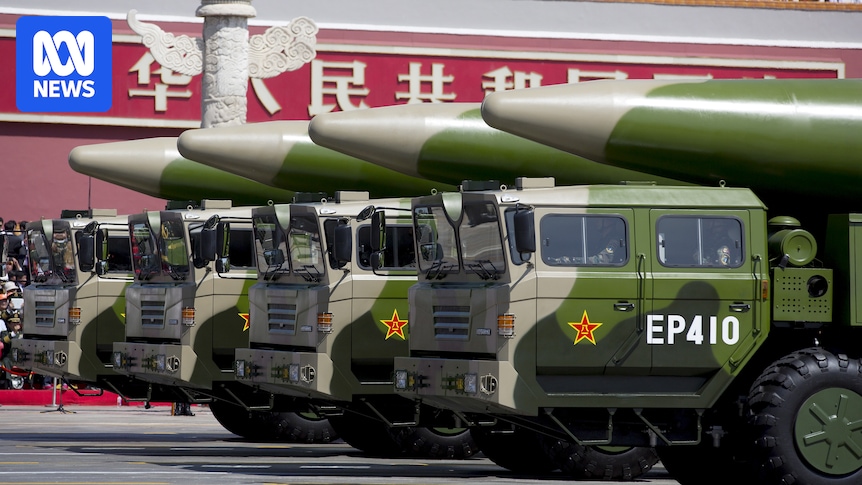
The report says that China can already hit Australia with ballistic missiles launched from ships and submarines, and retains the ability to strike northern Australia with its DF-26 missile system if fired from its artificially built islands in the South China Sea.
It also points out that Beijing can already block Australia’s trade routes through choke points of the Indonesian archipelago, sever undersea cables, which Australian communications and commerce depend on, and conduct sophisticated cyber operations against Australia’s critical infrastructure.
But the authors warn the threat to Australia would escalate “dramatically” if China secures a military base in the Pacific or successfully develops a new long-range bomber or drone with the size and range to reach Australia.
The Chinese embassy has been contacted for comment.
Mr Roggeveen told the ABC that while China’s ability to strike Australia directly was “limited” it was also “growing in a worrying fashion.”
“I’d argue that for a military force of China’s size, that direct strike capability is still fairly modest, as China’s focus has been closer to home,” he said.
“But that is now clearly beginning to change.“
Chinese H-6 bombers on Woody Island, in the South China Sea’s disputed Paracel archipelago. (Supplied: Maxar Technologies)
The report says China may have developed a new missile with a range that can reach Australia and points to speculation by the Pentagon that Beijing has also built a new intercontinental ballistic missile armed with a non-nuclear warhead.
The federal government has been locked in what the Foreign Minister has called a “permanent contest” with China across the Pacific as it tries to stop Beijing establishing a military foothold in the region.
The Lowy Institute report offers a blunt assessment of the status quo, saying that China has “actively sought basing arrangements in Pacific Island nations since at least 2018” and that “any such base would bring central Australia within [bomber] range and allow attacks to be mounted more frequently.”
Mr Roggeveen also pointed to recent analysis suggesting China is developing a new long-range H20 bomber that would be able to reach the Australian mainland.
“We have no photographic evidence it even exists, but there is plenty of reporting from good open sources and Pentagon annual reports which refer to this design,” he said.
“It’s quite possible that photographic evidence emerges this year. We assume it’s close to breaking cover.
“We also see some evidence emerging that China is looking at long-range drone systems, not just for surveillance, but potentially one which could act as a bomber, which could potentially reach Australia — although it’s difficult to see China fielding that capability within a decade.”
The report also details the way China’s military has been rapidly building up its naval power.
Mr Roggeveen said China had traditionally lagged in its nuclear-powered submarine capability, but “we now see good evidence of new shipyards and very modern designs.”
He said the People’s Liberation Army (PLA) Navy’s circumnavigation of Australia last year showed how it was increasingly able to project power further afield and that it was clearly intent on building more aircraft carriers that would allow it to push further afield.
“They’re learning to operate those carriers in an efficient manner and developing real military capabilities,” he said.
“And they’re pushing for up to nine carriers, which would make them far and away the second biggest aircraft carrier fleet in the world, and close to the US.“
The Lowy report concludes by warning that China’s growing military power also undermines Australia’s security because states in Southeast Asia “face growing pressure to accommodate Chinese preferences as the balance shifts, even where they resist doing so openly.”
“The primary counterweight is the credibility of US extended deterrence and the cohesion of US-led security arrangements, both of which China’s build-up is directly designed to erode,” it says.
“The PLA is thus helping China to construct a sphere of influence in Southeast Asia that excludes Australia and its partners.”
“In sum, these changes represent a historic shift that affects Australia’s interests regardless of China’s capacity to strike Australian territory directly.“