






Screening parties, brand activations, special menus — businesses across Toronto and Vancouver are stepping up their game to attract customers during the FIFA World Cup, which starts this week and runs until mid-July.
For example, Toronto restaurants Vinny’s Bar, Daphne and Beso — owned by Ink Entertainment — will broadcast matches and offer “Flavours of the World” cocktails throughout the tournament. That includes the Golden Ball, a Canadian twist on the classic Old Fashioned with a touch of maple syrup and apple cider.
Four Seasons, the Canadian luxury hotel chain, is also hosting watch parties and offering a special appetizer menu.
While these events can be costly and might not immediately translate into sales, businesses hope they generate something just as valuable: brand awareness.
Kristi Grotsch, who manages Four Seasons’ Toronto location, hopes these marketing efforts will help build customer loyalty at home and at its hotels and resorts across the world.

Restaurants and hotels, as well as international consumer brands, see aligning themselves with the FIFA World Cup as a smart marketing ploy.
“It’s really an opportunity for us … to see growth in hotel occupancy and an opportunity for us to also welcome a diverse net of international travellers,” she said. The hotel is expecting a 30 per cent boost in revenue from its rooms during the World Cup compared to the same period last year.
Tournament logos, trademarks and official branding are tightly controlled by FIFA, and unauthorized promotions could expose businesses to legal action. That’s why Ink Entertainment and Four Seasons, for instance, avoid overt references and signage about the World Cup.
Charles Khabouth, CEO of Ink Entertainment, says events at his venues are often paid for by other companies, which use them as advertising platforms. Khabouth says brands can spend around $300 per person for World Cup-related events, also known as “activations.”

“So if you invite 300 people, it’s $90,000, it’s $100,000. It’s quite intense, but [the companies] all see the value,” he said. “It’s like having an ad on television … a way of showcasing without asking people to give you anything back in return other than being loyal as customers and trusting you.”
“Everybody knows what the return is,” Khabouth said. “It doesn’t need to be monetary. The return is people believing in the brand.”
‘Top-of-mind awareness’
Local businesses aren’t the only ones looking to capitalize on the opportunity provided by co-hosting the world’s largest sporting event. Major corporations also want in.

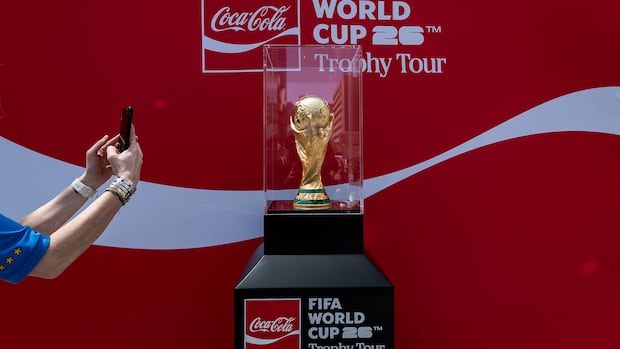
Coca-Cola is setting up “fan zones” across FIFA World Cup host cities, including in Toronto’s Fort York neighbourhood and Vancouver’s Hastings Park. Visa set up small soccer fields in front of Toronto city hall, with its logo plastered everywhere.
David Soberman, a marketing professor at the University of Toronto’s Rotman School of Management, says major brands do this to boost what he calls “top-of-mind awareness.”
This is a marketing concept that refers to the first brand that comes to mind when consumers think of a particular category of products or services, such as soft drinks, credit cards or express shipping.
By associating itself with the World Cup, Coca-Cola could boost its market share in Toronto and Vancouver by a few percentage points, Soberman says.
“Four or five share points in this market is worth millions of dollars. And that’s why these companies are willing to invest millions of dollars in events like the World Cup,” he said.

Even so, Soberman argues the marketing hype could be short-lived.
“I think, by August, people will be back to thinking about other things, like baseball and football, so the halo effect surrounding the World Cup will have waned by then.”
According to a survey conducted by the Canadian Federation of Independent Business (CFIB), 83 per cent of small businesses in Toronto and Vancouver don’t expect the tournament to boost sales. Seventy-two per cent of respondents suspect the World Cup will have no impact on revenue, while 11 per cent say it could actually decrease sales.
“Many consumers are already financially stretched, and higher event-related spending on things like tickets can leave less money available for local shops and restaurants,” said Kalith Nanayakkara, CFIB senior policy analyst for British Columbia.
Community organizations also showcased
That possibility clearly hasn’t deterred the host cities.
The City of Toronto invested $1.7 million to fund more than 60 community events during the World Cup, including music festivals, art showcases and multicultural fairs. Local business associations — in neighbourhoods like Cabbagetown, Kensington Market, North York and Roncesvalles — are among the funding recipients.
On its website, tourism agency Destination Vancouver highlights more than 140 venues, businesses and community organizations hosting FIFA-related events and experiences. Among these: the “After Dark: Science Scores” party at Science World and “soccer shows” featuring sea lions and otters at the Vancouver Aquarium.
“Most of what you’ll see on our World Cup Events calendar is very grassroots and initiatives by small businesses to attract customers to their establishments,” said Suzanne Walters, director of communications and stakeholder engagement at Destination Vancouver.

Jen Riley, president and chief executive at the British Columbia Chamber of Commerce, sees these events and initiatives as a “long-term opportunity” for businesses.
Riley points out the province is looking to bolster investment during the World Cup, launching the “BC Business House” last month. The business networking venue is meant to put a global spotlight on its key sectors and most promising companies.
“Getting your brand in front of this many people excited to see soccer, it’s a lot of eyeballs,” she said. “For us in British Columbia, we’re just excited to be able to bring the world to see what we have here.”