




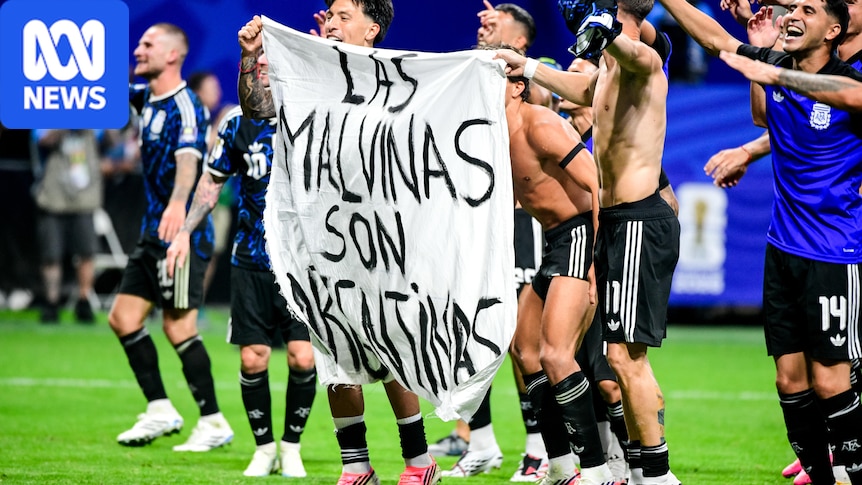
The British government has urged FIFA to investigate Argentina’s team after players celebrating their 2-1 win over England in the World Cup semifinals posed with a banner that claimed sovereignty over the contested Falkland Islands.
During post-match celebrations in Atlanta, Argentine players held a banner handed over by fans, reading “Las Malvinas son Argentinas” — “The Malvinas are Argentine.”
Argentina refers to the Falkland Islands as Islas Malvinas. They were invaded in 1982 under orders from Argentina’s then-military dictatorship, triggering a 10-week war won by Britain.
“The World Cup might not be ours, but the Falkland Islands definitely are,” a spokesperson for Prime Minister Keir Starmer said.
“Self-determination rests with the islanders, and our commitment to the Falklands will never waver.”
Britain’s Prime Minister Keir Starmer has supported calls for FIFA to take action against the Argentine players. (Reuters: House of Commons/Handout)
Sir Keir supported calls for FIFA to investigate, the spokesperson said, after UK Business Secretary Peter Kyle said the players’ behaviour was “entirely inappropriate.”
FIFA can prosecute Argentina’s players and soccer federation because its disciplinary code prohibits, at stadiums, any “message that is not appropriate for a sports event,” including those of “a political, ideological, religious or offensive nature”.
The FIFA fines for political messaging range from around $US5,000 to $20,000 ($AU7,100 to $28,500). FIFA was approached for comment.
Argentine President Javier Milei described the players’ celebration with the banner as “perfectly valid,” saying the message “reflects a sentiment shared by all Argentines”.
But he said he expected FIFA to fine the team.
Argentina’s President Javier Milei backed the players for displaying the banner. (AP: Rodrigo Abd)
“What the players do is understandable; they get carried away by their emotions, they act on impulse, and that will likely lead to discussions about a fine,” Milei told a local Buenos Aires radio station.
Vice-President Victoria Villarruel was more vocal in her support, posting a photo on social media of the players raising the banner with the caption: “The Malvinas are Argentine! They banned us from bringing [signs] into the stadium, forgetting that we carry them in our blood and in our hearts.”
A FIFA disciplinary case under previous leadership banned a South Korea player for two 2014 World Cup qualifying games because he held up a similar banner about a territorial claim against Japan at the 2012 London Olympics.
Park Jong-woo took a fan banner with the slogan “Dokdo is our territory” after South Korea beat Japan in the men’s bronze medal game.
Argentina player Lisandro Martínez was asked if the banner could have stirred deep emotions for veterans of the conflict.
“We couldn’t let the Argentine people down”, said Martínez, who has played in England for the past four years with Manchester United.
Where are the Falkland Islands?
Political tensions over the South Atlantic archipelago heighten the sporting rivalry between the two countries. It is a British overseas territory with a population of about 3,500 people, located about 13,000km from the UK and 480km from Argentina.
Argentina argues the islands were illegally taken from it in 1833. Britain, which says its territorial claim dates to 1765, sent a warship to the islands in 1833 to expel Argentine forces who sought to establish sovereignty over the territory.
The war in 1982 killed 649 Argentine troops, 255 British service personnel and three islanders.
That conflict ended during the 1982 World Cup in Spain, where Argentina, England, Scotland and Northern Ireland all played. British television networks declined to broadcast Argentina’s opening-game loss to Belgium.
“Sadly, it is a sad part of our history,” Argentina player Leandro Paredes said in Atlanta about the banner.
“For everyone involved in that chapter of, I repeat, our history. And it hurts. We knew we were playing for them, too.”
Politics in football
“Politics needs to be separate from football,” Mr Kyle told the BBC.
“In fact, the World Cup has one of its central tenets that politics is separate from football,” he said.
“That is now a matter for FIFA.”
FIFA boss Gianni Infantino takes a selfie with US president Donald Trump. (Getty Images: Emilee Chinn)
FIFA’s statutory political neutrality has been questioned at this World Cup after its president, Gianni Infantino, and disciplinary process — which could now judge Argentina — seemed to cave to pressure from US President Donald Trump in allowing United States forward Folarin Balogun to play Belgium in the round of 16.
Balogun was shown a red card in the previous round, and FIFA disciplinary rules mandated that he should be banned from his team’s next game. FIFA deferred the suspension for one year of probation. Belgium beat the US 4-1 to advance to the quarterfinals.
Mr Infantino is expected to sit with Trump at the World Cup final on Monday morning (AEST). Argentina plays Spain in East Rutherford, New Jersey.
Previous cases
Argentina players displayed the same “Las Malvinas son Argentinas” slogan during a warm-up game in Buenos Aires in June 2014, ahead of the World Cup that started days later in Brazil.
FIFA’s disciplinary panel ruling in that case was published after the tournament finished and fined the Argentina federation $37,000.
In the 2012 London Olympics case, FIFA’s ruling said the conduct of the South Korea player “cannot be tolerated.”
At the 2022 World Cup, FIFA fined the Serbian federation $24,800 for hanging a political banner about neighbouring independent state Kosovo in the locker room before playing Brazil.
It showed a map of Serbia that included the territory of Kosovo, which has been an independent state since 2008, and the slogan “No Surrender.”
AP