


On the night of June 12, 1996, six army Black Hawk helicopters were flying in formation over a defence training base near Townsville.
It was a routine counterterrorism training operation, simulating a hostage rescue.
When two of the helicopters flying at the front of the formation collided, it became a tragedy.
Eighteen soldiers were killed and twelve were injured — some critically.
It remains Australia’s worst peacetime military aviation disaster.
Loading…
Mass casualty
When a mayday call came in, senior paramedic Tony Kirkham was on shift in Townsville.
“It’s as if it was yesterday — so it’s very, very clear, very vivid,” Mr Kirkham said.
“For other colleagues that I’ve spoken to, it’s still quite fresh in their mind.”
Senior paramedic Tony Kirkham said there was a ‘constant stream’ of ambulances needed to treated patients from the Black Hawk tragedy. (ABC News: Kaitlyn Sawrey)
He had never responded to a mass casualty event.
A local sporting ground became a response centre, complete with a landing zone for a helicopter which was bringing the injured in.
Those killed were Trooper Jonathan Church, Trooper David Frost, Trooper Timothy McDonald, Corporal Mihran Avedissian, Corporal Darren Smith, Signaller Hendrik Peeters, Corporal Andrew Constantinidis, Corporal Darren Oldham, Corporal Brett Tombs, Lance Corporal Glen Hagan, Lance Corporal David Johnstone, Lance Corporal Gordon Callow, Captain Kelvin Hales, Captain John Berrigan, Corporal Michael Baker, Captain Timothy Stevens, Sergeant Hugh Ellis and Corporal Michael Bird. (Supplied)
Mr Kirkham remembers the injured arriving four at a time with a constant stream of ambulances needed to take them to hospital.
The work seemed endless.
“We didn’t really have any sound, confirmed information of how long this was going to go for,” he said.
“There were a lot of unknowns so that actually kind of made it feel like it was never going to end.”
He said while paramedics worked on treating and transporting patients, it was hard to focus on the enormity of the disaster.
The two Black Hawk helicopters involved in the crash were destroyed by fire. (ABC News)
He said he saw a great deal of courage and resilience from military personnel.
“I remember one gentleman [helping] and he actually had a broken arm and he … continued for quite some time,” he said.
Training turned disaster
On the day of the disaster, the air crew and soldiers conducted a daytime rehearsal of the mission as part of Exercise Day Rotor 96.
After dusk the mission was launched, with pilots and crew using night vision goggles.
The helicopters collided in a traiing excercise at a training area near Townsville. (ABC News)
It was a counterterrorism training operation, simulating a hostage rescue, which would culminate with SAS soldiers repelling down ropes and simulating the rescue of hostages.
Six helicopters were flying in formation, when one of the helicopters turned right and clipped the tail rotor of another.
It caused the helicopter to go into a spin, as both aircraft crashed to the ground, bursting into flames.
Between the two helicopters, six people survived and eighteen were killed.
The first helicopter exploded on impact with the ground, leaving only two survivors.
A permanent memorial in Townsville commemorates the 18 who were killed. (ABC News: Baz Ruddick)
A government inquiry found that inadequate planning and mission information could not pin down a single cause of the crash but rather a ‘chain of events’ — including planning failures, equipment limitation, and training deficiencies as contributing factors.
The remarkably, the pilot of the second aircraft, Captain David Burke, survived as he managed to keep the Black Hawk in an upright position.
Just days after the crash, he told media about the horror and bravery he witnessed.
Days after the tragedy, surviving pilot Captain David Burke told media about the bravery of the first responders. (ABC News)
“There were people going into the flames of aircraft to pull them out. There were rounds going off. There was ammunition in the air, there were explosives in the back of aircraft that were going off, there were aircraft exploding and these men — both SAS and aircrew — were going into the flames and cutting people out,” he told reporters.
“This has been a real tragedy and we are all deeply hurt by it, but what we have been doing we strongly believe in and we do it for the benefit of the people of Australia.”
A community in shock
At the time of the crash, Les Tyrell was the mayor of the City of Thuringowa — now part of Townsville.
He said the trauma had rippled through the community.
“The original information was of about three or four deaths and then that kept mounting up and mounting up,” Mr Tyrell said.
Les Tyrell was the mayor of Thuringowa at the time of the tragedy and said the community was ‘dazed’ and ‘shocked’ when the tragedy happened. (ABC News: Jess Naunton)
His strongest memory of the time was a commemoration ceremony held at Lavarack Barracks.
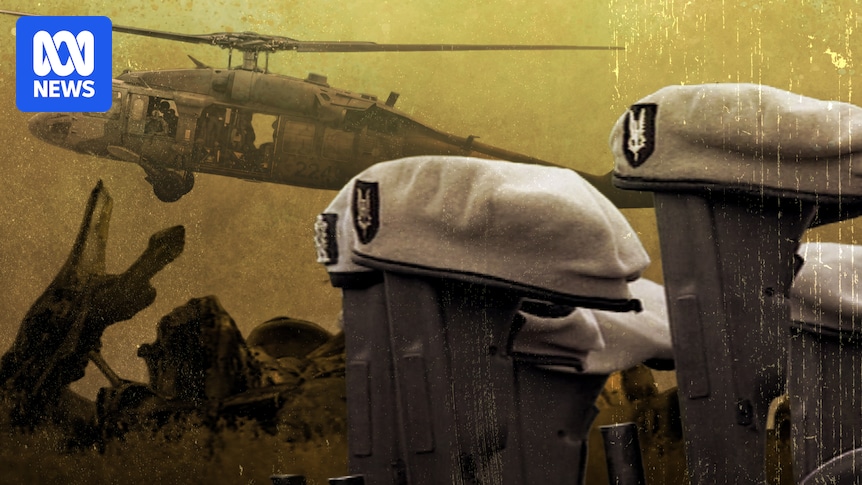
“They had rifles upended into the ground in a circle out in an open paddock and 18 of us were given a beret to take forward and put on the butt of the gun,” he said.
“It’s something that we should remember … and something that will go down in history as one of the saddest days of the city’s life.”
An Australian Defence Force spokesperson said the impact continued to be felt.
“Thirty years on, Defence honours the service and sacrifice of our fallen soldiers, and pays tribute to their enduring contribution to the Australian army and the nation,” the spokesperson said.
“We also recognise the exceptional courage and selflessness shown by survivors and rescuers in the aftermath.”
Remembering a devoted dad
Benjamin Berrigan was just about to turn three years old when his father Captain John Berrigan was killed in the crash.
Ben Berrigan said his dad Captain John Berrigan was remembered as a larrikin. (Supplied)
While his recollections of the time are foggy, the event and the loss of his dad shaped his life.
His memories are based on stories, photos and home movies.
“He loved to tell a joke. He played guitar so he was always kind of the life of the party,” Mr Berrigan said.
John Berrigan started his working career as a brick layer and an army reservist. He eventually went to the Australian Defence Force Academy in Canberra and developed a passion for helicopters.
Ben Berrigan says he has started telling his two-year-old daughter Elsie about his dad. (Picture:Supplied.)
“He worked his way up to being a captain and a pilot and that takes a lot of training, so as a soldier he was very strict and focused in what he did,” he says
Now a father himself, Mr Berrigan tells his own kids about their grandfather.
He sports a large tattoo on his back, a portrait of his dad.
“My oldest daughter points at it and asks questions about it which is good. I can kind of keep the memory alive and pass that down to my kids now.,” he said.
“He is with me forever no matter what.”
Ben Berrigan has a portrait of his dad tatooed on his back. (Picture: supplied.)
Mr Berrigan said when he was young he felt quite “emotional” when he’d watch the home movies of his family at the time, but as he got older his feelings changed.
“It’s more joyful more than anything — seeing him how he was.”
“They were brave soldiers doing what they did.”