






BHP has posted record iron ore production levels as the mining giant braces for a historic strike from its workforce in Western Australia’s Pilbara.
Unionised workers at BHP’s operations in Port Hedland will down tools from 2pm local time today for an eight-hour stoppage, the most significant industrial action in WA’s mining industry for a quarter century.
It follows months of bargaining between the mining giant and unions that has failed to produce an agreement.
Tensions reached boiling point when the combined ports unions — the Electrical Trades Union, the Australian Manufacturing Workers Union, and the Western Mine Workers Alliance — announced they had given the miner the required five days’ notice to take industrial action.
The industrial actions come amid record-setting quarterly performance for BHP, spruiking the company’s highest ever production of iron ore.
Critics, including Western Australia’s Chamber of Minerals and Energy, have accused the unions of holding the national economy to ransom, and have criticised the Albanese and Cook Governments for not intervening to halt the strike.
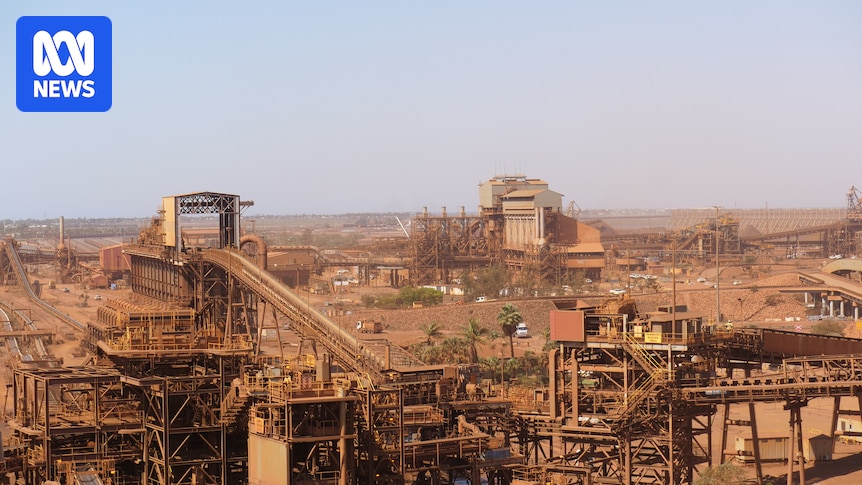
The stoppage will impact the miner’s facilities at the bulk export terminal in Port Hedland. (ABC Pilbara: Kimberley Putland)
Months of bargaining
The unions and miner have been locked in negotiations since October.
Unions have accused BHP of failing to negotiate in good faith, while BHP has continually said it was committed to reaching an outcome.
BHP tabled an offer that included a 16 per cent pay rise over four years — the same increase recently endorsed at the miner’s South Flank and Mining Area C operations.
Unions made no secret of their distaste for the deal, calling it “undercooked.”
BHP’s Nelson Point port operations in Port Hedland. (ABC News: Michelle Stanley)
The miner has since turned to the industrial relations regulator for help, making an application to the Fair Work Commission under section 240 of the Fair Work Act.
A bargaining meeting on Tuesday, involving the Fair Work Commission, ended without an agreement.
“Union claims that there has been no progress in bargaining are inaccurate,” a BHP spokesperson said.
“We will put the bargaining in front of the independent umpire to help dispel any myths about progress in bargaining.”
A bargaining meeting on Tuesday ended without an agreement. (ABC News: Jesmine Cheong)
Combined Ports Unions criticised the move as a delay tactic.
“BHP’s application relies on obtuse technicalities and has little objective merit,” the unions said in a statement.
“The way to solve this dispute is to negotiate a fair, transparent, enforceable agreement that recognises the specialist skills, difficult conditions and significant personal cost of workers who delivered the company a $15 billion profit last year.”
Record performance
Despite the stalled talks, BHP said it had still set several performance records across its operations.
Newly installed chief executive Brandon Craig wrote BHP’s Pilbara mines had achieved record iron ore production, “demonstrating the power of a disciplined operating system and world-class assets”.
Production increased 1 per cent to a record 265 million tonnes.
Mr Craig noted it came against a backdrop of strong prices for iron ore and BHP’s increasingly lucrative copper holdings.
Edith Cowan University industrial relations expert Alexis Vassiley said the strike signified a shift towards unionisation in the region and could set a precedent.
“It’s really about whether workers in the Pilbara can win a stronger collective voice in an industry that’s been largely de-unionised for decades,” he said.
Threat to Australia’s reputation
Mining industry consultant Philip Kirchlechner warned the strike action could make Australia less attractive to foreign investors.
“You may maximise the salaries in one particular company, but it will hurt the rest of the economy because of the spectre of strike action arising again,” he said.
“This action could have repercussions throughout the economy and other industries.“
Daniel Kiely says the strike is concerning for people in WA. (Supplied: Daniel Kiely)
WA’s Chamber of Commerce and Industry said any drop in iron ore exports would impact state and federal royalties.
“Now is not the time to put additional pressure on businesses and send the wrong signals to international investors,” CCI chief economist Daniel Kiely said.
He said any industrial disruption could also impact businesses and economic activity across the Pilbara.