









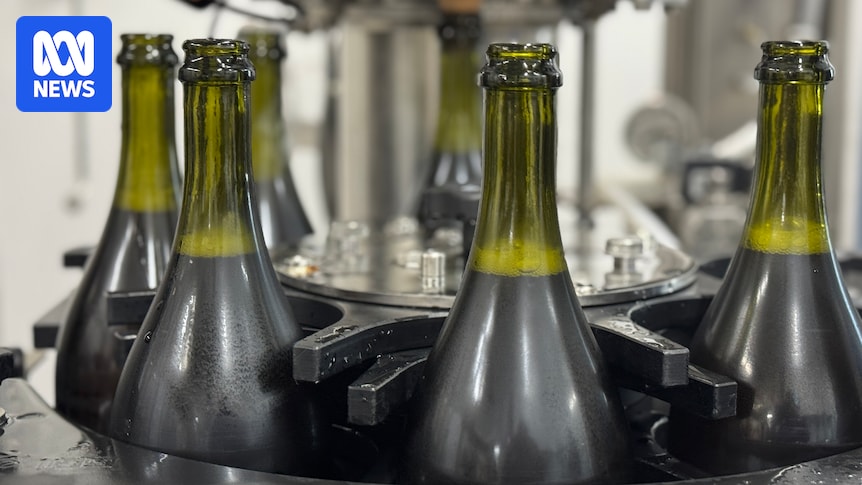
Acclaimed winemaker Ben Radford has introduced a new and surprising line-up of sparklings at a historic vineyard in South Australia’s Barossa Valley.
The bottles look at home among his cellar door wines, but when the cork pops, what pours out is actually beer.
Ben Radford is growing barley as well as wine grapes on his Barossa property. (ABC Landline: Tony Hill)
“What we’ve done is picked the most extreme soil types and climates and made an ale from each of those sub-regions in the Barossa,” he said.
If the process sounds familiar it is, at least in the wine industry.
“I’ve got a really good understanding of grapes [and] what flavours you get from different terroirs within the Barossa,” he said.
“And I went, imagine if we could show that with grain.”
The hobby that became a malt house
That seed was planted after a conversation with the operators of Malt Donkey, a new malt house in the Adelaide Hills that started as a home-brewing hobby.
“It was never a business, it was a passion project that’s gone out of control,”
founder Peter Michell said.
Mr Michell’s family owns a major wool processor, Michell Wool.
Peter Michell’s homebrewing hobby has taken on a life of its own. (ABC Landline: Kerry Staight)
His grandfather was also one of the pioneers of barley and wheat breeding in Australia.
When Mr Michell stopped running the wool business 12 years ago, he set out to take barley from functional commodity to beer’s flavour-carrying hero.
“People have been growing barley for years based on yield, yield from the paddock, yield in the malt house, we’re looking for flavour,” Mr Michell said.
Ben Radford has released his first single-origin ales. (ABC Landline: Tony Hill)
“We didn’t know whether it was land, whether it was climate, whether it was variety, so we had to try it all.
“We managed to beg, borrow and steal 30 to 40 different grains, some of them hadn’t been planted commercially for decades.”
Turning curiosity into a company
Mr Michell’s hobby became a commercial venture after years of research, field trials and brewing experiments.
“We started doing some really good stuff and I had a choice not to do it anymore because we’d come to the end of the small scale or go to the next level,” he said.
The Ashton malt house has state-of-the-art mini malting drums from Germany. (ABC Landline: Simon Goodes)
The next level is a state-of-the-art boutique malt house in an old apple packing facility at Ashton in the Adelaide Hills.
While it’s small compared to the massive malt houses of Australia’s brewing industry, it’s no backyard business.
“We have all the capabilities of the very large systems … to make top-shelf malt, but just condensed down to a very small system,” maltster Sam Barlow said.
Finding farmers to grow the barley and keep it isolated from other crops raised some eyebrows.
Sam Barlow runs the unusual malting operation. (ABC Landline: Simon Goodes)
“They operate in hundreds and thousands of tonnes and we’re like, ‘Cool, we’re looking for 10 tonnes,'” Mr Barlow said.
“So the scale they sort of giggle at, but then we talk about paying a massive premium for the barley and they stop giggling at that point.“
The company also leases part of a vineyard in South Australia’s McLaren Vale, where owner Oli Madgett grows the barley between rows of wine grapes.
“With a bit of a downturn in the wine industry, we wanted to actually optimise the usage of the whole of our block,” he said.
Oli Madgett grows brewing barley between his rows of wine grapes. (ABC Landline: Kerry Staight)
“When we’ve got vines, we’re actually only using about a third of the footprint of the block.“
“So now we can grow barley and grow with the other two-thirds.”
From malting to brewing
Malt Donkey’s initial aim was just to make the malt and supply other breweries, but with no existing market, it went into brewing instead.
Tom Whitehouse, who became Malt Donkey’s brewer, spent years at some of Australia’s best-known craft breweries where hops are the hero.
Tom Whitehouse’s job is to make the barley shine. (ABC Landline: Tony Hill)
“At first I didn’t believe it because it was a bit of a mystery and I was like what, malt’s just a commodity,” he said.
“But I guess the curiosity got to me and I just decided, ‘Let’s give it a shot and see what we can do.’“
To make barley the star, Tom Whitehouse brews each beer using the same recipe, changing only the grain.
“I was nervous that all the beers we made would taste the same,” he said.
“But when we brewed from five different sites in the first harvest, they all tasted different and now we’re getting similar results with barley from the second harvest.”
He took the same approach with Ben Radford’s Barossa Valley ales, recently launched to the hospitality industry after an initial private tasting.
Ben Radford is growing barley as well as wine grapes on his Barossa property. (ABC Landline: Simon Goodes)
“I had that epiphany moment where I sat down nice and quietly in the cottage after they’d all been bottled, lined them up and went through,” Mr Radford said.
“They are so different.
“Wine has always been amazing as far as different flavours from different sites, but I had no idea that grain had all these flavours locked within it.“
From the elegant packaging to the specific provenance story, the barley first ale is positioned as an alternative to wine, to be paired with food and shared on special occasions.
But with alcohol consumption declining, tight disposable incomes and beer’s identity already established, the test is whether Malt Donkey’s attempt to create a new “fine ale” category can break through.
The idea is to take barley from commodity to flavour-carrying hero. (ABC Landline: Simon Goodes)
“[That’s] as big a challenge as it has been to create the thing in the first place,” Mr Michell said.
“I think it will be viable, but it will be viable in a boutique way, just like a boutique winery will be.
“And I’d love us to then create the demand for people to make better beers, better ales because they can.”
Watch ABC TV’s Landline at 12:30pm AEST on Sunday or stream anytime on ABC iview.