







When South Australian beekeeper Ian Cass looks at his beehives he finds a tiny, red mite.
Despite its size, it is this hard-to-manage micro menace that scares him most and threatens his livelihood.
He has begun hoping overseas treatments for the deadly varroa destructor mite will be introduced in Australia, following growing resistance to available mite treatments.
“We need some more options, we need some more choices to get through this,” Mr Cass said.
Resistance to treatment has been rising in multiple Australian states, with it appearing in Victoria, Queensland, New South Wales and South Australia, according to Agriculture Victoria.
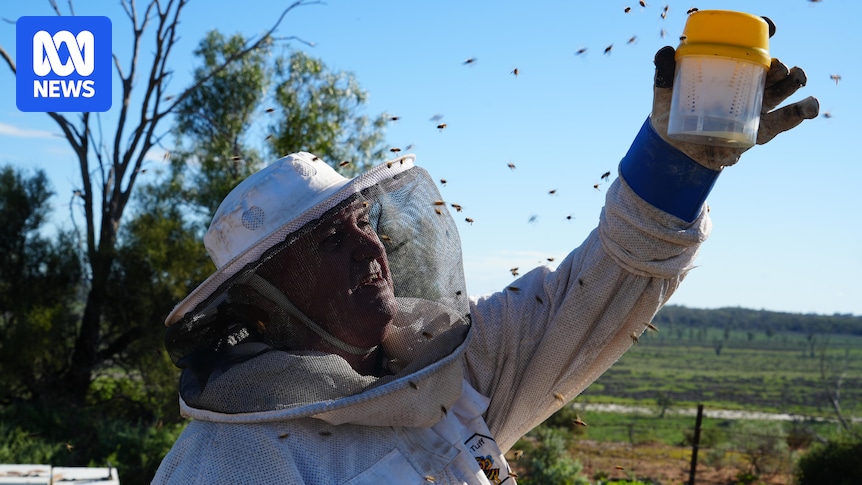
Ian Cass says the beekeeping community is scared for its future. (ABC Riverland: Amelia Walters)
The bee-killing mite has been in Australia since 2022, and is responsible for the estimated loss of 90 per cent of wild honey bee populations in some parts of Australia.
It most recently arrived in South Australia for the first time in September.
However, new research from New Zealand has offered beekeepers an alternative to the existing suggested combination of acaricide pesticides and hive biosecurity measures to manage the pest.
Victoria University of Wellington entomologist Phil Lester is part of a research team that has developed a biopesticide that makes the mites infertile.
Phil Lester says varroa mites in Australia are building their resistance to synthetic chemicals. (Supplied)
He said the approach used double-stranded RNA to silence reproductive genes.
“What it does is it’s a natural process that’s involved in turning off a gene,” Professor Lester said.
“This one in particular, this gene works on the reproductive system of the mite, so it doesn’t kill the mite … it stops it from laying eggs within the hive.
“What this sort of product does is allow a different approach — one that there isn’t any documented resistance to — that could be utilised or could be a key part of the toolkit for varroa control in Australia.”
Professor Lester said it would stop the growth of varroa populations and was safe for use on all bees, but it could take up to two years to be available in Australia.
“The bees themselves live for just as long as they should do, much longer than they do if you don’t treat them and just let varroa do its thing, parasitise and kill the bees,” he said.
The biopesticide is administered through a sugar wash solution that is then spread around the hive by the bees. (Supplied: Phil Lester)
The research was funded in part by GreenLight Biosciences Inc, a United States company that produces the product, called Norroa, commercially.
Beekeepers plead for investment
Mr Cass said he had been following the progress and results of Norroa in the United States from his Riverland property.
“When I saw that I thought, ‘Wow, that’s an opportunity for us,'” he said.
“We need it now.”
He wants Australia to implement it as soon as possible to address the exit rates of beekeepers.
In a 2026 Australian Honey Bee Industry Council industry-wide survey, 32.2 per cent of respondents said they were planning to leave the industry, with varroa mite listed as the top driver.
“We’re trying to survive something that we don’t know what’s going to happen,” Mr Cass said.
Varroa mite was first detected in South Australia in September. (ABC Riverland: Amelia Walters)
He said while treatments had worked so far, the building resistance was the biggest issue.
“The beekeeping community, I think, are quite terrified,”
Mr Cass said.
“I thought I had a plan organised … all of a sudden, our plan got thrown in our face and our safety net is gone.”
More than 30 per cent of surveyed beekeepers say they are planning to leave the industry. (ABC News: Will Murray)
South Australia’s Department of Primary Industries said in a statement that beekeepers should continue with their treatments.
“Indications in New South Wales and Queensland, where the bulk of interstate detections of resistant varroa have occurred, both synthetic pyrethroid- and formamidines-based acaricides continue to remain very effective against the susceptible population,” a spokesperson said.
“[They] should not be discounted in a rotation of treatment for the management of varroa mite.”
The department encouraged beekeepers to report suspected cases of treatment resistance.
Federal Agriculture Minister Julie Collins has been contacted for comment.