







An Australian fertiliser company says it has already sold the entire urea output from its proposed plant, worth about $2.4 billion, before it has been built.
The Australian Fertilizer Corporation plans to build a facility on the site of a defunct ammonia export project at the Port of Gladstone, about 530 kilometres north of Brisbane.
Australian Fertilizer Corporation plans to develop a site in the Gladstone State Development Area. (Supplied: Queensland government)
Chief executive Stein Haugan said the company secured contracts covering all of its planned production capacity of 220,000 metric tonnes of technical grade urea per year for the next 10 years.
“The core product that will be coming out is AdBlue, which is an emission exhaust control product,”
he said.
“One [customer] is an Australian company, which will be exclusive for the Australian market.
“And one is a major international producer and marketer of the same product, which will have the exclusivity for all the overseas market.”
Out of the blue
AFC’s proposed Gladstone facility will be Australia’s first new urea manufacturing plant since 1969. (Supplied)
Demand for AdBlue, a fuel additive that reduces pollution, has risen globally as stricter emissions standards are adopted for diesel vehicles.
In Australia, all new cars are required to meet a standard equivalent Europe’s “Euro 6d,” which requires the use of AdBlue in some vehicles.
“The global use for this technical grade urea is growing exponentially because of legislation on environmental issues,”
Mr Haugan said.
“We envision that the growth in consumption will also go much higher in Australia than it is today.”
Loading…
Australia imports all of its urea after the Gibson Island facility at the Port of Brisbane closed in early 2023.
“So it’s an import replacement project as well,” Mr Haugan said.
While traditionally made using natural gas, the Gladstone Urea Facility would use mining by-products like old tyres, biomass and solid waste in its production process.
Mr Haugan said the method was attractive to manufacturers looking to capitalise on carbon credits, and similar technology was already being used in the United States and China.
Urea production will be aimed at supplying farmers. (ABC Rural: Clint Jasper)
He said there were plans for at least two more factories on the east coast, predominantly targeting farming.
“So in the long run, we hope to be able to produce about 1 million tonnes of urea and a large part of that will go into Australian agriculture,” he said.
Fertiliser pressure easing
National Farmers’ Federation president Hamish McIntyre said the proposal was a good step forward in strengthening Australia’s sovereign capability and food security.
“Hopefully it can develop further just past AdBlue into paddock-grade urea that we all require to produce food and fibre in Australia,” he said.
Hamish McIntyre wants more urea to be produced in Australia. (ABC News: Callum Flinn)
The Gladstone project was still looking to secure finance and development approvals, but if successful, construction could start within two years.
Mr McIntyre urged governments to support developing more manufacturing in Australia.
“Don’t apply a regulatory burden to it that makes it not affordable for these companies [and] industries to get on with what we need to have in Australia,” he said.
Earlier this week, the federal government announced it had secured three new shipments of fertiliser to arrive in coming weeks, and with the Strait of Hormuz technically reopened, he said pressure was steadily easing.
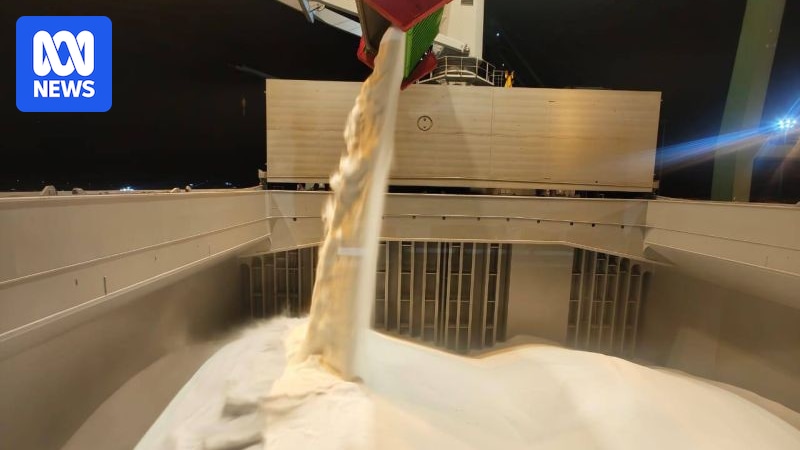
MV Karisma arrived in Australia from Brunei in early June with a full load of urea. (Supplied: Marnco)
“Australia’s planted a big winter crop again, despite these constraints and costs,” he said.
Even so, farm profits were forecast to fall by up to 70 per cent, and while fertiliser supply had improved, Mr McIntyre said prices were yet to normalise.
“Hopefully our in-crop fertiliser we all need to apply to our winter crops will be at a more affordable price,” he said.
“That will drive down our cost of production but also drive our productivity.”