







Listen to this article
Estimated 4 minutes
The audio version of this article is generated by AI-based technology. Mispronunciations can occur. We are working with our partners to continually review and improve the results.
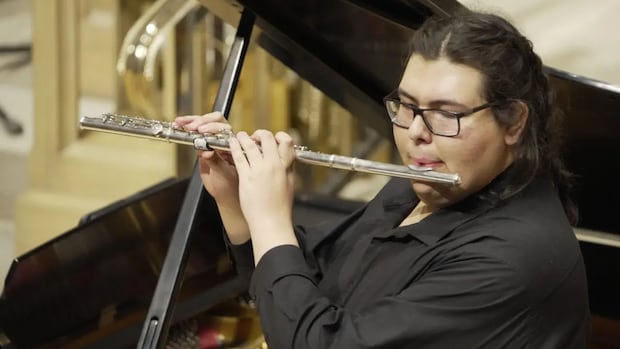
Tyler Evans-Knotts has been playing the flute since he was nine and it’s taken him from Curve Lake First Nation in southern Ontario to the Victoria Conservatory of Music.
“I just fell in love with the process of music making and the community that came with that,” said Evans-Knott, 25.
Evans-Knott was recently accepted into McGill University’s Schulich School of Music. But damage to his flute has put a hold on those plans, forcing him to seek outside help to afford a new professional flute in order to continue his career.
Evans-Knott’s mother Janet Evans said she might have to dip into her own retirement fund.
“It’s hard to ask people for money,” Evans said.
“There’s no other way without support from others that we’re going to be able to do this.”
Evans-Knott has had his current flute for eight years, which he said according to his instrument technician is the end of the lifespan for most flutes.
But the real problem is an erosion of the flute’s silver caused by a physiological condition that makes his sweat more acidic.
“The silver is eaten away at the pads of my flute, so I’m getting leaks in the instrument frequently and it’s just not sounding its best, and it hasn’t been for a while,” he said.
Evans-Knott said a gold flute would reduce the risk of erosion but as well as saving on repairs, gold has other advantages for the aspiring composer.
“What drew me to gold was the sound quality, very rich and dark in tone colour,” Evans-Knott said.

Evans-Knott’s mother estimates a new gold flute would cost well over $16,000.
“The timing is terrible,” she said.
She said they had to withdraw from McGill. Evans set up a fundraiser, but knows a gold instrument might sound extravagant.
“We’re trying to get as much duration out of it,” she said.
“We don’t want to five years down the line have [erosion] starting to happen again.”
‘The price of admission’
Cree flutist Virginia Sparvier-Wells said the cost of higher-level instruments keeps many Indigenous youth from furthering their careers in classical music.
She said there is a clear difference between a beginner, intermediate and professional level flute.
“We’re often told that the instrument shouldn’t matter, you just have to be good,” said Sparvier-Wells, who is a member of Cowessess First Nation in Saskatchewan.
The first professional flute Sparvier-Wells bought in 2005 while in university cost $11,000, which she could afford only because of an Indspire grant and a loan from her parents.
Later, an award allowed her to upgrade the head joint to a rose gold alloy, bringing the total cost of her instrument to $19,000.
“I wouldn’t have been able to progress further into my career without having access to a better instrument,” she said.
Melody McKiver, an Anishinaabe violist and composer from Obishikokaang (Lac Seul First Nation) in northwestern Ontario said a lack of generational wealth is one of the biggest barriers young Indigenous musicians face in classical music.
“It’s sort of the price of admission to be able to be considered competitive in this art form and discipline,” McKiver said.
“Just as an elite athlete will need specialized training and equipment, so do musicians to be able to play. The instrument really impacts your ability to perform.”

McKiver was one of the instructors when Evans-Knott attended the Banff Centre for Arts and Creativity’s Classical Indigenous Music Residency in Calgary two summers ago.
“He’s an incredible flutist,” McKiver said, adding he was performing at a “world class level.”
“I could see the jaws dropping as Tyler performed, like he’s doing something that few flutists are doing at such a young age.”
Evans-Knott said he’ll need a new instrument soon so he can start auditioning for programs, including re-auditioning for McGill. He also hopes to return to school in Victoria this winter to finish up courses for graduation.
As for the future, he said there are a lot of different avenues open to him, including composing.
“[It] is something I took up in 2024 at the Banff residency, and that’s becoming more prominent in the work I’m getting,” he said.