







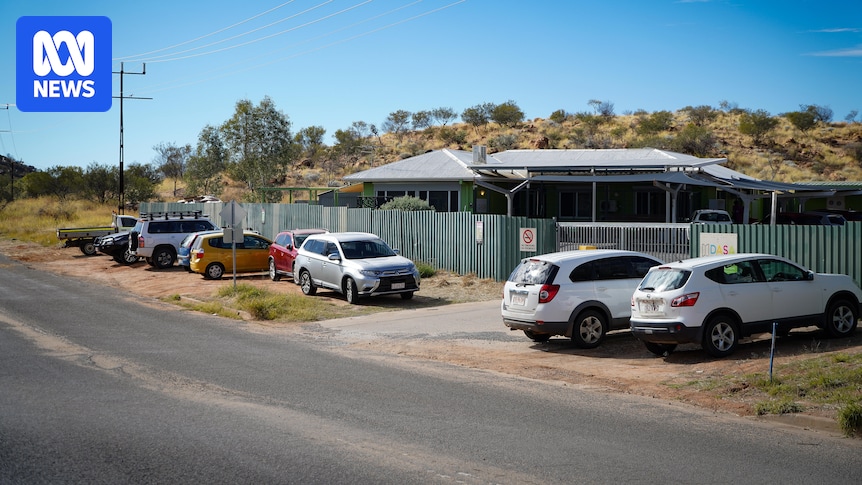
A major provider of drug and alcohol rehabilitation in central Australia has reduced the number of clients participating in programs at one of its sites to a third after it flooded earlier this year.
Drug and Alcohol Services Australia (DASA) was providing services to 28 clients at Aranda House earlier this year.
But when floodwaters inundated the site in February, DASA moved its programs to run, at a reduced capacity, out of the Central Australian Aboriginal Alcohol Programmes Unit (CAAAPU) as an interim solution.
Chief executive Eloise Cole said since then the programs had been moved again to run from DASA’s Bob Gaff House on Schwarz Crescent.
The space, however, could only accommodate 10 program participants, one-third of the number who could participate at Aranda House.
Aranda House was inundated with floodwaters in mid-February 2026. (Supplied: DASA)
“It’s certainly not something you would go out and choose to have as your facility for your therapeutic community [program] because of the size,” she said.
Ms Cole said Bob Gaff House also lacked commercial cooking and laundry facilities and did not have the same outdoor space as Aranda House.
“We will run it at a reduced capacity, and we’ll make it work,” she said.
It is not the first time DASA has been forced to move its programs after an infestation of cockroaches and bed bugs saw Aranda House residents temporarily relocated to CAAAPU a few years ago.
Hopes for new DASA infrastructure
Ms Cole said she hoped a new all-in-one, purpose-built site could be developed on the Schwarz Crescent block to better meet the demand for drug and alcohol services in central Australia.
The Northern Territory Department of Health, which owns Aranda House, has provided funding to explore the costs and designs for such a development.
DASA provides drug and alcohol rehabilitation services, which chief executive Eloise Cole says can reduce offending. (ABC Alice Springs: Xavier Martin)
Ms Cole said if further funding was granted for construction, the development could be a long-term solution to DASA’s infrastructure problems.
“People who are suffering or struggling with harm from drugs and alcohol use often have not very much self-esteem. They don’t feel worthwhile,” she said.
“If we can provide them with a facility that actually recognises that we as a community value them, and that their lives are worth so much, I think that’s only going to bring positive outcomes.“
Eloise Cole says a purpose-built facility for DASA could help reduce crime in Alice Springs. (ABC Alice Springs: Victoria Ellis)
Ms Cole said a new facility would also play “a very big part” in reducing crime in central Australia through its restorative day program, therapeutic community program and outreach work.
“We have a lot of referrals through the court and correction systems,” she said.
“If people go to prison and are unable to access support, education, healing, etc while they’re there, then they’re more likely to re-offend.”
Strong need for more supports
CAAAPU chief executive Demian Coates said Alice Springs and central Australia had a real need for more services and greater capacity with services.
“From the perspective of CAAAPU we could double in size and there’d still be a demand for us,” he said.
“We got over 500 referrals last year and with an eight-week program with limited beds it’s just not possible to fit every single person in.“
Demian Coates says CAAAPU could double in size and there would still be a demand. (ABC Alice Springs: Victoria Ellis)
Mr Coates said CAAAPU had space for 20 men and nine women in its program, but it would often operate over capacity with up to 25 men to support more people.
“We can still negotiate to ensure that the 125 per cent of capacity is still receiving treatment, but that puts a lot of strain on us financially because it puts strain on our staffing,” he said.
“It’s very challenging.”
Ms Cole said NT Health needed to decide what it would do with the Aranda House site, but DASA would be seeking support from the federal government to rebuild on Schwarz Crescent.
An NT Health spokesperson said it would continue to work with DASA and would provide funding in accordance with planning and assessment outcomes.
“NT Health has committed to maintain DASA’s operational funding for service delivery and to support flexible models of treatment from the changed location,” the spokesperson said.
“Any substantial infrastructural changes require investment from a range of sources.”
The federal Department of Health was contacted for comment.