









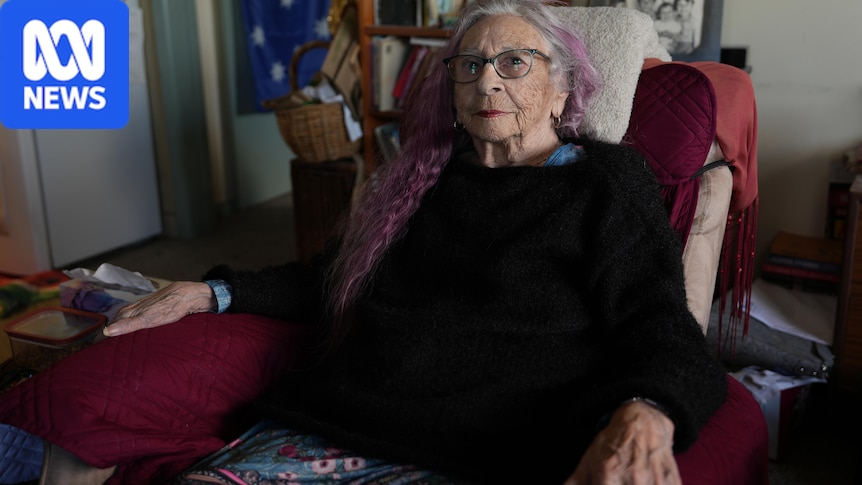
Edwina Dawn Horwath’s top-floor apartment is filled with her framed drawings, stacked books, and glass decorations that hang in the window and reflect rays of winter sun.
Like many residents, the 82-year-old has lived in the Victoria Avenue public housing tower in Albert Park, just south of Melbourne CBD, for decades.
So the prospect of having to place her treasured belongings into boxes and move elsewhere is almost impossible to accept.
“I’ve been really, really depressed about the whole thing. I feel betrayed,” Ms Horwath said.
“It just doesn’t make sense to me.“
Public housing like Victoria Avenue provides affordable accommodation for the elderly. (ABC News: Simon Tucci)
The public housing building at 150 Victoria Avenue is one of seven such towers earmarked for demolition under the third tranche of the Victorian government’s program to demolish and rebuild all 44 of Melbourne’s public housing towers by 2051.
Built under the decades-old Older Persons High Rise Program, the seven towers — in Flemington, Kensington, North Melbourne, Prahran, St Kilda and Albert Park — provide dedicated housing for vulnerable Victorians aged over 55.
Ms Horwath, who suffers from emphysema, relies on an oxygen tank to help her breathe.
Ms Horwath has an oxygen tank within easy reach at her Albert Park home. (ABC News: Costa Haritos)
“For me personally, I wouldn’t be able to move,” Ms Horwath said. “I can’t do six paces without getting breathless.
“I’d like for them to stop it. Think it through. Think about the people that live here. We’re all elderly.“
Homes Victoria last week began meeting with residents in the towers to begin the relocation process.
Several apartments in 150 Victoria Ave have now been affixed with signs declaring the residents’ refusal to leave or speak with the body’s representatives.
Signs advising residents to avoid talking with Homes Victoria were put up by 44 Flats United. (ABC News: Costa Haritos )
(could we get a better pic?)
The signs are the work of grassroots collective 44 Flats United (44 FU).
It was formed in the wake of the government’s announcement, and is comprised of public housing residents, former residents and supporters.
Residents uprooted from ‘forever homes’
Founder R-Coo Tran says 60 per cent of residents in the St Kilda and Flemington towers have signed a petition opposing demolition and relocation.
“When they moved here they were told that this would be their forever home,” Ms Tran said.
“They love living here. A lot of them have lived here for decades. One resident is 100 years old, and she’s lived here for almost 30 years.”
44 FU founder R-Coo Tran says vulnerable residents have been left in the dark about the future. (ABC News: Costa Haritos)
Of the 600 residents who live across the seven older persons towers, so far 4 per cent have already moved out.
Several residents of the Albert Park tower have been told they will be moved to Barak Beacon estate in Port Melbourne, but the government has been unable to say where the remainder will go.
Ms Tran says no information has been provided about suitable, alternative housing that would meet the residents’ complex health needs — with many relying on medical assistance close to home — nor what the site will look like if they choose to return.
“We do not get answers,” Ms Tran said. “We don’t know what the future plan is.“
Ms Tran says the state government hasn’t spelled out what defects at Victoria Avenue necessitates residents moving out. (ABC News: Costa Haritos )
“They can’t tell us — even the basic question of ‘what’s wrong with this exact building?’ ‘Why can’t the issues be repaired?'”
In June, the Victorian government flatly rejected a parliamentary inquiry’s recommendation that it halt the redevelopment of Melbourne’s public housing towers until it provides a cost-benefit analysis for each site demonstrating that demolition was the best option.
Previous studies published by not-for-profit design firm OFFICE and RMIT have argued that refurbishment could deliver far better outcomes for residents, and taxpayers, with researchers calling for the towers to be considered on a case-by-case basis.
‘Campaign of bad faith run around this issue’
The Victorian government has repeatedly rejected the argument, with Housing Minister Nick Staikos asserting the towers were coming to an end of their “useful life”.
Nick Staikos says Melbourne’s public housing towers “weren’t built to last forever”. (ABC News)
“These towers were built in the 1960s and 1970s, and they weren’t built to last forever,” Mr Staikos told the ABC.
“To meet with contemporary building codes, we’d actually end up with less homes than we do now.“
Following a parliamentary referral, the Victorian Ombudsman announced in June it would investigate the experience of public housing residents required to move due to the demolition of the towers.
The Albert Park tower is one of seven facing demolition under the government’s public housing redevelopment program. (ABC News: Costa Haritos)
The referral requires the ombudsman to examine several areas, including the move from public housing to community housing, residents’ mental, social and physical wellbeing, and whether the Victorian government’s approach was compatible with residents’ human rights.
Mr Staikos has dismissed the referral as “politics”, taking aim at what he described as “scaremongering” about the relocation.
“There’s a campaign of bad faith that has been run around this issue,” Mr Staikos said.
“There’s been a lot of scaremongering, and I’m happy to call out the scaremongering.
“I think it’s disgraceful that there’s been scaremongering of vulnerable people.“
“I don’t understand how anyone could visit the towers and then visit where we’ve relocated tenants to and could say we’re not doing right by tenants.”
Older people ‘facing eviction, facing homelessness’
The demolition plan could put an end to a long-running program of public housing for older Victorians. (ABC News: Simon Winter)
For decades, the Victorian government has provided dedicated older persons public housing, with 13 towers built across Melbourne.
Non-profit organisation Housing for the Aged Action Group (HAAG) says it fears the government’s demolition plan could now signal the end of the program.
“What that could mean for older people in their 60s, 70s, 80s, is that they’re unable to put down roots in an area, they can’t receive aged care in the home,” executive officer Fiona York said.
“And we hear from older people every day who are struggling in the private rental market, facing eviction, facing homelessness.“
The Victorian government says there are no funding changes to the Department of Health’s Low-Cost Accommodation program, which includes the Older Persons High Rise Program. But it did not elaborate on what the scheme would look like going forward.
New apartments being built in Port Melbourne is where some residents from Albert Park’s public housing will go. (ABC News: Peter Healy)
The government has committed that the sites once redeveloped will see 10 per cent more social housing, an umbrella term that refers to both community and public housing.
While often conflated with public housing – which is owned and run by the state government with rent capped at 25 per cent of gross household income – community housing is owned and managed by not-for-profit community housing organisations. Each has different policies, financing models and funding agreements.
“Although we think there’s a place for community housing, it shouldn’t be at the expense of public housing,” Ms York said.
“At the moment, what we’re seeing is only a 10 per cent minimum increase in the amount of social housing, with no commitment to any public housing.“
Court battle could decide residents’ futures
Homes Victoria can’t move public housing residents into new accommodation until a High Court appeal is heard.
(ABC News: Peter Healy)
In May, the High Court agreed to hear an appeal by residents against the demolition of Victoria’s public housing towers.
The class action was thrown out by Victoria’s Supreme Court in May last year. A subsequent appeal was struck down by the state’s Court of Appeal in December.
The High Court appeal means Homes Victoria is blocked from evicting the remaining residents at public housing towers in North Melbourne and Flemington, while the case is heard.
About 30 households are thought to remain at the towers, with about 95 per cent of residents now relocated.
Edwina Horwath, who has lived at Victoria Avenue for 24 years, doesn’t believe a move will improve her quality of life. (ABC News: Costa Haritos)
The cost of moving residents from 120 Racecourse Road, 12 Holland Court Flemington, and 33 Alfred St North Melbourne has reached $150 million, including moving costs, lease costs, property acquisitions and staff costs.
But for Edwina Horwath, losing her community will be the greatest cost.
“I don’t see having to move as aiding my quality of life,” Ms Horwath said.
“Some people have places to go … but for people like me, no chance.“