






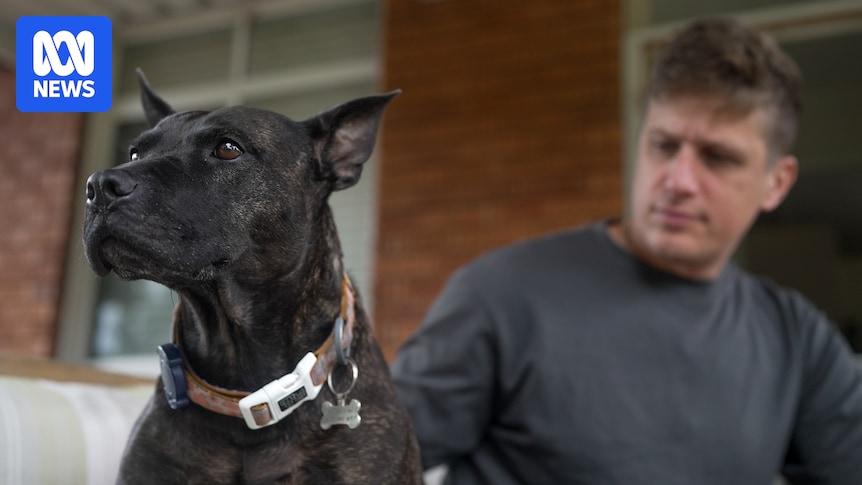
An Australian staffy named Rosie gave hope to cancer patients around the world when her tumours were successfully treated with the help of artificial intelligence.
Now, scientists say outdated regulatory hurdles are preventing Australia from leading the future of cancer care in the face of an AI revolution.
The Staffordshire crossbred Shar Pei, was diagnosed with mast cell cancer — a common type of skin cancer in dogs — about two years ago.
After multiple surgeries, immunotherapy and targeted anti-cancer therapies, Rosie’s owner Paul Conyngham harnessed his background as a tech entrepreneur to explore treatment options using AI chatbots.
The treatment has bought more precious time for Rosie to spend with her owner. (Supplied: UNSW/ Jake Willis)
The AI models assisted in processing gigabytes of genetic data that would form the blueprint for Pall Thordarson and a team of scientists from UNSW to create an mRNA vaccine, which ultimately shrank the tumours affecting Rosie’s legs.
Mr Conyngham’s ingenious use of AI has subsequently taken the tech world by storm.
Rosie’s story even swayed controversial US Health Secretary and vaccine sceptic Robert F Kennedy Jr, who declared at a US Senate hearing in April: “We’re going to see that now across medicine … [and] we’re very excited about it.”
But is Australia keeping up with the pace of discoveries on the horizon, and is it ready to take the lead in AI-driven precision medicine?
AI revolution versus regulatory approvals
Pall Thordarson says Australia now has the opportunity to take the lead in precision medicine. (Supplied: UNSW/ Jake Willis)
Rosie still only has several months to live, but because the tumours on her legs have dramatically shrunk, her time has been extended and she can continue to run and play.
AI did not cure Rosie’s cancer, nor did it create or administer the vaccine, but it did play an important role in the pipeline design process of a personalised cancer treatment by fast-tracking development from years to months.
“One of the things that we were able to get was the genomic healthy cells from the dog and then from the cancer, and then work out what might be possible to do with that,” Professor Thordarson said.
He said three emerging technologies were at play — RNA, genomics and computation.
But AI streamlined the design process and also reduced the mistakes made in the manufacturing process.
“AI is one of the disruptors here,” he said.
Professor Thordarson said the challenge now was how AI would fit into regulatory and reimbursement frameworks that were established “50 to 100 years ago” and who was going to incentivise investment in personalised medicine.
“It’s almost a political decision at some point. This is where Australia could take the lead.“
When a personalised vaccine is created, scientists use DNA sequencing that is unique to each patient’s tumour. (ABC News: Cason Ho)
In a human setting, every time a personalised vaccine is created, scientists use DNA sequencing that is unique to each patient’s tumour.
The property making process for each drug is nearly identical.
However, each one is required to undergo the same regulatory approval, starting from the beginning, which can take between five and 10 years.
“It’s sort of heartbreaking, because I get quite a few messages from people asking whether we can do anything for their loved ones and people ask the same thing about their animals,” Professor Thordarson said.
“We’re just not in a position as this was a recent project and you know, to go to that scale requires [time]. That’s when we have to start to talk about these regulatory environments.”
Shortened turnaround ‘really compelling’
Martin Smith hopes the wider medical community gets behind this project and others like it. (Supplied: UNSW/ Jake Willis)
Martin Smith from UNSW’s Ramaciotti Centre for Genomics, said in Rosie’s case, AI helped Mr Conyngham understand the biology, what genomics is, and generate the code to process the data to understand the biology of the cancer.
“What’s really compelling about the story is it’s not just that it’s a dog, or the guy with no technical, real expertise in cancer or biology,” he said.
“It’s the fact that we can shorten what used to take years and millions of dollars into a more realistic and practical treatment of cancer.
“And then, of course, there’s the whole aspect of personalised medicine and personalised therapies and how we can skew the medication or treatment option to a patient.”
Rosie still has cancer but it has effectively treated her tumours, improving her quality of life. (Supplied: UNSW/ Jake Willis)
Professor Smith said Australia was lagging in cancer genomics and called on the medical community to assist in making the technology more accessible.
“I guess the take-home message is we need to support this research a bit better. This is not a clinical trial, this was a citizen science project that showcases what’s possible,” he said.
Professor Smith said the government had already made a lot of investment in the space, including in infrastructure and small grants.
“But it’s really a lot more to operationalise these clinical projects into practice [and] that’s where I think there’s an unmet need of progress,” he added.