






An artificial intelligence (AI) company will become Tasmania’s biggest power user if its ambitions to establish three “AI factories” in the state come to fruition.
Singapore-based Firmus Technologies is building an AI factory in the Launceston suburb of St Leonards, which is expected to be operational early next year.
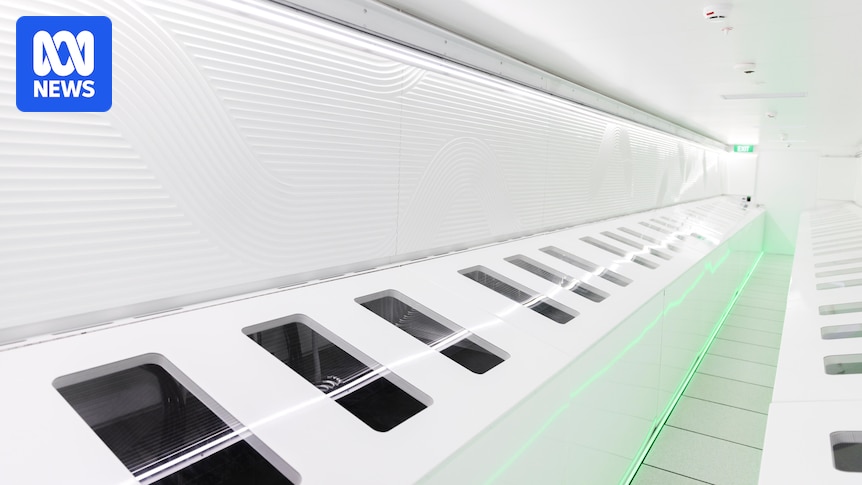
Firmus has said the factory will contain data centre infrastructure and specialised computers that use graphics processing units to produce “AI tokens” needed for tools such as generative AI chatbot ChatGPT.
Construction is underway at St Leonards for Firmus’s AI factory. (ABC News: Morgan Timms)
Now, the Tasmanian government has revealed Firmus’s plans for two more AI factories.
Responding to questions from the Greens in budget estimates earlier this month, Energy Minister Nick Duigan said Firmus wanted to set up facilities at Bell Bay, north of Launceston, and at Wesley Vale in the state’s north-west.
Firmus also plans to build facilities in Melbourne, Sydney, Perth and Canberra.
Firmus says it’s still assessing sites
Latrobe Council told the ABC it had received a development application for the Wesley Vale proposal, and that its planning team would need to assess the documents before the application could go before council.
The council understands Firmus intends to use part of the old paper mill site.
A satellite image of Mill Park in Wesley Vale, where the paper mill used to be. (Google Maps)
Firmus confirmed its interest in building in those areas, but did not respond to questions about whether it had bought the old pulp and paper mill sites.
“Firmus continues to assess potential sites in Tasmania, including in the George Town and Wesley Vale regions, as part of its long-term growth plans,” the company said in a statement.
“Site selection is guided by access to power, transmission connectivity, planning pathways and alignment with government policy.”
Premier Jeremy Rockliff with Tim Rosenfield and Oliver Curtis, the co-CEOs of Firmus Technologies. (Supplied: Tasmanian government)
Many AI companies are increasingly looking to Australia to build their infrastructure due to its access to renewable energy, and Firmus has said Tasmania was considered particularly ideal due to its cold climate, which meant less cooling was required.
TasICT, which advocates for the technology sector in Tasmania, said AI infrastructure would benefit the state.
“Tasmania is going through a digital economy boom. Every sector is using more and more technology and jobs are increasingly relying upon it,” chief executive Russell Kelly said.
Russell Kelly says AI companies must be transparent with the communities where they are looking to build AI infrastructure. (ABC News: Cameron Atkins)
But he said AI companies needed to be transparent with the public, which did not generally trust AI, to gain social licence for their facilities.
“It is beholden on a company like Firmus and the tech sector generally to explain the benefits, to be right out in front and showing what technology change can mean for the benefit for Tasmanians,”
Mr Kelly said.
Concerns over power needed for AI factories
Firmus has signed a contract with state energy company Aurora for 104 megawatts to power the St Leonards AI factory through hydro energy, which the government said would not impact power prices for residents.
Questions have previously been asked about how Firmus has secured so much power while the Boyer Paper Mill near Hobart, which currently uses 100 megawatts has been unable to secure an additional 45 megawatts to install electric boilers.
Inside one of Firmus’s AI factories in Singapore. (Supplied: Firmus)
Mr Duigan dismissed the comparison.
“Boyer has continued to talk to Hydro about power. It’s not about the availability of power; it is a discussion around the pricing of power,” he told estimates.
Mr Duigan revealed Firmus would require about 400 megawatts in total to power the three sites, which would make it the largest power user in the state.
An energy consultant said 400 megawatts represented about 20 per cent of the state’s current energy use, or more than the combined demand of all Tasmanian households.
The Greens are concerned about the “enormous” power requirements.
“Exactly where the power is going to be coming from for all of those factories is still a really big question,” the Greens MP for Lyons, Tabatha Badger, said.
“If we give 400 to 500 megawatts of power to this AI factory, what happens into the future? What happens if there’s any kind of energy shortage?“
Greens MP Tabatha Badger wants to know where the 400 megawatts Firmus will require for the three sites will come from. (ABC News: Luke Bowden)
Aurora Energy and Hydro Tasmania would not reveal the price Firmus was paying for power, but the company said it paid “market rates”.
The state government acknowledged the energy requirements were large.
“However, the proposed load from Firmus is scalable across three sites, and the final installed capacity is subject to meeting regulatory approvals, reaching commercial terms with energy companies, and is ultimately a matter for the proponent to determine,” a government spokesperson said.
Expectations data centres will bring new renewables online
The federal government released a National AI Plan in December last year, including expectations that AI companies building data centres would not place upward pressure on energy prices and bring new renewable energy online.
Firmus has previously said it would do as much.
“We’re proud we’ve signed a very large energy contract with Hydro, but at the same time we will be supporting the build out of new renewable projects,” co-CEO Oliver Curtis told 936 ABC Hobart in March.
Ms Badger said this raised further questions “about what sort of renewable energy that is and where that project is going to go”.
She would like to see state-specific regulation.
“There are exciting things that could come from this, but at the moment, we’re the Wild West for AI factories because we don’t have any legislation and regulation in place,”
she said.
The proposed Bell Bay pulp mill was heavily protested before the proponent went into administration in 2012. (Supplied: Wilderness Society)
Ms Badger said legislation could regulate how much energy and water were appropriate to give to AI companies, and oblige them to employ a certain number of residents in construction and ongoing jobs.
The Tasmanian government said it supported the National AI Plan, including the expectations of data centres, and had been actively involved in its development.
“The expectations work alongside existing laws and regulatory frameworks and are intended to guide responsible investment in AI-related infrastructure,” a spokesperson said.
“Firmus developments will need to go through the same planning and environment approvals processes as other projects, which includes opportunities for community input.”
Firmus plans new fibre optic cable to mainland
Firmus announced earlier this month that it was partnering with SUBCO to build a submarine fibre optic cable connecting Tasmania to mainland Australia, the first new such cable in more than 20 years, which the company said would substantially increase the state’s digital capacity.
If approved, the company expects it to be operational in the second quarter of next year, and would extend on the broader SMAP subsea cable project connecting Sydney, Melbourne, Adelaide and Perth.
TasICT said the new cable would have numerous benefits for the state.
“It’s not every day that a company offers to build a bridge across Bass Strait,” Mr Kelly said.
“It provides the compute power that all our sectors need to innovate, to improve and grow their businesses and to increase the jobs as well.“