






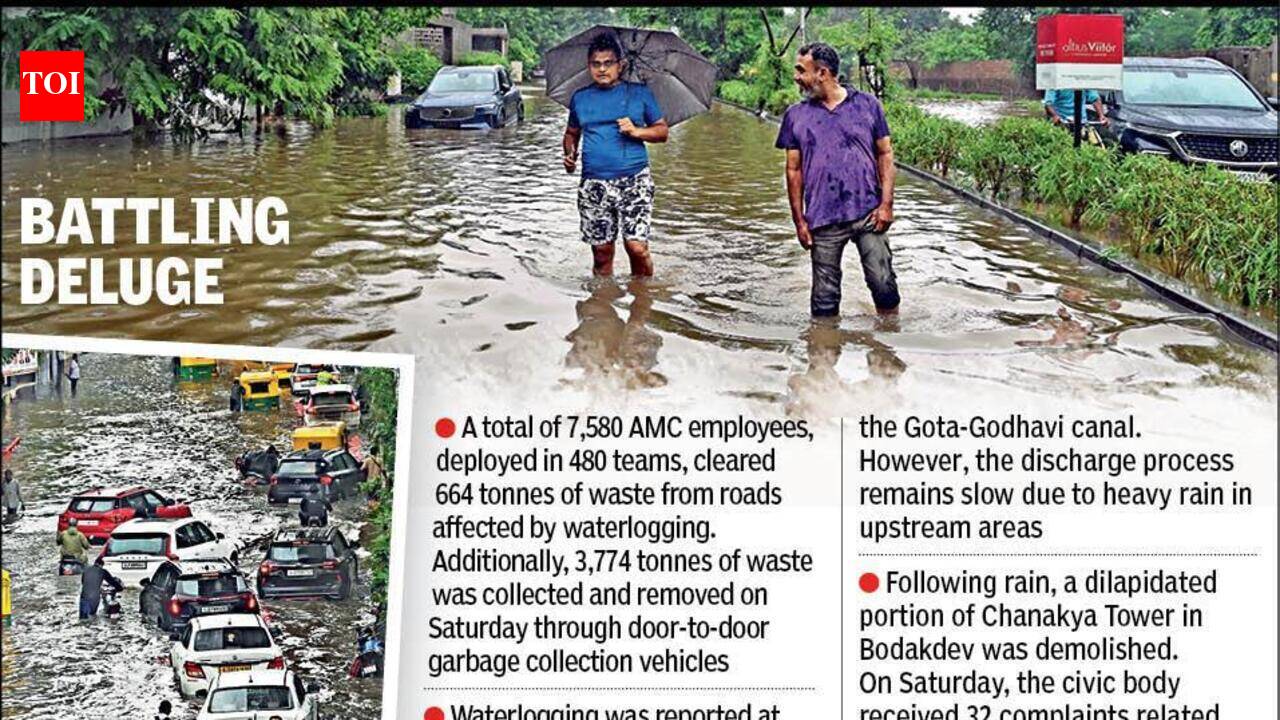
Ahmedabad: Bopal and Ghuma bear the brunt of downpours every year, with this year’s 22 inches of rain in three days bringing the annual monsoon malaise of flooding and gridlocks to the two areas.On Saturday, 15 societies remained flooded across both areas, which paid yet again for bureaucratic delays that stretch over three decades.Development in Bopal began around 1997. Within a decade, large-scale residential and commercial construction had taken place under gram panchayat rules that mandated neither parking provision nor drainage standards.When Ahmedabad Urban Development Authority (Auda) finally absorbed Bopal and Ghuma into its jurisdiction in 2009, it inherited an already built-up area with no systematic underground civic infrastructure.
CJP Jantar Mantar Protest Updates
Auda took years to draft three Town Planning (TP) schemes, each for Bopal and Ghuma. By the time draft schemes received preliminary approval, construction had already outpaced planning.New utility lines in the old village areas (gamtal) were connected to old, undersized ones, worsening waterlogging with every monsoon.In 2015, Bopal and Ghuma merged to form a municipality. In 2020, that municipality was absorbed into AMC. “In the intervening five years, Auda launched drainage and water network projects worth over Rs 100 crore. But not all were completed on time,” a source in the civic body said. “Drain networks were built in parts of Bopal village and portions of TP schemes 1, 2, and 3 of both areas.”Work remains incomplete in several pockets. The 2022 monsoon demonstrated the effect of the incomplete projects. The areas were flooded, and societies faced severe sewage backflow.A former office-bearer of Bopal nagarpalika said, “Civic infrastructure failed to keep pace with rapid urbanisation in Bopal.”Around 2009, vehicle numbers and population began increasing. “We repeatedly urged authorities to upgrade the drainage network, widen internal roads and develop BRTS connectivity and bylanes, particularly in low-lying areas,” the former official said.However, those requests were not acted upon in time.Smarth Shah, a resident of South Bopal, said the bylanes sit lower than the surrounding areas, channelling all runoff directly into societies.“Even 1 inch of rain can cause severe flooding,” he said.The official said that letters were written to Auda to change the drainage system, but the authority demanded a betterment charge. Drainage was untouched.Before Bopal was included in Auda, Congress held the gram panchayat while the BJP controlled Auda. BJP-led Auda demanded a plot on the main road for commercial development. Congress said no.Auda then neglected the area until Gujarat High Court intervened and forced a takeover.As for Shela, every monsoon floods it due to inadequate stormwater drainage and 13 neglected lakes clogged with construction debris.Rapid development without adequate sewage infrastructure causes severe sewage backflow into Shela homes during heavy rain.Hiren Shah, a Bopal resident, described gradual improvement in his immediate surroundings but an unchanged picture outside.“About four years ago, during monsoon, floodwater rising to 1 foot would enter my house,” he said. “Eventually, we got the cemented roads and our society was not waterlogged this year. But outside, 2 feet of water accumulated after rain.”